Google Genie 3: When a Neural Network Replaces the Game Engine (and Reality)
Google has released a new podcast episode about Genie 3, its most ambitious attempt at a "world model." Unlike ordinary video generators, Genie 3 lets you interact with the content it creates in real time. Logan Kilpatrick and the DeepMind team explain why this matters more than pretty clips. The technology turns static images into controllable environments, which opens the door to endless games and to training robots in virtual sandboxes. While competitors chase image quality, Google is laying the groundwork for a digital reality that understands the laws of physics.
AI-processed from Google AI Blog; edited by Hamidun News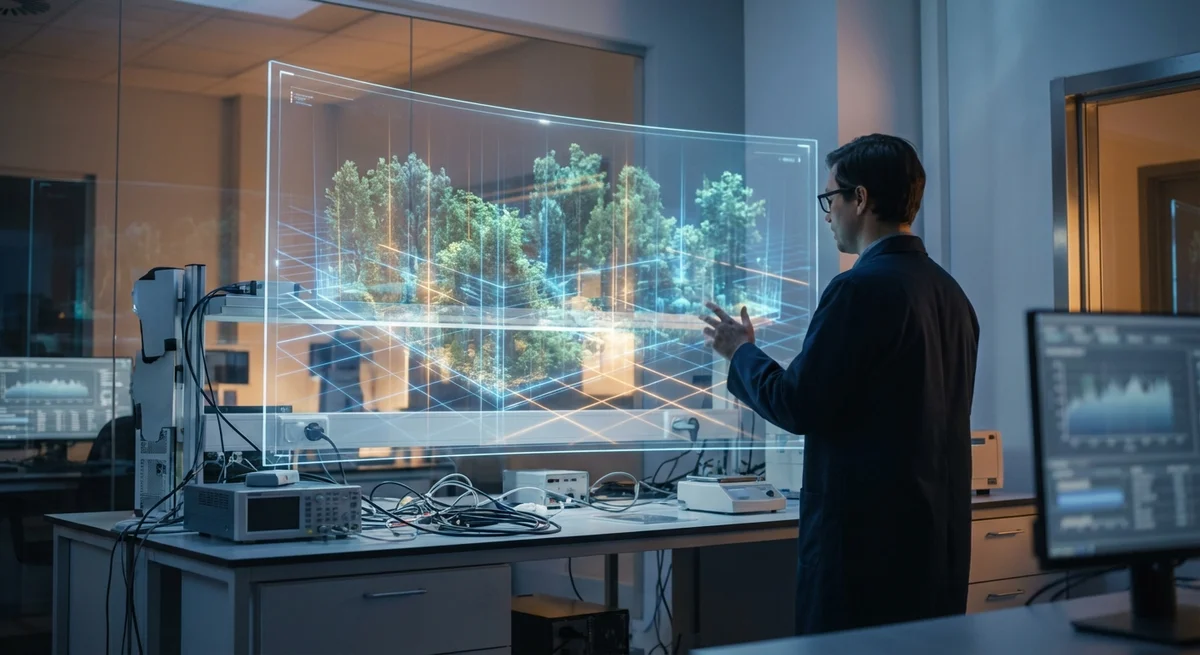
Remember that childhood feeling of staring at a picture in a book and desperately wanting to step inside? Google seems to have decided, in earnest, to turn that fantasy into working code. In the latest episode of the Google AI: Release Notes podcast, Logan Kilpatrick talked with DeepMind engineers about Genie 3. This is not yet another neural network for generating Pixar-style kittens. It is a full interactive world model that understands what happens if you press a button or push an object.
Let's start with some context. For a long time, the industry was obsessed with pixel quality. We admired OpenAI's Sora or Kling because they produce footage that is hard to tell from reality. But these models share one fundamental problem: they are just very advanced "gap fillers." They know what the next frame should look like, but they do not grasp cause and effect. If a person in a Sora video bites into a cookie, the cookie may stay intact. Genie 3 takes a different path.
The DeepMind team has spent years teaching AI to understand physics by watching video. Genie 3 is the culmination of the "world model" idea. It does not just draw frames; it simulates an environment. You give it a single image or a text description, and it creates a space you can move through. It is as if a video game were built in real time around your every step, with no programmers or 3D artists involved.
Why does this matter so much right now? Because we have hit a data ceiling. To train smarter agents or self-driving cars, we need more data than exists on the entire internet. Genie 3 can generate endless, physically consistent simulations for training other neural networks. It is a "sandbox" where robots can make mistakes millions of times per second without breaking expensive real-world manipulators. Google is clearly betting that the future of AI lies not in chatbots but in agents that act in space.
Of course, there is a touch of irony here. While OpenAI and Anthropic ship products people use every day, Google keeps releasing podcasts and research papers. We hear about Genie 3's incredible capabilities, but when will we be able to run it on our own devices? That question is open. Still, DeepMind's technical lead in the architecture of such models is undeniable. They are building the foundation on which the next generation of AI will grow: active rather than passive.
The shift from "look what I drew" to "look what I turned this picture into" is a tectonic one. It changes everything, from game development, where levels will be generated for each player, to training AI assistants in virtual copies of our apartments. Google is trying to prove it is still the leader in innovation, even if its road to release seems endless.
The key point: Genie 3 turns AI from an artist into an architect of realities. Can Google commercialize it faster than competitors copy the method?
- Nov 2, 2026Bun creator uses Claude Code to port 750K lines from Zig to Rust in 11 days
- Nov 2, 2026The Verge reviewer builds a $50 Meta Muse Charm alternative with Claude Code
- Nov 1, 202616 models tested on 7 search tools: Exa averaged 10.5 out of 14, SearXNG about 3
- Nov 1, 2026Google's StreamVibe video agent beats other models by 10.7% on response timing and quality
Test Frontier LLMs & Autonomous Agents in One Workspace
Run Claude Opus 5.5, GPT-6, Gemini 3.1, and DeepSeek side-by-side in Nomad AI (nomadnet.ai) — unified model routing, deep research, and multimodal workflows under one subscription.
The AI world, distilled — once a week
Seven stories that actually mattered, hand-picked. No noise, no reposts, no press releases.
Done! Check your inbox for a confirmation.