OpenClaw: Why a Veteran Developer No Longer Reads His Own Code
The story of OpenClaw is not just another AI agent. It is a chronicle of Peter Steinberger's personal transformation. A developer with 15 years of experience, used to optimizing every megabyte in his PDF engines, has crossed over to the dark side. He now burns through billions of tokens and runs ten agents at once, letting neural networks write thousands of lines of code without his review. Some call the project a quick-and-dirty hack; others see the future of development, where the human is merely a conductor. The project has already gone through five names, but its essence has not changed: total automation of life through AI. It is an important precedent for how the old school adapts to a world where code costs less than electricity.
AI-processed from Habr AI; edited by Hamidun News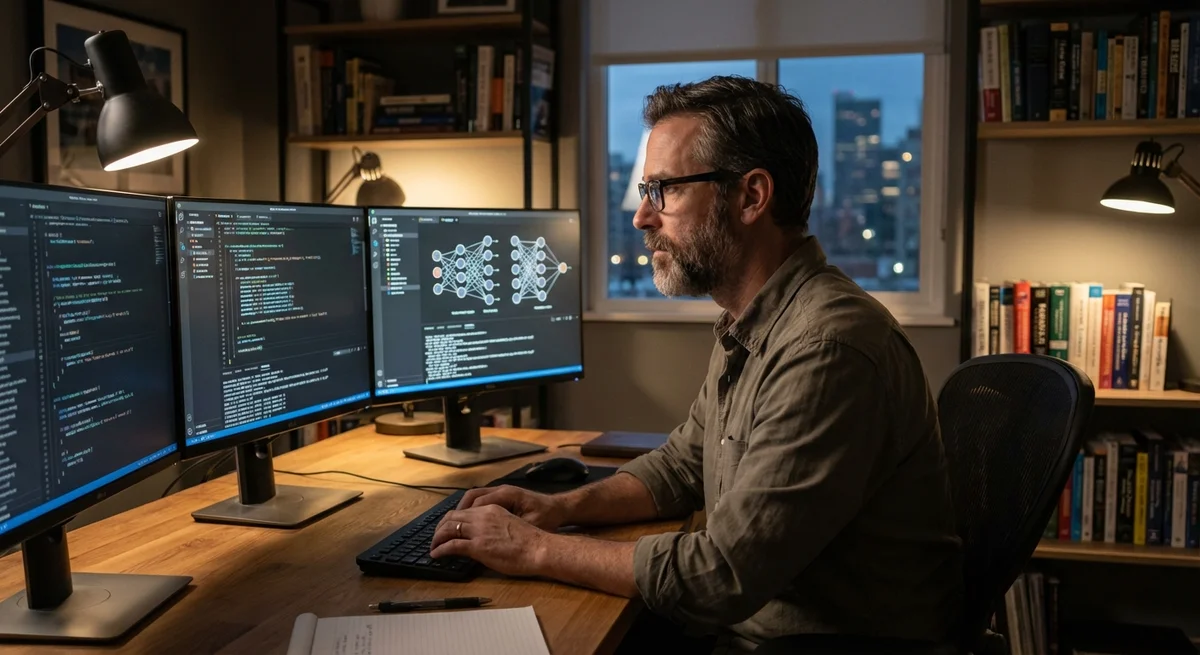
Picture an old-school programmer who spent decades polishing every line of C++ or Objective-C, fighting for every spare CPU cycle. Now picture the same person pressing a launch button and letting an AI agent generate thousands of lines of code that he does not even plan to open for review. This is not a dystopian scenario about lazy newcomers. It is the reality of Peter Steinberger and his project OpenClaw. His path from fanatical megabyte optimization to extravagantly burning billions of tokens is arguably the most honest illustration of what is happening to the industry right now.
OpenClaw, which previously went by the names Clawdbot and Moltbot, quickly gathered myths in narrow circles. Skeptics wince and call it a typical example of vibe coding, where the result hangs on a wing and a prayer and lucky prompts. But those who follow the details see a master's hand in the project. The irony is that Steinberger himself admits he often has no idea what exactly his agents push to the repository. For a man who built his career on ultra-precise PDF tools, where any error costs millions, such carelessness looks like professional heresy. But this is precisely where the main shift in paradigm lies.
Why should we care today? Because OpenClaw shows us the death of the craftsman and the birth of the systems architect of agents. Steinberger did not simply build an assistant for writing code. He built a system that manages his work schedule and everyday tasks. When an industry veteran of this caliber says that manual code review is becoming economically impractical, it sounds like a verdict on traditional Computer Science education. We are moving from the era of writing algorithms to the era of conducting black boxes.
The saga of the project's names, with OpenClaw already the fifth, captures the chaos and speed of the modern AI market. While you design a logo and buy a domain, the base model gets updated and the tool's capabilities expand so far that the old name feels cramped. In this world there is no room for finished products in the classic sense. There is only a continuous process of iteration, where the human is just the one setting goals. Steinberger does not merely use GPT-4 or Claude; he makes them work in tandem, spending huge sums on APIs to reach a level of automation that once required a staff of ten mid-level developers.
This shift highlights a deep split in the community. On one side remain the purists, who believe in code purity and full control over every variable. On the other are pragmatists like Steinberger, who have realized that the volume of work done by AI matters more than the risks of model hallucinations. If a developer of his caliber is ready to loosen the reins, the barrier to entry into the profession may soon disappear for good. Programming is turning from writing instructions into managing intentions. And if you still spend hours debugging by hand, perhaps you are simply too expensive for yourself.
The bottom line: OpenClaw is an admission that the era of manual labor in IT is ending, even for those who created the industry. Are you ready to stop reading your own code and trust an algorithm that makes mistakes, but makes them a thousand times faster than you?
- Nov 2, 2026Bun creator uses Claude Code to port 750K lines from Zig to Rust in 11 days
- Nov 2, 2026mcp-linter finds 18 undescribed parameters in Anthropic's filesystem server
- Nov 2, 2026The Verge reviewer builds a $50 Meta Muse Charm alternative with Claude Code
- Nov 2, 20268 Skills for video in Claude Code: from 244 pixel effects to rough-cut editing
Build & Ship Production AI Agents Without Boilerplate Code
Start your free 72-hour trial at Hamidun Academy (academy.hamidun.com) — interactive lessons on Claude Code & Cursor, live Tech Radar, and production agent templates.
The AI world, distilled — once a week
Seven stories that actually mattered, hand-picked. No noise, no reposts, no press releases.
Done! Check your inbox for a confirmation.