Chunyun: 540 Million People Against Chinese Algorithms
When we talk about stress-testing systems, we usually imagine launching a new version of GTA or a global Black Friday sale on Amazon. But for China, the real stress test begins today. Chunyun has started — the period of "spring transportation," officially considered the world's largest annual human migration. On the very first day, the country's railways plan to transport 12 million people. If that sounds like a lot, look at the forecast through March 13: 540 million passengers. That's more than the entire population of the European Union if it all decided to visit relatives at the same time. Behind these dry figures from reports by China's State Railway Group lies something greater than just overcrowded cars. It's a triumph or a potential nightmare of automation and big data systems.
AI-processed from 36Kr (36氪); edited by Hamidun News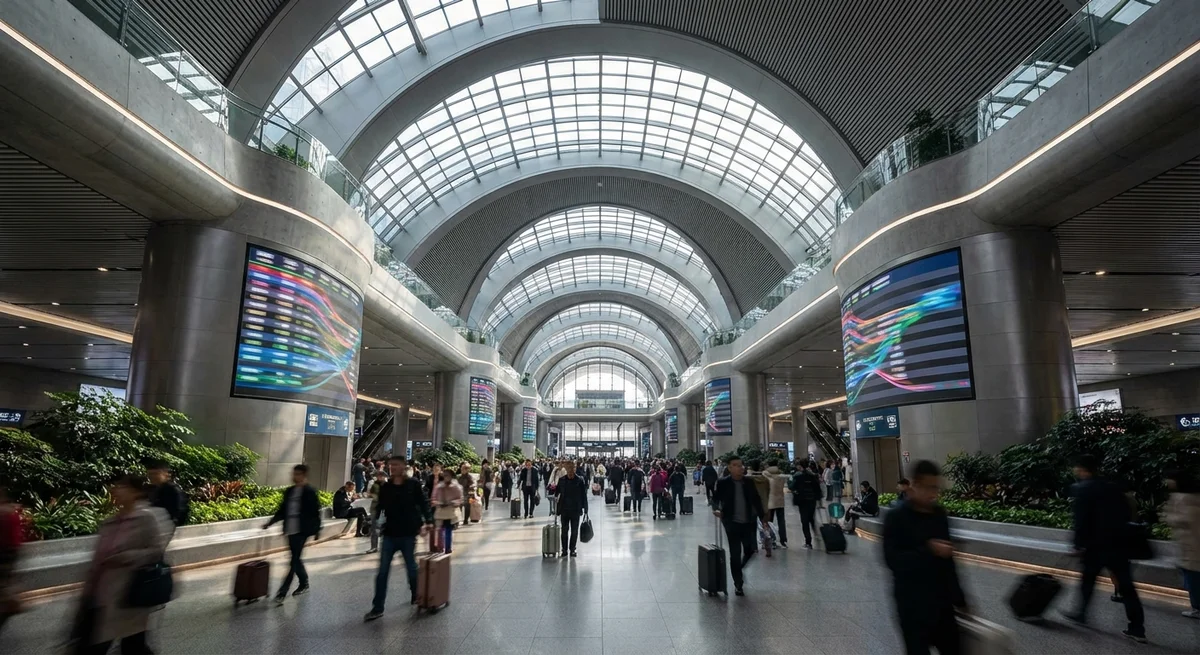
When we talk about stress-testing systems, we usually imagine launching a new version of GTA or a global Black Friday sale on Amazon. But for China, the real stress test begins today. Chunyun has started — the period of "spring transportation," officially considered the world's largest annual human migration.
On the very first day, the country's railways plan to transport 12 million people. If that sounds like a lot, look at the forecast through March 13: 540 million passengers. That's more than the entire population of the European Union if it all decided to visit relatives at the same time.
Behind these dry figures from reports by China's State Railway Group lies something greater than just overcrowded cars. It's a triumph or a potential nightmare of automation and big data systems. To digest such a flow — averaging 13.
48 million people per day — classical management methods are no longer sufficient. A 5% increase in passenger traffic compared to last year is forcing transport giants to rely on predictive analytics algorithms that distribute train compositions in real time. Why should this interest us?
Because Chunyun is the ideal sandbox for testing "smart city" technologies. In recent years, Chinese railway stations have transformed into high-tech hubs where facial recognition systems and automatic gates have replaced armies of controllers. Here, artificial intelligence isn't just generating pictures; it's solving the problem of infrastructure survival.
Errors in demand forecasting here cost not lost profit, but a collapse on a national scale. Remember how logistics worked ten to fifteen years ago: endless queues at ticket windows and ticket resellers. Today, System 12306 (the official ticket sales service) uses sophisticated algorithms to combat bots and dynamic pricing.
This is a real technology war: while some write scripts for automated ticket purchases, others train neural networks to block those scripts. This year the server load will be at its peak, and watching this duel of algorithms is more interesting than many presentations in Silicon Valley. Moreover, such an unprecedented concentration of people is a challenge for security systems.
We're seeing how computer vision technologies are being trained to monitor crowd density, preventing crushes before the first sign of panic emerges. Chinese engineers use data from smartphone geolocation and tickets to predict "bottlenecks" at transfer stations. This is applied AI in its harshest and most large-scale manifestation, working at the limits of hardware capabilities.
The key point: Will algorithms be able to keep this controlled chaos in check until mid-March? If the system can handle 540 million people without serious failures, it will become the best proof that centralized data-driven management is the only way to survive the megacities of the future.
Need AI working inside your business — not just in your newsfeed?
I build production AI for companies — custom CRM, internal tools, autonomous agents, workflow automation. Owned by you, shaped to your process, no per-seat tax. Built by Zhemal Khamidun, CPO of AlpinaGPT (AI platform, 6,000+ users).
The AI world, distilled — once a week
Seven stories that actually mattered, hand-picked. No noise, no reposts, no press releases.
Done! Check your inbox for a confirmation.