Your Own AI Server: Stop Torturing Your Home Laptop and Ignore the Influencers
Running an LLM on a home laptop is a one-evening novelty that quickly hits a wall of insufficient video memory and glacial speeds. If you need a work tool rather than a toy, it's time to move to server hardware. The market is full of advice on running a "cut-down" Llama, but such models offer little practical value. Real inference starts where consumer graphics cards end and careful hardware and software tuning begins. We walk through a step-by-step plan, from choosing a GPU to optimizing model weights. It's an investment in privacy and independence from cloud giants like OpenAI or Anthropic.
AI-processed from Habr AI; edited by Hamidun News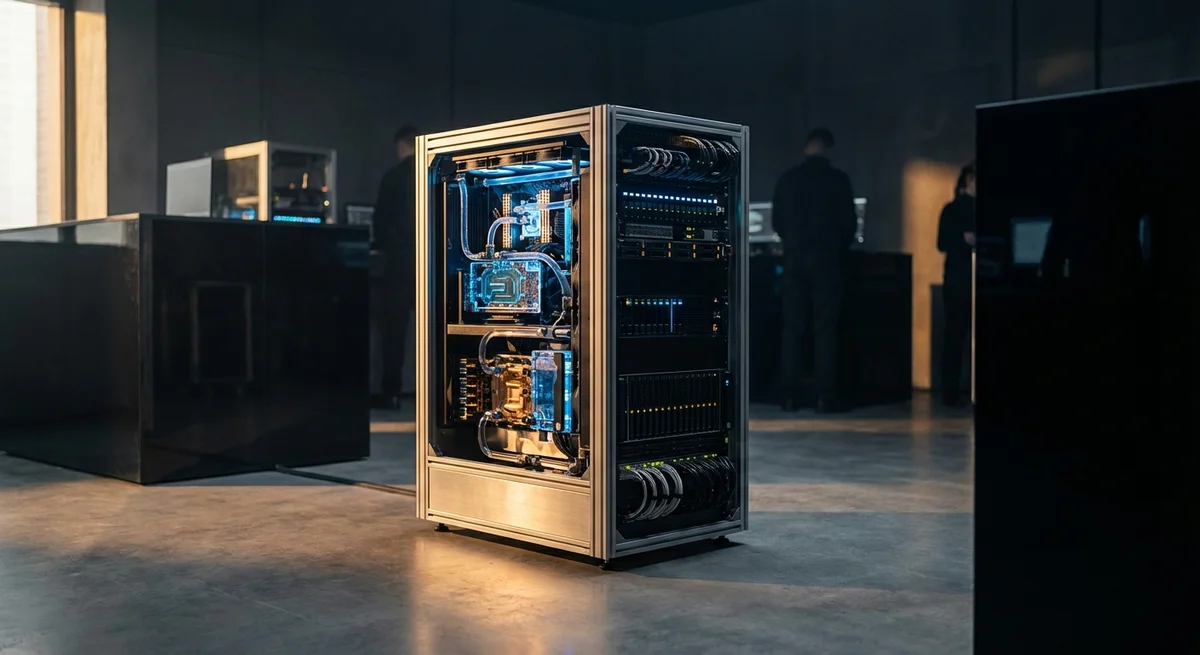
Remember the first time you ran Llama on your laptop? First came the thrill that it actually worked. Five minutes later came a dull irritation: the model was producing two words per second, and your computer's fans were trying to launch into the stratosphere. The internet today is packed with guides from self-proclaimed experts who promise full-fledged artificial intelligence on five-year-old hardware. Let's be honest: that's self-deception. Serious work with local language models demands a serious approach to infrastructure. If you want an AI that actually helps with coding or document analysis, rather than just entertaining you with clumsy jokes, it's time to build your own server.
Why bother with your own hardware when the OpenAI and Anthropic APIs are right there? The answer comes down to two words: privacy and control. Corporations change the rules on the fly, impose strict censorship, and can block your account without explanation. In that world, owning your own digital brain becomes a security question. You don't share trade secrets with servers in California, and you don't depend on whether Sam Altman decides to triple prices tomorrow. Besides, with heavy use, cloud bills start to look like phone numbers, and buying your own GPUs pays for itself faster than you might think.
The main challenge in building such a server is video memory. VRAM, not CPU clock speed, determines which model you can run and how capable it will be. A mid-range gaming graphics card is enough for tiny 7-billion-parameter models, but anything truly powerful, like Mixtral or the larger versions of Llama 3, needs tens or hundreds of gigabytes of VRAM. This is where the hard trade-offs begin. You either spend a fortune on professional cards like the NVIDIA A100 or H100, or you master the art of quantization. Quantization compresses model weights with almost no loss in quality, and it's the critical tuning step that separates amateurs from professionals.
Memory, however, is only half the problem. The second one, which newcomers often forget, is bandwidth. You can buy plenty of cheap memory, but if the data bus is narrow, your model will think agonizingly slowly. That's why server hardware built on high-bandwidth architectures is worth the money. We're moving from the era of ordinary AI users to the era of local system operators. Today, the ability to deploy, optimize, and maintain your own compute is valued far more than simply knowing how to write prompts in a chatbot.
The software side is just as engaging as picking the hardware. Launching a model from the console is only the start. To turn a server into a useful tool, you need to set up an inference environment with modern tools like vLLM or Ollama. You need to learn how to manage request queues, configure the context window, and integrate the model into your existing workflows. That turns a pile of expensive hardware into a well-tuned machine that works for you 24 hours a day, with no weekends or holidays.
Ultimately, your own server is about the freedom to experiment. With a powerful machine at hand, you start testing hypotheses you previously wouldn't have spent paid tokens on. You can fine-tune models on your own specialized data, build autonomous agents, and stop worrying that your access to the technology will be restricted tomorrow by yet another privacy policy change. It's your ticket into the major league of technological independence, where you set the rules and control every byte of information.
The bottom line: a local server is the only way to get truly private, high-performance AI without answering to corporations. Are you ready to invest in your digital independence, or will you keep renting brains from Silicon Valley giants?
- Nov 1, 2026OpenAI Rewrites GPT Behavior Rules: Five Values and a Chain of Command
- Nov 1, 2026Google admits AI Mode cuts search revenue, shares fall 15%
- Oct 31, 2026Author puts his script before an AI jury: the verdict cost 850 thousand tokens
- Oct 31, 2026Anthropic: Fold Subagents Back Into a Single Loop — One Customer's Tasks Ran Twice as Fast
Test Frontier LLMs & Autonomous Agents in One Workspace
Run Claude Opus 5.5, GPT-6, Gemini 3.1, and DeepSeek side-by-side in Nomad AI (nomadnet.ai) — unified model routing, deep research, and multimodal workflows under one subscription.
The AI world, distilled — once a week
Seven stories that actually mattered, hand-picked. No noise, no reposts, no press releases.
Done! Check your inbox for a confirmation.