Jensen Huang and OpenAI: When an Investment Smells Like a Monopoly
Nvidia is officially in. Speaking in Taipei, Jensen Huang confirmed that the company will invest in OpenAI's new funding round. This isn't simply a goodwill gesture; it's a strategic move. While OpenAI burns billions training models, Nvidia funnels part of its profits back into the ecosystem, ensuring that demand for H100 and Blackwell doesn't dry up. In effect, we're watching a closed loop take shape: Nvidia gives OpenAI money so OpenAI can buy even more Nvidia chips. Brilliant or alarming? Probably both.
AI-processed from Bloomberg Tech; edited by Hamidun News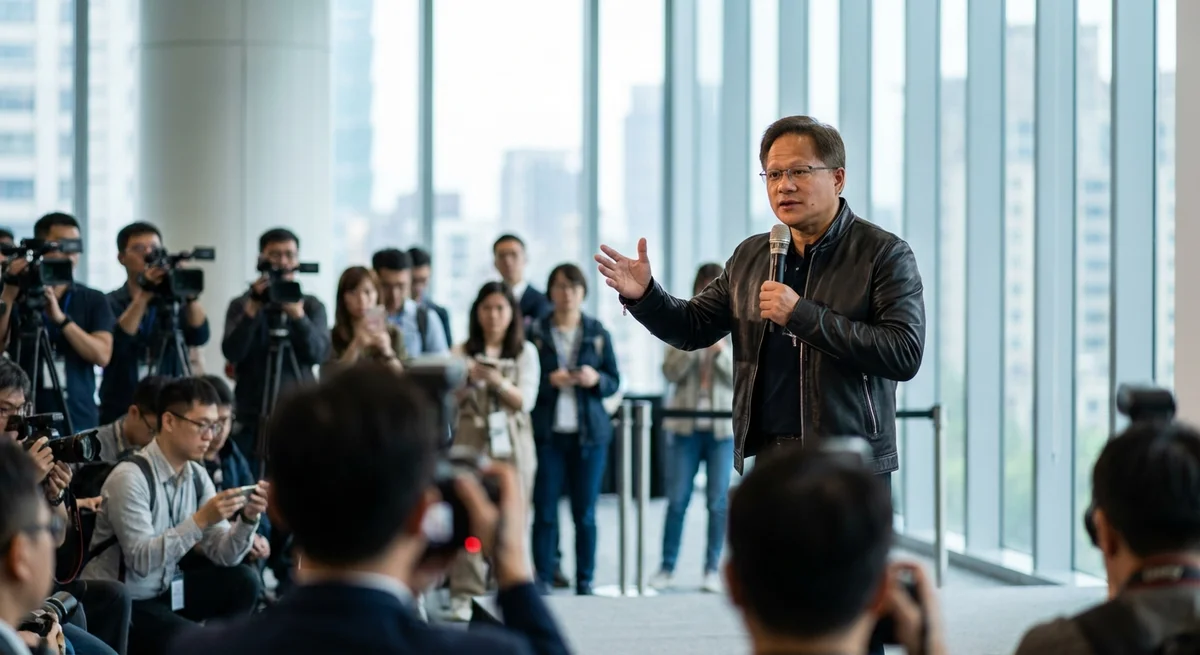
Jensen Huang rarely talks for the sake of talking, especially when money is involved. At a recent press briefing in Taipei, the Nvidia CEO confirmed what the market had been whispering about for weeks: the "green giant" is officially taking part in OpenAI's new funding round. Huang called it a "damn good investment," and coming from him, that sounds less like bravado than a statement of fact. For context: OpenAI is currently trying to close a $6.5 billion round at a sky-high valuation of $150 billion. That's more than the market cap of most S&P 500 companies, and Nvidia wants to lock in its slice of the pie.
The relationship between the two companies reads like a tech romance. In 2016, Huang personally delivered the first DGX-1 supercomputer to OpenAI's office, back when it was still a modest nonprofit startup. A lot of water and teraflops have passed under the bridge since then, but the dependence remains. Today, OpenAI is the world's largest consumer of Nvidia chips. Every new GPT iteration demands more compute, which means more H100 accelerators and upcoming Blackwell ones. By investing in OpenAI, Nvidia is effectively investing in its own sales department. It's an elegant, if questionable, arrangement: you give a customer money so they can buy your product.
Why does Nvidia need this now? The answer lies in its rivals' ambitions. Microsoft has already put more than $13 billion into Sam Altman's company, Apple is in talks to take a stake, and Anthropic and Google are breathing down OpenAI's neck. In this game of thrones, Nvidia can't afford to remain just the "shovel seller" in a gold rush. A direct equity stake gives Huang not only financial upside but also strategic influence over the roadmap of the most influential neural network on the planet. If OpenAI decides to develop its own chips — and rumors to that effect have circulated for a long time — having Nvidia among its shareholders could seriously cool that enthusiasm.
But behind the glitter of billion-dollar deals lies a troubling trend. We're watching a closed ecosystem form, in which a handful of giants control the entire tech stack, from the silicon in chips to the algorithms in chatbots. Regulators in the US and Europe are already starting to look askance at this kind of "cross-pollination." When a hardware supplier becomes a co-owner of its biggest buyer, questions about fair competition follow. Could smaller startups end up never getting access to the newest chips simply because they're not part of the investors' "inner circle"?
For OpenAI itself, this round is a matter of life and death. Despite huge revenue, the company keeps burning cash at an alarming rate. Training next-generation models requires infrastructure costing tens of billions of dollars. Without backing from Nvidia and other heavyweights, Sam Altman's ambitious AGI plans could crash into the harsh reality of a liquidity crunch. In that sense, Jensen Huang acts not just as an investor but as a guarantor that the AI bubble — if it is a bubble — keeps inflating for a while longer.
What does this mean for us? Most likely, we'll see even tighter integration between OpenAI's software and Nvidia's hardware. Future GPT models may be optimized for the Blackwell architecture at such a deep level that running them on AMD or Intel chips becomes practically impossible. That would create a technological monopoly that will be extremely hard to break. The AI market is turning, for good, into a game for the ultra-rich, where the entry ticket costs billions and the rules are set by whoever holds the keys to the server rooms.
The bottom line: Nvidia is closing the loop, turning from a supplier into a co-owner of the industry. Can anyone break up this alliance, or do we already live in a world where the future of AI depends entirely on Jensen Huang's mood?
- Nov 1, 2026Kimi scores 96.2% on a 1C database analytics test and emerges as a fallback if Claude access is blocked
- Nov 1, 2026OpenAI Rewrites GPT Behavior Rules: Five Values and a Chain of Command
- Nov 1, 2026Google admits AI Mode cuts search revenue, shares fall 15%
- Oct 31, 2026Author puts his script before an AI jury: the verdict cost 850 thousand tokens
Test Frontier LLMs & Autonomous Agents in One Workspace
Run Claude Opus 5.5, GPT-6, Gemini 3.1, and DeepSeek side-by-side in Nomad AI (nomadnet.ai) — unified model routing, deep research, and multimodal workflows under one subscription.
The AI world, distilled — once a week
Seven stories that actually mattered, hand-picked. No noise, no reposts, no press releases.
Done! Check your inbox for a confirmation.