Moon from a Neural Network: Why Your Smartphone Can't Take Photos Anymore
Buying a new flagship like the Vivo X200 Ultra today suspiciously resembles a visit to a cosmetic surgeon. You know in advance that the result will be blindingly beautiful, yet you're aware that it has almost nothing to do with the original material. Recent tests of this device attempting to photograph the Moon once again exposed an abscess that has been festering in the industry for years. When you point the camera at the night sky in automatic mode, the smartphone delivers a masterpiece with sharp craters and dimensionality. But switch to professional mode and peek at the "honest" RAW file, and the magic crumbles. In place of the celestial body is a dull murky spot that can hardly be called a photograph. This story didn't start yesterday. We remember the loud scandals around Samsung S22 Ultra and other manufacturers caught "redrawing" the Moon.
AI-processed from Habr AI; edited by Hamidun News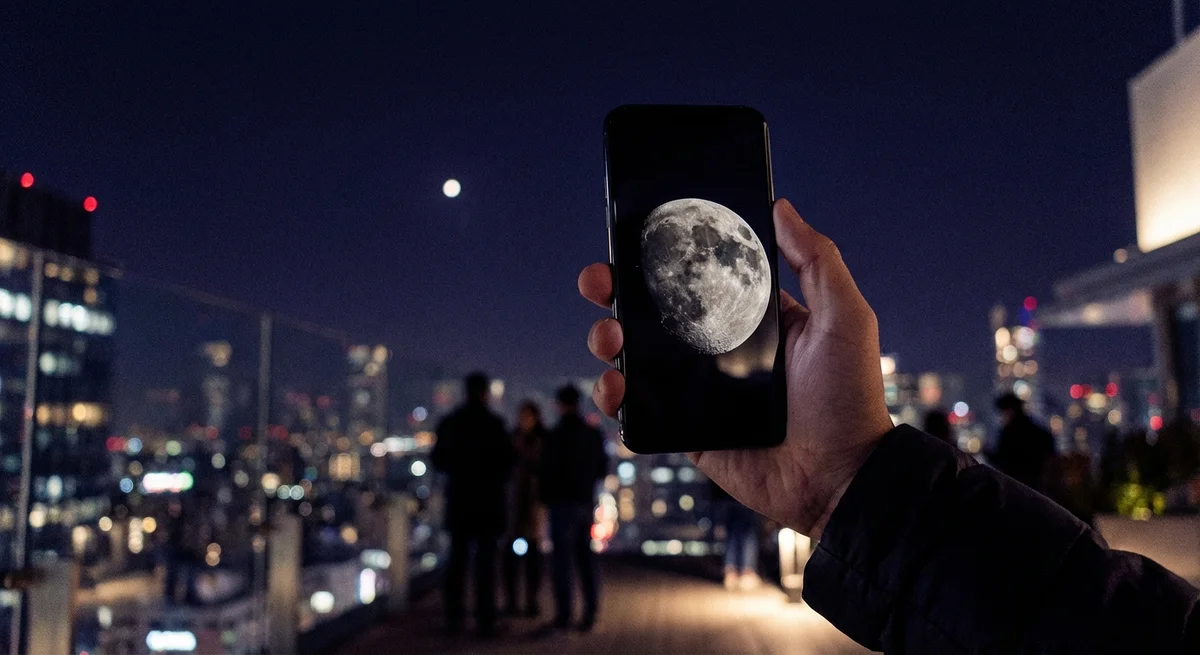
Buying a new flagship like the Vivo X200 Ultra today suspiciously resembles a visit to a cosmetic surgeon. You know in advance that the result will be blindingly beautiful, yet you're aware that it has almost nothing to do with the original material. Recent tests of this device attempting to photograph the Moon once again exposed an abscess that has been festering in the industry for years.
When you point the camera at the night sky in automatic mode, the smartphone delivers a masterpiece with sharp craters and dimensionality. But switch to professional mode and peek at the "honest" RAW file, and the magic crumbles. In place of the celestial body is a dull murky spot that can hardly be called a photograph.
This story didn't start yesterday. We remember the loud scandals around Samsung S22 Ultra and other manufacturers caught "redrawing" the Moon. However, we are now witnessing a qualitative shift. If previously algorithms simply enhanced sharpness or removed noise, now they engage in full creative work. The smartphone no longer captures light falling on the sensor. It uses that light as a brief technical specification for the embedded neural network. Upon receiving a blurry white circle, the processor understands the context and overlays a pre-trained Moon texture on top of it. This is not a photograph in the classical sense; it is image generation based on a visual prompt.
Let's be honest: the laws of physics are inexorable. A smartphone's small sensor and tiny optics are physically incapable of resolving details of objects 384,000 kilometers away the way a telescope does. The diffraction limit is a wall that all engineers run into. But marketers don't care about physics; they need sales. So GAN networks and diffusion models come to the rescue. They know what the Moon should look like and simply "paste" it into your frame. In the end, we get a perfect picture for social media that is completely devoid of documentary value. We willingly agreed to this deception for the sake of a beautiful picture.
The problem here runs much deeper than just fake craters. We are entering an era of post-photography, where images finally stop correlating with reality. If a smartphone can subtly replace the Moon, what prevents it from "enhancing" your interlocutor's face, changing the weather in the frame, or adding details that never existed? The line between documentary photography and digital art is blurred. Cameras are turning into hallucinogenic filters that show us the world not as it is, but as we want to see it. We stop being photographers and become prompt operators, without even realizing it.
Ultimately, this will lead to a complete crisis of trust in visual content. If every shot passes through the meat grinder of neural network enhancements, then no photo can serve as proof of anything anymore. We buy expensive devices with huge lenses only for the powerful chip inside to ignore their work and paint its own version of reality. The irony is that the more perfect the algorithms become, the less sense quality optics make. Why spend money on glass if a neural network will fix everything anyway?
The bottom line: Mobile photography has finally become a branch of generative art. Are we ready to acknowledge that our memories in the smartphone gallery are nothing but high-quality fakes?
Want to stop reading about AI and start using it?
AI News is a curated feed of AI/tech news. Hamidun Academy teaches you to use AI systematically in your work.
The AI world, distilled — once a week
Seven stories that actually mattered, hand-picked. No noise, no reposts, no press releases.
Done! Check your inbox for a confirmation.