A Moon from a Neural Network: Why Your Smartphone No Longer Knows How to Take Photos
Buying a new Vivo X200 Ultra confirms a long-running trend: mobile photography is dead, replaced by computational hallucination. In automatic mode, the phone produces a sharp Moon with shadows and craters, but in an "honest" RAW mode the same object turns into a blurry smudge. This is not just image enhancement. It is an aggressive substitution of reality with neural-network textures. We have entered an era in which a smartphone camera works as an image generator, and the lenses and sensors merely hint to the algorithm what it should draw. That calls into question the very essence of photography as documentary evidence.
AI-processed from Habr AI; edited by Hamidun News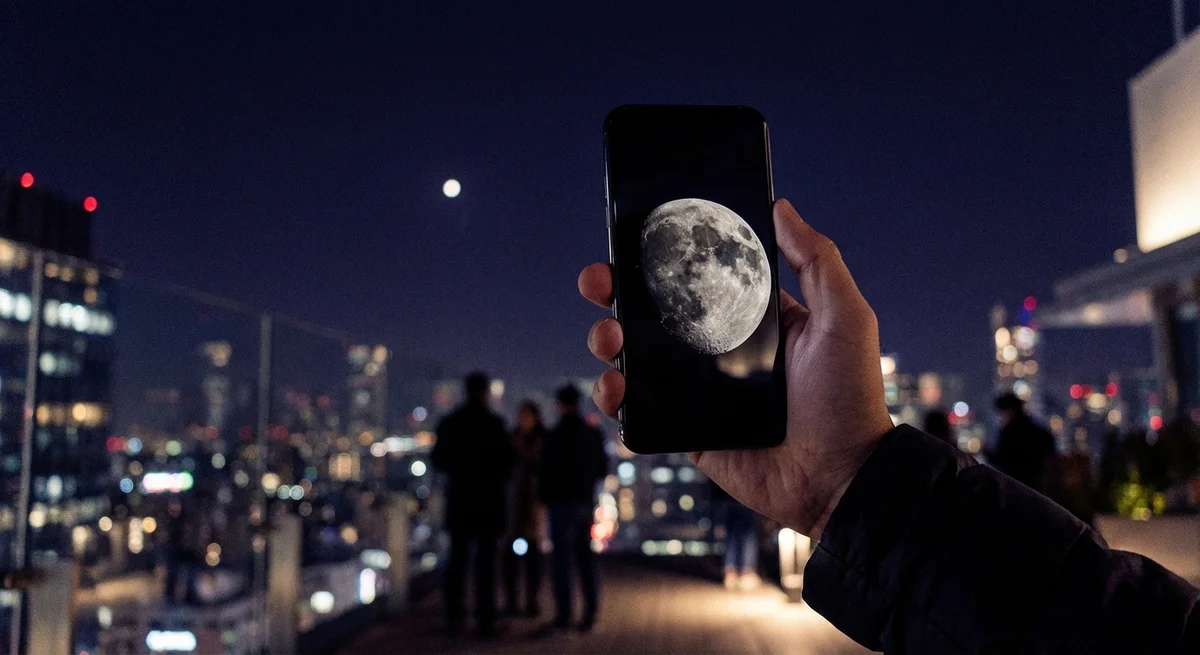
Buying a new flagship like the Vivo X200 Ultra today feels suspiciously like visiting a plastic surgeon. You know in advance that the result will be dazzlingly beautiful, yet you also realize it has almost nothing in common with the original material. Recent tests of this device trying to shoot the Moon have once again lanced a boil that has been festering in the industry for several years.
Point the camera at the night sky in automatic mode and the phone delivers a masterpiece with sharp craters and depth. But switch to pro mode and open the "honest" RAW file, and the magic falls apart. Where the celestial body should be, there is a dreary, muddy smudge that can hardly be called a photograph.
This story did not begin yesterday. We remember the loud scandals around the Samsung S22 Ultra and other manufacturers caught "painting in" the Moon. But now we are seeing a qualitative shift. Where algorithms once simply sharpened an image or removed noise, they now engage in full-blown creative work. The smartphone no longer records the light hitting the sensor. It uses that light as a brief technical assignment for a built-in neural network. Given a blurry white circle, the processor understands the context and overlays a pre-trained texture of the Moon on top of it. This is not photography in the classical sense; it is image generation from a visual prompt.
Let's be honest: the laws of physics are unforgiving. A small smartphone sensor and tiny optics are physically incapable of resolving details of objects 384 thousand kilometers away the way a telescope does. The diffraction limit is a wall every engineer runs into. But marketers do not care about physics; they need sales. So GANs and diffusion models come to the rescue. They know what the Moon should look like and simply "paste" it into your frame. The result is a perfect picture for social media that has no documentary value whatsoever. We agreed to this deception voluntarily, for the sake of a pretty picture.
The problem runs much deeper than fake craters. We are entering an era of post-photography, in which the image finally stops correlating with reality. If a smartphone can quietly swap out the Moon, what stops it from "improving" the face of the person you are talking to, changing the weather in the frame, or adding details that never existed? The line between a news photograph and digital art is blurring. Cameras are turning into hallucinogenic filters that show us the world not as it is, but as we want to see it. We are ceasing to be photographers and becoming prompt operators, without even realizing it.
Ultimately, this will lead to a full-blown crisis of trust in visual content. If every shot goes through the meat grinder of neural-network enhancement, no photo can serve as proof of anything anymore. We buy expensive devices with huge lenses only for the powerful chip inside to ignore their work and draw its own version of reality. The irony is that the more sophisticated the algorithms become, the less point there is in quality optics. Why spend money on glass if the neural network will fix everything anyway?
The takeaway: Mobile photography has finally turned into a branch of generative art. Are we ready to admit that the memories in our phone's gallery are nothing more than high-quality fakes?
Test Frontier LLMs & Autonomous Agents in One Workspace
Run Claude Opus 5.5, GPT-6, Gemini 3.1, and DeepSeek side-by-side in Nomad AI (nomadnet.ai) — unified model routing, deep research, and multimodal workflows under one subscription.
The AI world, distilled — once a week
Seven stories that actually mattered, hand-picked. No noise, no reposts, no press releases.
Done! Check your inbox for a confirmation.