AI vs. Breast Cancer: 12% Fewer Diagnoses Made "Too Late"
Sweden has completed the largest study to date of AI in mammography, involving 100,000 women. The results are striking: using neural networks cut the number of diagnoses made at late stages by 12%. One group got the standard review by two radiologists, while the other had an algorithm acting as a safety net. The upshot: AI does not simply replace the second doctor. It finds pathologies that the human eye systematically misses. This is not just another startup launch, but real evidence that AI in medicine is becoming a question of survival, not merely convenience.
AI-processed from Guardian; edited by Hamidun News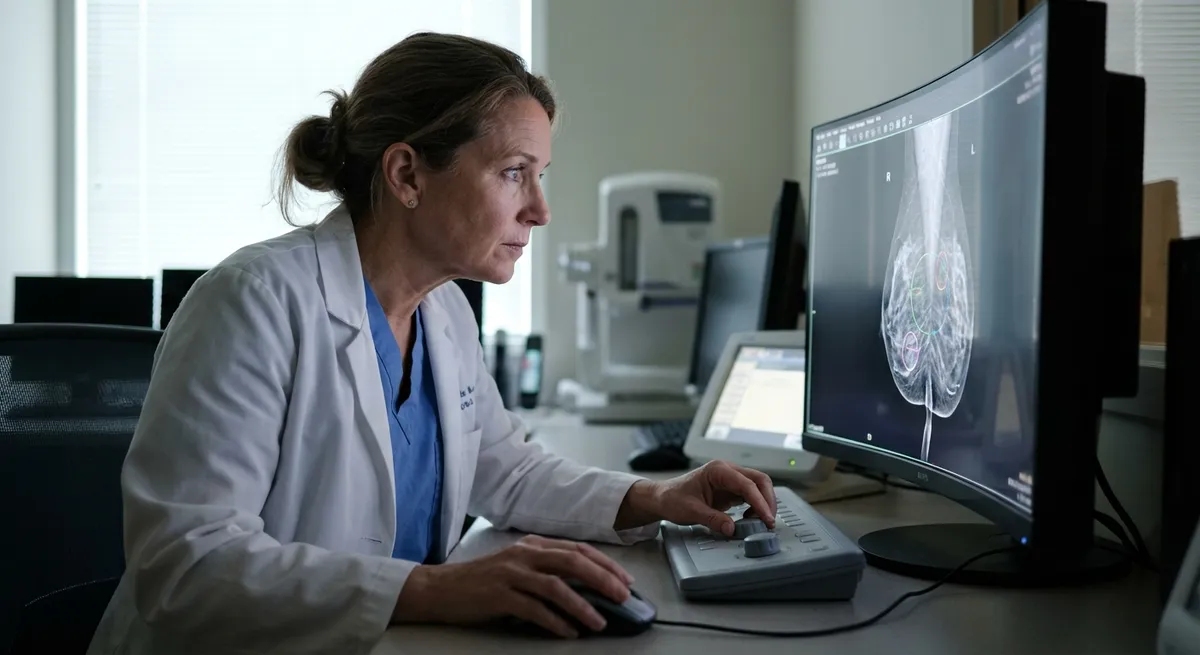
While we argue about whether ChatGPT will replace programmers, AI is already saving lives in Swedish clinics, and doing so with a precision humans cannot match. Let's be honest: a radiologist's job is an endless stream of grey images in which you have to spot a tiny deviation that could cost someone their life. Eyes glaze over, attention flags, and the price of a mistake is enormous. That is why Europe has adopted the "double reading" standard, in which two independent specialists review each image. Even this system fails at times, not to mention the severe staff shortage in the field.
Swedish researchers set out to test whether an algorithm could become the ideal partner that never tires and never drinks coffee. The experiment involved 100,000 women. This is not just a sample; it is the largest trial of its kind in history. Half of the images were checked the old way by two doctors, the other half by one doctor supported by AI. The results, published recently, force a rethink of how we view digital diagnosticians. Using AI cut the rate of cancers detected in the intervals between screenings by 12%. These are the cases where the doctor says at the exam that everything is clear, and a year later the patient comes back with an advanced tumor.
Why does this happen? The human brain tends to ignore anomalies that don't fit the typical picture, or simply to miss microscopic changes because of fatigue. A neural network, by contrast, is trained on millions of images and looks for patterns in pixels that look like ordinary noise to us. In the study, the AI-supported group showed a significantly higher rate of early detection. That means the disease was caught when the chances of a full recovery are close to 100 percent and treatment is far less aggressive.
It's important to understand the context: this study is not about robots kicking doctors out into the cold. On the contrary, it is about allocating resources efficiently. Healthcare worldwide is groaning under a shortage of experienced radiologists. If AI takes on the role of a "co-pilot" or a first-pass filter for obviously clear images, doctors can spend more time on complex, disputed cases. This is not a replacement for human intelligence but a multiplier of it. The Swedes showed that this model is not merely viable; it is safer for the patient.
Of course, questions of ethics and accountability remain. Who is to blame if the AI makes a mistake? How do we avoid algorithmic bias? But numbers are stubborn things. 12% means thousands of women saved from hearing a terrible diagnosis too late. We are entering an era in which the "opinion of the machine" carries more weight than a council of professors, and this seems like the best use of technology one could imagine. While Silicon Valley generates pictures of cats, medicine is quietly carrying out a quiet revolution whose main prize is our longevity.
The takeaway: AI has proven effective at the hardest task of all, finding hidden threats that professionals miss. Should we expect mass adoption of "doctor + algorithm" protocols within the next couple of years?
- Nov 2, 2026Meta's Muse assistant keeps dossiers on loved ones and gets root on Ubuntu by default
- Nov 1, 2026Local models lose to Opus and Codex: 0.21 on a MacBook versus 1.00 for Codex
- Nov 1, 2026Kimi scores 96.2% on a 1C database analytics test and emerges as a fallback if Claude access is blocked
- Nov 1, 2026OpenAI Rewrites GPT Behavior Rules: Five Values and a Chain of Command
Test Frontier LLMs & Autonomous Agents in One Workspace
Run Claude Opus 5.5, GPT-6, Gemini 3.1, and DeepSeek side-by-side in Nomad AI (nomadnet.ai) — unified model routing, deep research, and multimodal workflows under one subscription.
The AI world, distilled — once a week
Seven stories that actually mattered, hand-picked. No noise, no reposts, no press releases.
Done! Check your inbox for a confirmation.