ChatGPT in a hard hat: Japan's Taisei hands construction work to neural networks
Japanese construction giant Taisei has decided that ChatGPT Enterprise is the best mentor for its young engineers. The company is scaling generative AI across its entire global business. This is not just an attempt to speed up report writing. With Japan short of skilled workers, AI is becoming the only way to preserve expertise and pass it on to newcomers. While competitors play it safe, Taisei is betting that neural networks can handle drawings and regulations better than people. It is an important signal for the whole industry: AI is finally leaving the office and moving onto real job sites.
AI-processed from OpenAI Blog; edited by Hamidun News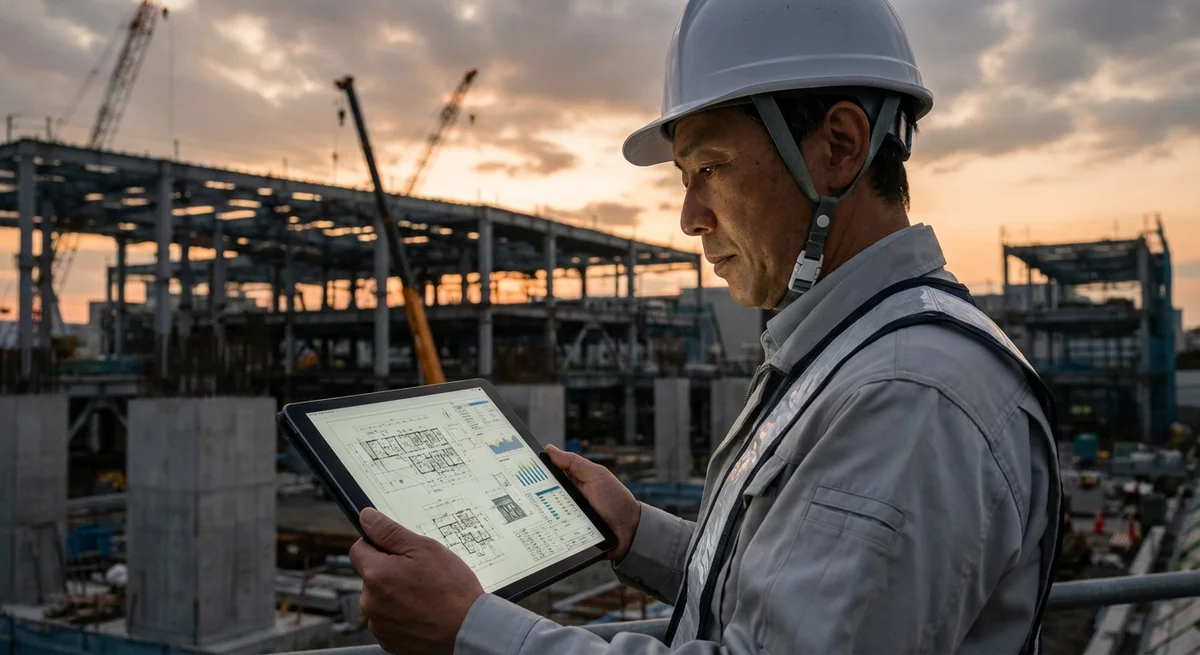
The construction industry has always been a bastion of conservatism. What it values is not fast software updates but the strength of concrete, the precision of geodetic measurements and the years of experience a site foreman brings. Yet even giants like Japan's Taisei Corporation have begun to see that modern megacities can no longer be built with old methods. While the world debates whether AI will replace copywriters and artists, Taisei is putting a virtual hard hat on ChatGPT and sending it to the front line of global development. This is not just an experiment but a forced evolution, at a time when reality bites.
Why would builders need a neural network? The answer lies not in a wish to look modern but in Japan's harsh demographic reality. The country is aging rapidly, and there are fewer and fewer experienced engineers who can spot a defect in rebar by eye or optimize logistics on a complex site. Taisei decided that ChatGPT Enterprise would become the "digital mentor" that absorbs veterans' experience and passes it to younger staff. It is an attempt to digitize intuition and knowledge built up over decades before they retire along with the people who hold them. In Japan this is called the "2024 problem": a critical labor shortage in logistics and construction that demands radical solutions.
The choice of ChatGPT Enterprise was no accident. In construction, any leak of data about drawings, new materials or tender terms is a catastrophe of biblical proportions. The corporate version offers the security and privacy that lets engineers feed the model confidential regulations and internal archives without fearing they will surface in competitors' answers a week later. Taisei did not simply give employees access to a chat; it integrated AI into the talent management system itself. That means the neural network now helps draw up individual training plans and answers employees' complex technical questions in real time.
It is interesting to watch how the role of HR is changing in such conservative organizations. HR used to handle paperwork and organize annual medical checkups. Now HR at Taisei is a full-fledged driver of technological transformation. It was the first to recognize that in 2024 "talent development" is not only about professional training courses but also about the ability to work in tandem with an algorithm. If a young engineer cannot properly write a prompt to analyze structural stability using the company's historical data, he becomes less effective than a colleague who has mastered that skill. Here AI acts not as a replacement for people but as an exoskeleton for the brain.
Scaling generative AI across the whole global business is a risky step, but a strategically calculated one. Construction is literally buried in unstructured data: site reports, safety logs, materials specifications and endless email chains. ChatGPT can turn this mountain of informational clutter into a structured knowledge base. Instead of spending hours searching decade-old archives for the right clause, an employee simply asks the AI. This saves thousands of person-hours, which in a labor shortage are worth more than gold.
What does this mean for the industry as a whole? We are seeing the end of the era of "isolated AI". Neural networks used to be a toy for data scientists in sterile Silicon Valley offices. Now they are becoming part of basic infrastructure, as familiar as electricity or the internet. If Japan's construction sector, known for its legendary sluggishness and love of paper seals, makes such a sharp turn toward OpenAI, the point of no return has been passed. The rest of the market will have to either catch up fast or keep building the old way, hoping young people suddenly want to work without the help of smart algorithms. Spoiler: they won't.
The takeaway: Taisei is turning AI from a "smart chatbot" into a survival tool in the face of a labor famine. Will other players in the sector be able to follow suit, or will we keep using neural networks only to generate pretty pictures of future buildings?
- Nov 2, 2026TJ Digital: 23% of AI-cited pages open with a direct answer, versus 14% of uncited ones
- Nov 2, 2026Arca gives AI agents finance tasks lasting up to 10 days, but leaves the trades to humans
- Nov 2, 2026Meta's Muse assistant keeps dossiers on loved ones and gets root on Ubuntu by default
- Nov 1, 2026Local models lose to Opus and Codex: 0.21 on a MacBook versus 1.00 for Codex
Test Frontier LLMs & Autonomous Agents in One Workspace
Run Claude Opus 5.5, GPT-6, Gemini 3.1, and DeepSeek side-by-side in Nomad AI (nomadnet.ai) — unified model routing, deep research, and multimodal workflows under one subscription.
The AI world, distilled — once a week
Seven stories that actually mattered, hand-picked. No noise, no reposts, no press releases.
Done! Check your inbox for a confirmation.