Spark Ring: The AI Ring That Survived Despite Investors and Common Sense
Tan Chan, a 29-year-old veteran of a Chinese big tech company, decided AI needs a physical vessel that is always within reach. That became Spark Ring. The road was rough: from an ugly 3D-printed prototype with a camera, which investors called "too scary," to an elegant ceramic device. Its main feature is 8 hours of recording and an AI Agent that turns your thoughts into tasks and calendar entries on the fly. At CES 2025, Western users valued the simplicity above all: the ability to capture an idea without pulling out a smartphone. While giants like Apple and Samsung hesitate, startups like Spark are searching for the right form factor for "everyday AI."
AI-processed from 36Kr (36氪); edited by Hamidun News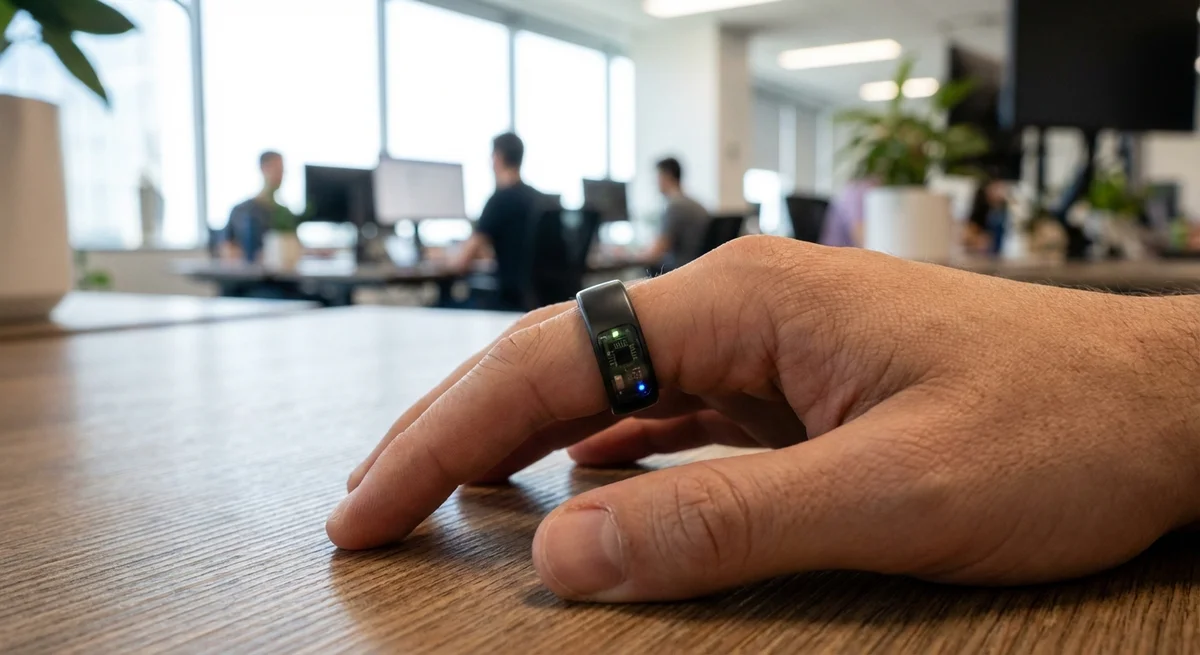
Picture a meeting with investors where you bring a chunk of black plastic printed on a 3D printer. It is thick and crude, with an absurd square sticking out of the top, supposedly a camera. That is how the story of Tan Chan and his Spark Ring project began. The investors didn't just say no. They advised him not to show this horror to anyone if he wanted to keep any reputation at all. The team scattered, the funding was pulled, and Tan was left alone with his idea of a "multimodal ring." It is a typical scenario for a hardware startup, where death comes before the first working prototype.
Tan Chan didn't give up. He switched to "survival on handouts" mode, collecting subsidies in Hong Kong and Shenzhen and literally clawing out his product's right to exist.
By January 2025, things had changed. At CES in Las Vegas he presented a completely different device: a sleek black ceramic ring with a transparent inner wall through which the chips are visible. The main change was that he removed the camera.
It was a strategic surrender. Investors didn't understand why a ring needed an eye, and the technical complexity made the device too bulky. The focus on voice, however, paid off.
Spark Ring is now positioned as a "personal agent at your fingertip." The ring can record up to 8 hours of audio and pass the data to an app, where a neural network does the rest. It recognizes intent, creates calendar events, builds to-do lists and answers questions in streaming mode.
CES revealed an interesting difference in mindset. Chinese users probed in detail how the agent works and how its workflow is built, while Americans and Europeans simply asked: "Turn off the phone screen and record something again." When they saw the magic work without a smartphone, they were ready to pay.
Why does this matter now? We are in a phase of searching for the ideal AI form factor. The smartphone is an intermediary that often gets in the way. Glasses are too invasive, and clip-ons like the Humane AI Pin are questionable. A ring, by contrast, is a familiar accessory that people have already learned to wear thanks to Oura and other fitness trackers. Tan Chan is convinced that a big AI brain must have constant access to our lives to be truly useful, and voice is the shortest path to that access. While Apple and Samsung see rings purely as health sensors, small players are trying to turn them into a full interface for talking to a machine.
Interestingly, Tan is not afraid of competition from tech giants. He calls it the "innovator's dilemma." Big corporations don't want to spend billions on a market that hasn't yet been confirmed by customer receipts. They wait for someone else to pave the road, take the bumps and prove that people really want to whisper their thoughts into a finger. For a startup this is a window of opportunity: build a brand and a loyal community before the heavyweights enter the game.
Spark Ring is now preparing to enter the US market in March, and that will be the decisive test for the "recording ring" concept.
Bottom line: Whether voice in a ring becomes a new standard or remains a toy for geeks is an open question. But Spark Ring has shown that in the AI era even the "ugliest" prototype has a chance, if its creator is ready to cut the excess (here, the camera) to keep the product alive.
- Nov 2, 2026TensorFold 1.2.0 boosts Qwen3.8-27B throughput on M3 Ultra by 44.2% at 16 streams
- Nov 1, 2026Local models lose to Opus and Codex: 0.21 on a MacBook versus 1.00 for Codex
- Oct 29, 2026Claude Code Edits Video From a Transcript: How the video-use Skill With 30 000 Stars Works
- Oct 29, 2026Stanford AI tool verifies part of Signal's code in half a day for under $500, versus five months of expert work
Test Frontier LLMs & Autonomous Agents in One Workspace
Run Claude Opus 5.5, GPT-6, Gemini 3.1, and DeepSeek side-by-side in Nomad AI (nomadnet.ai) — unified model routing, deep research, and multimodal workflows under one subscription.
The AI world, distilled — once a week
Seven stories that actually mattered, hand-picked. No noise, no reposts, no press releases.
Done! Check your inbox for a confirmation.