Brainfon: the state is replacing scarce doctors with neural networks
The Sovereign Technologies Fund has taken a stake in the startup Brainfon, which is building an AI system for early detection of brain pathologies. Why does the state care? The population is aging, doctors are in short supply, and conventional diagnostics are expensive. The neural network is meant to act as a cheap filter that separates healthy patients from those who needed help yesterday. It is a textbook case of moving toward preventive medicine through algorithms. If the project takes off, diagnostics could become tens of times more affordable and queues at clinics shorter. The key condition is that the AI's accuracy holds up where the price of a mistake is a human life.
AI-processed from CNews AI; edited by Hamidun News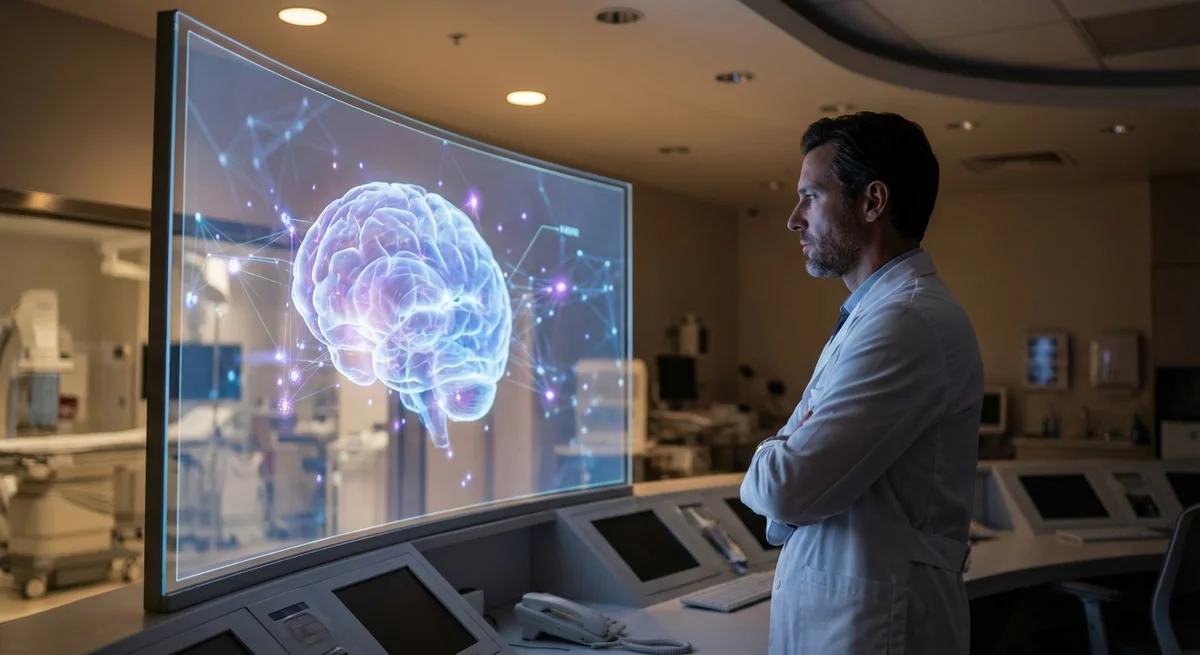
While the industry argues over whether ChatGPT will replace screenwriters, the state has played its strongest card and started deploying technology where the staffing shortage hurts most: medicine. The Sovereign Technologies Fund has bought a stake in the startup Brainfon. This is not just another software investment; it is an attempt to build a "digital sieve" for the human brain. The context is simple and rather harsh: the number of neurodegenerative diseases grows along with the average age of the population, while the number of qualified diagnosticians does not.
Brainfon is working on technology that uses neural networks to detect brain diseases at early stages. In essence, it is building an algorithmic filter. Today, finding out that something is wrong with your brain means going through a long chain: a general practitioner, a neurologist, an expensive MRI, and a wait for the scan to be read. The neural network promises to shorten that path and, more importantly, make it tens of times cheaper. When we talk about a "cheap filter," we mean economies of scale. A single trained algorithm can process thousands of scans and data points per minute, running 24/7 with no lunch breaks and no burnout.
Why does this matter right now? Russia's healthcare system, like many others around the world, faces a bottleneck. Primary care doctors are in catastrophically short supply, and specialists are overloaded with routine work. Using AI as a first line of defense makes it possible to separate normal findings from pathology automatically. That frees up human doctors' time for truly complex cases that call for intuition and experience, not just hunting for familiar patterns on a scan.
The state fund's interest here is entirely pragmatic. Investing in such technology is not charity; it is an attempt to cut future budget spending on the care of seriously ill patients. The earlier a disease is detected, the cheaper patient support becomes and the longer the person stays socially active. We are watching hardware and code become instruments of social policy. Where the state once invested in building hospitals, it now invests in algorithms meant to make those hospitals more efficient.
Questions remain, of course, about data quality and accountability for errors. In medicine, a neural network's hallucination is not a funny line from a chatbot but a wrong diagnosis. Brainfon will have to prove that its system works reliably across different samples and does not lose accuracy in the real conditions of regional clinics, where equipment may be far from state of the art. The link to a state fund gives the startup not only money but also access to huge data sets, a critical advantage in the race among AI solutions.
In the long run, projects like this could completely change the shape of routine medical checkups. Imagine basic brain screening becoming as ordinary and cheap as a blood test. That is the digital transformation everyone talks about in reports but which rarely takes the form of concrete, working tools. We are watching medicine become a data-driven industry, where a patient's first encounter is not with a person in a white coat but with code on a server.
Bottom line: The state is moving from talking about innovation to buying tools that directly save budget money. Whether the algorithm can become a reliable shield against dementia and other diseases remains an open question, but the healthcare system, it seems, is simply running out of alternatives.
- Nov 2, 2026Meta's Muse assistant keeps dossiers on loved ones and gets root on Ubuntu by default
- Nov 1, 2026Local models lose to Opus and Codex: 0.21 on a MacBook versus 1.00 for Codex
- Nov 1, 2026Kimi scores 96.2% on a 1C database analytics test and emerges as a fallback if Claude access is blocked
- Nov 1, 2026OpenAI Rewrites GPT Behavior Rules: Five Values and a Chain of Command
Ship AI Faster with Founders, Engineers & Weekly Architecture Reviews
Inside Vibe Club (hamidun.com/club) — weekly live masterminds with Zhemal Khamidun, Tech Radar, full LMS access, and 370+ production Claude Code skills.
The AI world, distilled — once a week
Seven stories that actually mattered, hand-picked. No noise, no reposts, no press releases.
Done! Check your inbox for a confirmation.