The Race for AGI: Hassabis and Amodei Argue About the End of the Familiar World
In Swiss mountains, where the fate of the world economy is usually decided, this time they tried to understand when that same economy will cease to be purely a human affair. In Davos, an event occurred that the industry had long awaited: Demis Hassabis from Google DeepMind and Dario Amodei from Anthropic sat at the same table. The moderator, sparing no pathos, compared them to the Beatles and the Rolling Stones. The comparison limps, because unlike rock stars, these two are not arguing about charts, but trying to calculate the date when artificial intelligence will match us or leap over humanity's head. The theme was announced ambitiously: "The Day After AGI." But before planning breakfast in a world of superintelligence, we need to understand when this very dawn will come. Context is more important here than the words themselves.
AI-processed from Habr AI; edited by Hamidun News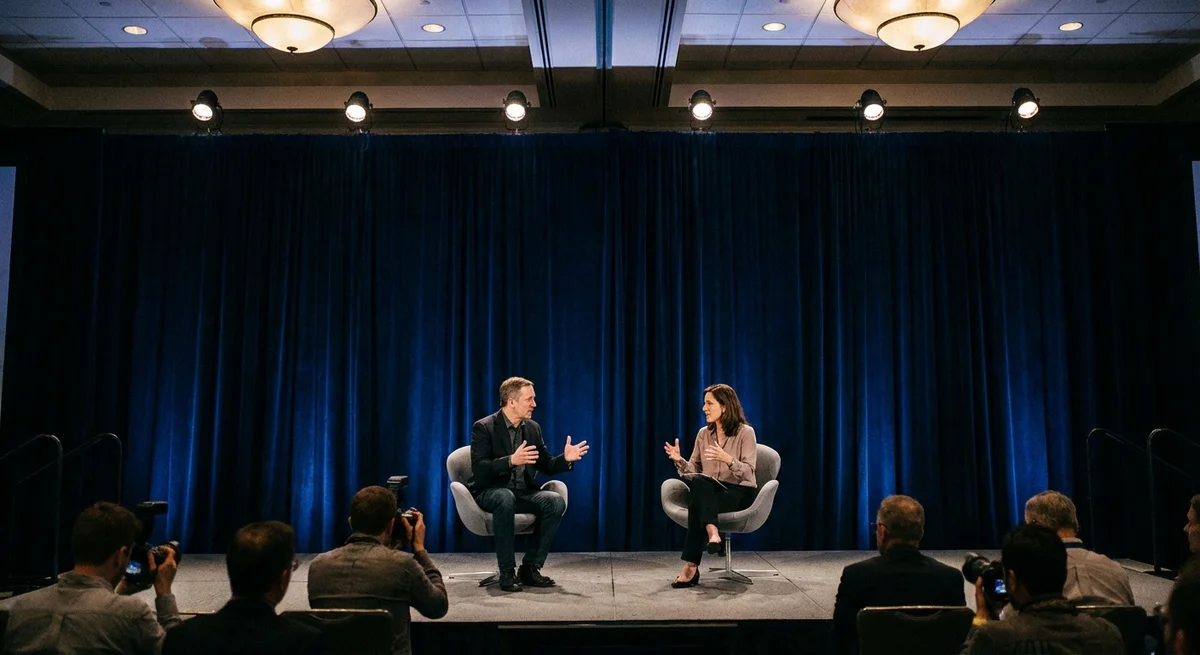
In Davos, Demis Hassabis of Google DeepMind and Dario Amodei of Anthropic sat down at the same table to discuss "The Day After AGI" — and disagreed on the main point: when the day will come after which it makes sense to talk about "after." Hassabis is betting on the end of the decade, while Amodei allows that unexpected leaps in AI capability could begin much sooner.
Who argued about what in Davos
In the Swiss mountains, where the fate of the global economy is usually decided, this time the question was when that very economy would stop being a purely human affair. Davos saw an event the industry had been waiting for a long time: Demis Hassabis of Google DeepMind and Dario Amodei of Anthropic sat down at the same table. The moderator compared them to the Beatles and the Rolling Stones — a comparison that doesn't quite hold, because unlike rock stars, these two aren't arguing about the charts, but trying to calculate the date when artificial intelligence will match humans or leap past them.
The topic was billed ambitiously: "The Day After AGI." But before planning breakfast in a world of superintelligence, one needs to understand when that very dawn will arrive.
Just a couple of years ago, the term AGI (artificial general intelligence) was considered the domain of geeks and science-fiction writers. Today it's a line item in the quarterly reports of the world's largest corporations.
Hassabis's argument: AGI as a tool for science
Hassabis, the man who effectively launched the modern AI wave by selling DeepMind to Google, has always been a cautious optimist. He builds systems that play Go, predict protein structure, and now try to reason. His vision of AGI is a tool that will solve problems in physics and biology. For him, it's evolution, albeit a very fast one: a powerful lever that will help humanity handle what it cannot manage on its own.
Amodei's argument: nonlinear growth and the point of no return
Dario Amodei of Anthropic is playing a different game. His company was born out of a split from OpenAI specifically over safety concerns. If Hassabis is a research engineer, Amodei is a man who looks at exponential curves and sees in them not only progress but also a threat. In Davos, he once again invoked the scaling laws: billions of dollars are being poured into computing power, and neural networks obediently get smarter, but this growth is nonlinear. The world could wake up with a next-generation model that suddenly displays capabilities no one is prepared for — legally or morally. Amodei stresses that the point of no return is closer than many regulators think.
Why the disagreement over timelines matters
The difference in approach exposes the industry's core conflict: a belief that the process can be controlled and AI gradually integrated into science and daily life — versus a fear that the pace of technological development has already outstripped the pace of social institutions' adaptation. When the moderator asked about specific timelines, tension hung in the air: Hassabis is betting on the end of the decade, while Amodei hints that surprises could arrive much sooner. These dates will determine where the next trillions of dollars in investment flow and what laws the EU and the US pass in the coming months.
The era of "toy" chatbots is ending, and the industry is moving toward agents capable of acting autonomously. If the leaders of the two companies that effectively hold the keys to this technology disagree on the assessment of fundamental risks, that's cause for concern: it amounts to a situation where the engine's creators are arguing over whether the machine has brakes and where the cliff edge is. Meanwhile, both keep pressing on the gas, because stopping in this race means losing everything. The Davos meeting showed that there's no consensus even at the very top, and "the day after AGI" could arrive suddenly for everyone involved.
Hassabis and Amodei agree on one thing: AGI is inevitable and close. But while Google sees it as a super-assistant for scientists, Anthropic warns of a tectonic shift the world is not ready for.
When, according to Hassabis and Amodei, will AGI arrive?
Hassabis is betting on the end of the decade. Amodei, meanwhile, hints that unexpected leaps in AI capability could begin much sooner — he stresses that the point of no return is closer than many regulators think.
Why do Hassabis and Amodei disagree on assessing AI risks?
Hassabis sees AGI as a tool and an evolution, albeit a very fast one — a lever that will help solve problems in physics and biology. Amodei, whose company Anthropic was born out of a split from OpenAI over safety, points to the nonlinear growth of model capabilities as computing power increases, and warns that the world may turn out to be unprepared for this, legally or morally.
What do Hassabis and Amodei agree on?
Both agree that AGI is inevitable and close. Where they differ is on what that means: Google sees AGI as a super-assistant for scientists, while Anthropic warns of a tectonic shift the world is not ready for.
Want to stop reading about AI and start using it?
AI News is a curated feed of AI/tech news. Hamidun Academy teaches you to use AI systematically in your work.
The AI world, distilled — once a week
Seven stories that actually mattered, hand-picked. No noise, no reposts, no press releases.
Done! Check your inbox for a confirmation.