YC startup Maritime offers a cloud agent for $1 a month with 2 GB of memory
A sandbox alone isn't enough for an AI agent: teams end up building sleep, storage, schedules and spending limits themselves. YC startup Maritime sells those pieces ready-made: each agent gets its own micro-VM, and with 2 GB of memory it costs $1 a month. A standard sandbox at $0.04 an hour running nonstop costs about $29, so a $20 subscription loses money. Start by calculating what idle time costs you.
AI-processed from Hacker News AI; edited by Hamidun News
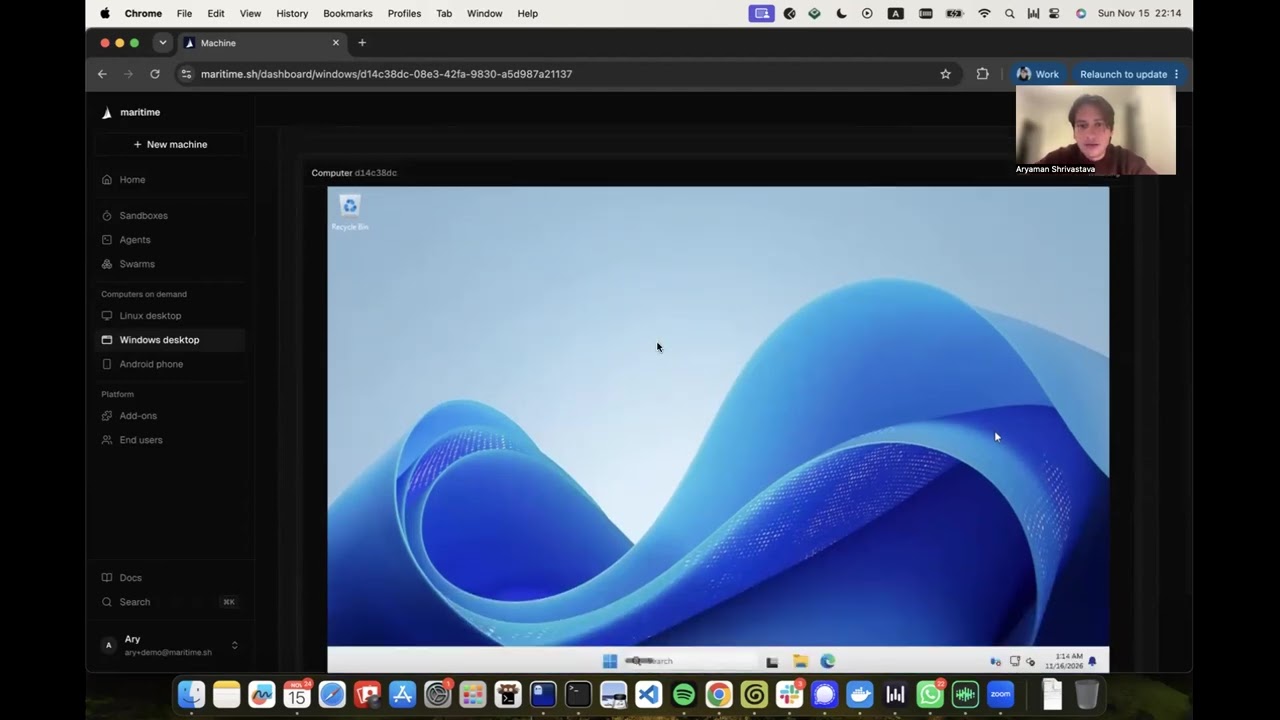
If you build a product on AI agents, each customer may need their own agent with an isolated virtual machine: a sandbox where it runs code, opens a browser and works with files. The founders of Maritime (Y Combinator F26 batch) say the sandbox solves only about 10% of the infrastructure problem. Teams build the rest themselves: sleep and wake-up, storage, schedules, spending limits. The result is expensive: a sandbox at $0.04 an hour, running around the clock, costs about $29 a month, so you can't build a $20 subscription on it. Maritime offers a ready-made cloud where an agent with 2 GB of memory costs $1 a month.
What you have to build on top of a sandbox
The founders, Ary and Maria, talked to a couple hundred companies building agents, from personal assistants and coding agents to medical services. Almost all of them ran into the same three problems.
The first is lifecycle management. An agent has to go to sleep and wake up, keep data between sessions, start on a schedule or an event, and reach the right user. Teams also need spending limits, monitoring, crash recovery and the ability to update thousands of VMs without downtime. Each task is small, but together they add up to a dedicated platform team.
The second is custom environments. One agent needs Windows apps, another needs Android, a third needs a browser with saved sessions or its own OS image. Some need access to a customer's private network, some need residential IP addresses, and some must have network access blocked entirely.
The third is money. The article's example: an assistant priced at $20 a month and a sandbox at $0.04 an hour. If the VM runs nonstop, it costs about $29 a month. That figure includes neither LLM requests nor storage. Every user, in other words, loses you money before you pay for a single token.
How Maritime works
Each agent gets its own isolated, persistent micro-VM with a configurable environment. Services run on top of it: resource provisioning, persistent state, sleep and wake-up, triggers, schedules, network settings, updates with rollbacks, recovery, per-agent cost accounting and handing off a login to the user.
The main focus is cost. The authors name several techniques:
- scale-to-zero: an idle agent costs almost nothing;
- copy-on-write on top of shared base images: agents don't need to store full copies of the system;
- compressed memory snapshots;
- splitting snapshots and disks into hot, warm and cold tiers.
All of this has to be balanced against latency so the agent wakes up fast enough. The resulting price, according to the founders, is $1 a month per agent with 2 GB of RAM, with usage inside that allocation not limited. Additional resources are purchased separately.
For context, many sandbox providers, as the authors describe it, rent physical servers from Hetzner or OVH, slice them into VMs with Firecracker and sell them at a small markup. Maritime positions itself a level above that and sells agent management together with compute.
What to keep in mind
This is a Hacker News launch, and all the figures come from the founders themselves. The text contains no independent measurements of wake-up latency, reliability or behavior under load. The phrase "unlimited usage for $1" also deserves scrutiny: the terms may well include caveats on CPU, disk and network, as well as on the price of additional resources. The company is young: the project started in March, and the team is two people. Maria gave lectures at MIT and did research on agent infrastructure at Project NANDA; Ary studied agent coordination protocols in the same lab.
The demand is easy to understand, though. While you have few agents, a bare sandbox is enough. Once you have thousands of users, each with their own agent with memory and a schedule, the biggest cost items become idle time and manual glue code.
What to do in practice
If you're building an agent product, calculate the real monthly cost of one user. Count not only tokens but also the time the VM sits idle. If it runs around the clock while the agent is active one hour a day, you pay for 23 extra hours. Check whether your system can put an agent to sleep and wake it quickly without losing state. If it can't, either build that yourself or compare ready-made options like Maritime in a small pilot. The authors are asking for feedback: what workarounds you've built on top of sandboxes and what you're still missing.
- Nov 19, 2026A Lawyer Taught an AI Agent to Make Surgical Edits in Word with Track Changes
- Nov 19, 2026RSAC 2026 in Hindsight: AI Assistants Invented 19.7% of Recommended Packages
- Nov 19, 2026AI agent wrote a green refund test that checks only 2 of 6 requirements
- Nov 19, 2026An AI agent sitemap cut downloaded text by 58%, but input tokens rose 3.5%
Key Questions Answered
What you have to build on top of a sandbox?
The founders, Ary and Maria, talked to a couple hundred companies building agents, from personal assistants and coding agents to medical services. Almost all of them ran into the same three problems. The first is lifecycle management. An agent has to go to sleep and wake up, keep data between sessions, start on a schedule or an event, and reach the right user. Teams also need spending limits, monitoring, crash recovery and the ability to update thousands of VMs without downtime.
How Maritime works?
Each agent gets its own isolated, persistent micro-VM with a configurable environment. Services run on top of it: resource provisioning, persistent state, sleep and wake-up, triggers, schedules, network settings, updates with rollbacks, recovery, per-agent cost accounting and handing off a login to the user. The main focus is cost.
What to keep in mind?
This is a Hacker News launch, and all the figures come from the founders themselves. The text contains no independent measurements of wake-up latency, reliability or behavior under load. The phrase "unlimited usage for $1" also deserves scrutiny: the terms may well include caveats on CPU, disk and network, as well as on the price of additional resources. The company is young: the project started in March, and the team is two people.
Ship AI Faster with Founders, Engineers & Weekly Architecture Reviews
Inside Vibe Club (hamidun.com/club) — weekly live masterminds with Zhemal Khamidun, Tech Radar, full LMS access, and 370+ production Claude Code skills.
The AI world, distilled — once a week
Seven stories that actually mattered, hand-picked. No noise, no reposts, no press releases.
Done! Check your inbox for a confirmation.