The End of the Chalk Era: AI Starts Proving Theorems for Humans
The era of automated mathematical proofs has officially arrived. The Numina-Lean-Agent project showed that AI can do more than guess answers: it can build rigorous chains of logic in the Lean system. That is a fundamental shift, turning mathematics from a creative search into an engineering problem. At the same time, cyberespionage is going industrial thanks to neural networks. While some build models, others use them to break into systems at a scale that once required thousands of staff. The question of the week: will there be room for human intuition where algorithms and formal logic now rule?
AI-processed from Import AI; edited by Hamidun News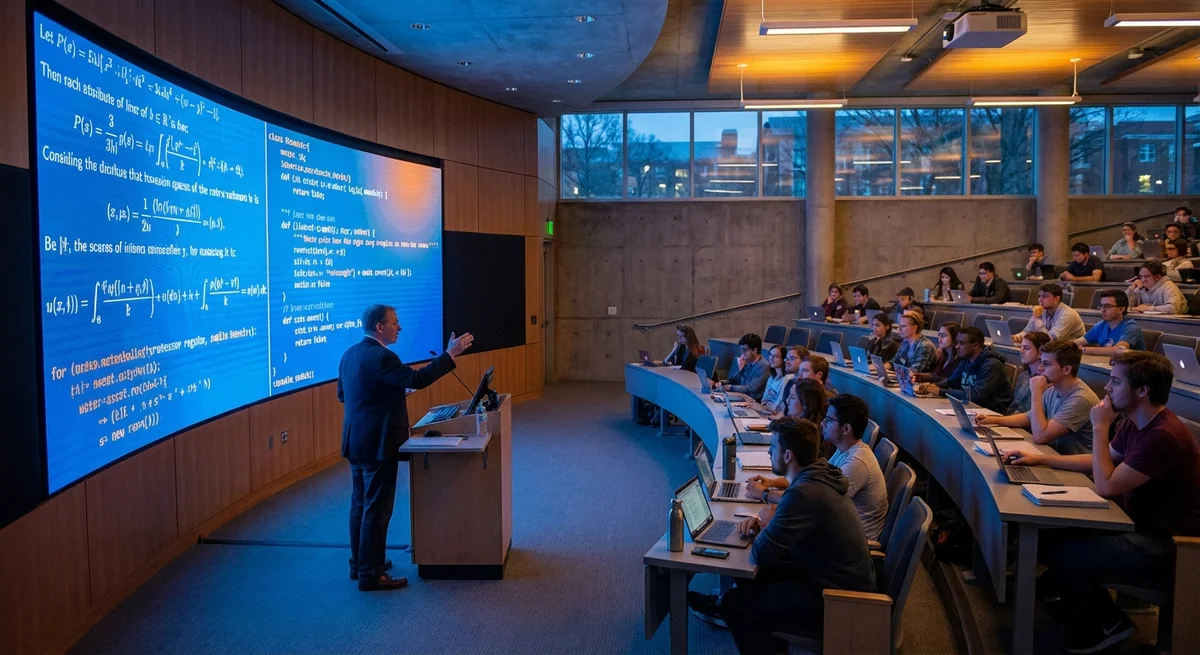
For a long time we lived with a comforting belief that mathematics is the last bastion of pure human intelligence. We forgave language models their clumsy arithmetic mistakes, assuming that the creative spark needed to prove theorems was beyond them by definition. But the latest issue of Import AI and the Numina-Lean-Agent project make it plain that it is time to take off the rose-tinted glasses. Mathematics is no longer a safe harbor for humans; it is becoming a battlefield for formal verification algorithms.
The change comes down to a move from simply predicting the next word to working in strict logical environments such as Lean. Where a neural network once just tried to guess the answer, Numina-Lean-Agent now acts as an agent that writes code to check its own hypotheses in real time. It is as if a schoolchild, instead of just writing a solution in a notebook, instantly checked it on a supercomputer that does not allow a single logical error.
This approach turns mathematical research from intuitive wandering in the fog into a targeted engineering process. It fundamentally changes the rules of the game: the pace of scientific discovery is now limited only by computing power, not by the number of brilliant minds on the planet.
But the automation of science is only one side of the coin. While academics welcome the new tools, something far less inspiring is happening in the shadow economy: the industrialization of cyberespionage. Where a complex attack once required a team of highly skilled hackers, AI now lets attackers put the process on an assembly line. Neural networks take over the routine work: finding vulnerabilities, writing exploits and running social engineering at industrial scale. This creates a dangerous imbalance in the economics of security. The cost of attack is falling fast, while the cost of defense keeps rising. We are entering an era in which cyberwars are fought not by individual masters but by huge automated code factories.
The economic landscape of the AI industry is also starting to crystallize, revealing clear winners and losers. We are seeing a classic concentration of capital: those who own huge GPU clusters dictate the rules. But, ironically, the open-source community is not giving up. Projects like Numina show that, with the right approach to data and architecture, it is possible to reach results comparable to those of the closed giants. The only question is how long this parity will last, before the cost of training next-generation models becomes unaffordable even for the largest consortia.
What does this mean for us? We are watching AI stop being merely a "smart assistant" and become a full participant in the production of knowledge and of threats. When a machine starts proving theorems that a human cannot verify without the help of another machine, we enter a new phase of civilization's development. This is no longer just the automation of labor; it is the automation of logic itself. And if we do not learn to control this process at a fundamental level, we risk ending up in a world where every important decision is made inside "black boxes" whose logic is flawless but completely incomprehensible to our biological brains.
Bottom line: Mathematics has officially become an engineering discipline, and cyberespionage an industrial sector. Are we ready for a world where human intelligence is no longer the fastest way to find the truth?
- Nov 2, 2026DeepSeek Open-Sources Super-agent Prototype: p95 Task Time Drops from 29.5 to 15.7 Minutes
- Nov 2, 2026LLM Agent Built a Gearbox in KOMPAS-3D, but Scored Only 50 out of 100 on the Specification
- Nov 2, 2026Agents ignored the prompt to read memory in 7 of 7 sessions: an analysis of 13 thousand logs
- Nov 2, 2026Karpathy Built HackerTube, a Catalog of 6,454 Videos, in Two Hours with Claude Code
Test Frontier LLMs & Autonomous Agents in One Workspace
Run Claude Opus 5.5, GPT-6, Gemini 3.1, and DeepSeek side-by-side in Nomad AI (nomadnet.ai) — unified model routing, deep research, and multimodal workflows under one subscription.
The AI world, distilled — once a week
Seven stories that actually mattered, hand-picked. No noise, no reposts, no press releases.
Done! Check your inbox for a confirmation.