China Trades Old for Smart: Beijing Wants Its Citizens to Buy AI Gadgets
China's Ministry of Commerce has unveiled its plan for 2025–2026. The centerpiece is a "trade the old for the new" program. Beijing plans to subsidize purchases of cars, home appliances and, most importantly, "smart digital products." Under the "Buy in China" initiative, dozens of events will take place across 15 major cities. This is not just an attempt to rescue retail. It is a strategic move to force a refresh of the installed device base to an AI-ready level. For the industry, that means a huge injection of liquidity into the consumer hardware market.
AI-processed from 36Kr (36氪); edited by Hamidun News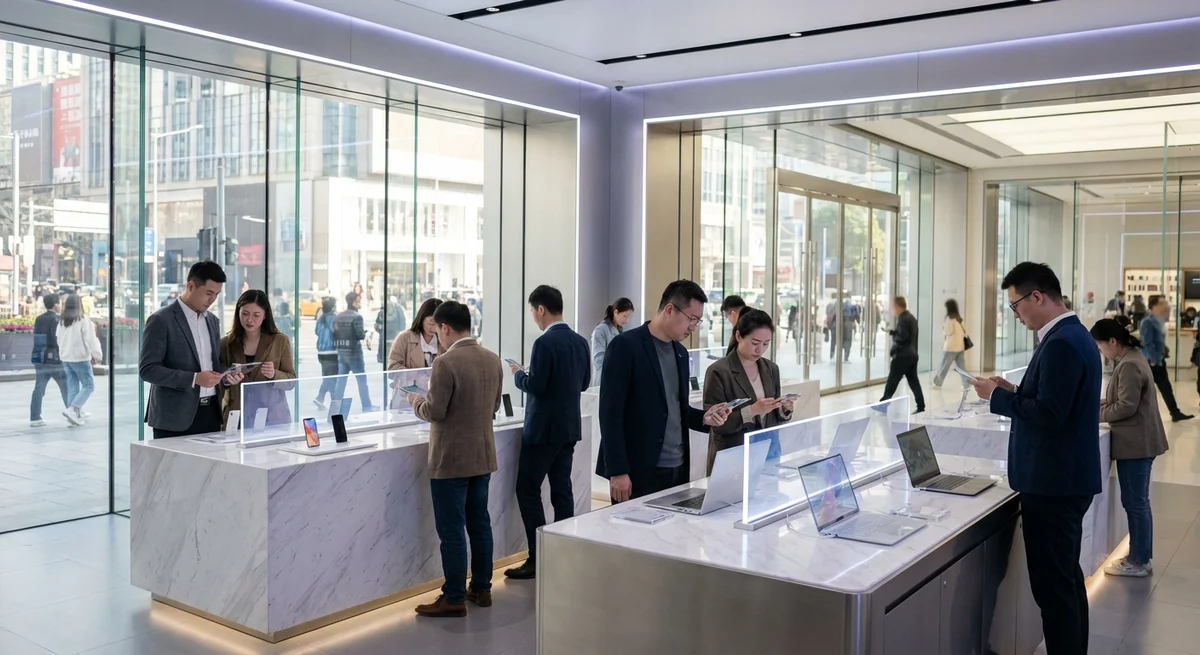
Imagine your old laptop, which barely handles three browser tabs, suddenly turning into an asset the government is willing to pay extra for. That is the picture China's Ministry of Commerce paints in its new plan for developing the domestic market over the next two years. While Western analysts wonder how to get people to buy new smartphones without any obvious reason, Beijing has settled the question in a radical, state-driven way.
The authorities are launching a large-scale campaign to optimize consumption, with the concept of "trading the old for the new" at its center. It sounds like an ordinary sale, but the devil is in the details and the scale. Let's look at why this is happening now.
Domestic demand in China is recovering after the pandemic more slowly than the party would like. People have started saving rather than spending. To crack open that piggy bank, simply releasing a new gadget is not enough.
You have to create conditions in which owning an old device becomes economically unattractive. The Ministry of Commerce states outright that the focus will be on cars, home appliances and "smart digital products." That last term covers the whole range of devices now moving onto on-device artificial intelligence.
Beijing is effectively subsidizing the nation's move to AI-compatible hardware, creating a giant proving ground for its neural network models. The program is not limited to slogans. The authorities are introducing concrete incentive mechanisms, including pilot projects with "lottery vouchers."
It is an old but effective mechanic: when you buy a product, you get a chance to win a cash prize from the state. The list of cities for this experiment has already been published. In addition, the "Buy in China" initiative is being launched, which will bring together more than 20 major themed events across the country.
Fifteen cities, among which Shanghai and Shenzhen will almost certainly appear, will serve as testbeds for "international consumption centers." There, new retail formats will be tested in which online and offline merge through augmented reality and smart logistics systems. Why does this matter for the global market?
China is the world's largest consumer of electronics. If Beijing pulls off this maneuver, we will see a huge surge in demand for chips and components for the consumer segment. That would give Chinese manufacturers such as Xiaomi, Huawei and Honor a major advantage through economies of scale in the home market.
While the rest of the world is still asking whether it needs an AI smartphone, millions of Chinese will have one in their hands simply because it will be the most financially sensible choice when trading in an old device. It is a classic example of how government policy can reshape the technology landscape of an entire region within a few quarters. Also interesting is how the ministry plans to develop the so-called "first launch economy."
This means supporting brands that choose China for the global premieres of their products. The authorities promise to create "practical and effective" measures for such companies. In essence, it is an invitation to those willing to play by Beijing's rules and bring their most advanced products first to Chinese consumers.
Against the backdrop of trade wars and technology export restrictions, this looks like an attempt to build a self-sufficient ecosystem in which innovations are born, sold and consumed within one country with active budget support. The key point: Beijing is turning the consumer market into a tool for accelerated technological modernization. Will Western brands be able to fit into this system of subsidized trade-ins, or will the "Buy in China" program finally close the door to everyone except local players?
- Oct 31, 2026Author puts his script before an AI jury: the verdict cost 850 thousand tokens
- Oct 31, 2026SciGame Tests Five LLM Agents: Familiar Formulas Get in the Way of Finding Altered Laws
- Oct 30, 2026Agent traffic on Zocdoc is up 30x since July, and ChatGPT faces two health lawsuits
- Oct 29, 2026OvisOCR3: an 0.8B-parameter model that reads documents better than specialized systems
Test Frontier LLMs & Autonomous Agents in One Workspace
Run Claude Opus 5.5, GPT-6, Gemini 3.1, and DeepSeek side-by-side in Nomad AI (nomadnet.ai) — unified model routing, deep research, and multimodal workflows under one subscription.
The AI world, distilled — once a week
Seven stories that actually mattered, hand-picked. No noise, no reposts, no press releases.
Done! Check your inbox for a confirmation.