AI in Flames: How a Fire Hose Became Digital Gold
Imagine the chaos of a forest fire. This is not an environment where modern neural networks trained on clean Wikipedia texts or neat photos of cats are accustomed to working. Here there is smoke, unpredictable wind, and temperature changing by the second. For a long time, we believed that automating fire suppression was simply a matter of creating a powerful pump and a tracked platform. But Sunny Sethi, founder of an ambitious project in this niche, decided that "hardware" is only the tip of the iceberg. His approach overturns the understanding of where the real money actually lies in the artificial intelligence industry. Sethi states directly: their robotic fire nozzle is merely "muscles on the ground." The real value is hidden in what these muscles see, hear, and feel.
AI-processed from TechCrunch; edited by Hamidun News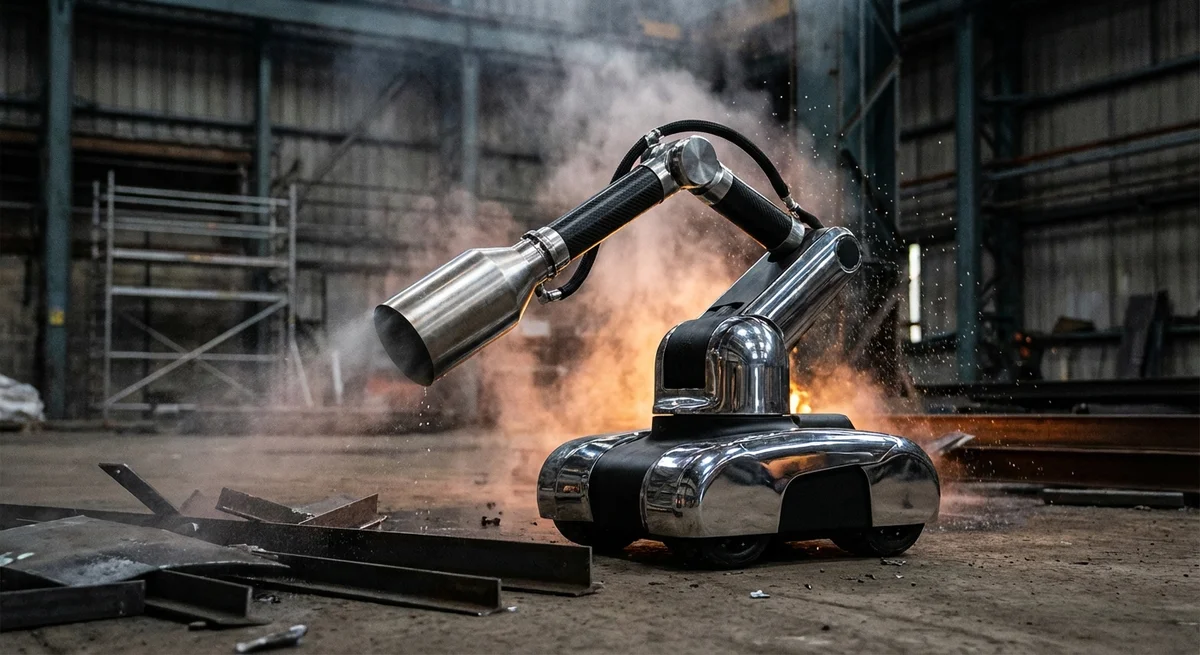
Imagine the chaos of a forest fire. This is not an environment where modern neural networks trained on clean Wikipedia texts or neat photos of cats are accustomed to working. Here there is smoke, unpredictable wind, and temperature changing by the second. For a long time, we believed that automating fire suppression was simply a matter of creating a powerful pump and a tracked platform. But Sunny Sethi, founder of an ambitious project in this niche, decided that "hardware" is only the tip of the iceberg. His approach overturns the understanding of where the real money actually lies in the artificial intelligence industry.
Sethi states directly: their robotic fire nozzle is merely "muscles on the ground." The real value is hidden in what these muscles see, hear, and feel. While Silicon Valley is seriously concerned that quality texts on the internet will soon run out and GPT-6 will have nothing to train on, Sethi has found an untouched vein of data in the real world. His systems transform extreme situations into structured information, creating a kind of "gold mine" for training autonomous systems. This is data that cannot be "scraped" from websites or bought from photo stock services.
Why does this matter right now? We have come to a point where virtual intelligence catastrophically outpaces its capabilities for interacting with physical reality. The problem of "embodied AI" lies in the fact that robots lack experience in non-standard scenarios. Fire is the quintessence of non-standardness. If you teach an algorithm to navigate dense smoke and predict flame movement, managing an ordinary warehouse forklift or autonomous truck will become child's play for it. Sethi is essentially building a universal survival manual for machines.
The company's strategy resembles Tesla's path, but in a far more hostile environment. Just as Elon Musk collects data from roads to improve autopilot, Sethi's startup accumulates experience fighting the elements. This is an elegant maneuver: the company stops being merely a manufacturer of specialized equipment and becomes a supplier of critically important knowledge for the entire robotics industry. In a world where every other startup tries to make "yet another marketing chatbot," working in the "dirty" real-world sector looks like the most sensible business plan of the decade.
Investors have already smelled profit, and it is clearly not the smell of smoke. Data on the behavior of various materials at extremely high temperatures or on air turbulence at the epicenter of a fire is worth millions for defense, construction, and industrial giants. Sethi is building infrastructure that will allow AI to go beyond computer screens and start actually acting in the physical world, relying not on operator intuition, but on terabytes of lived experience. This is a transition from the economy of "likes and clicks" to the economy of "sensors and actions."
Of course, the path from prototype to a real "gold mine" is thorny. The physical world is merciless to electronics, and sensors have the unpleasant habit of melting at the worst possible moment. However, the bet has been placed correctly: whoever digitizes chaos first will become the owner of an operating system for reality. While competitors polish video generation algorithms, Sethi is teaching machines to understand how our world works in its most dramatic and unpredictable moments. This is the true frontier.
Main point: The value of AI is shifting from processing publicly available texts to collecting unique data from the physical world. Whoever captures the "field" will dictate the rules in robotics. Are we ready to entrust our lives to an algorithm that has been baptized by fire?
Need AI working inside your business — not just in your newsfeed?
I build production AI for companies — custom CRM, internal tools, autonomous agents, workflow automation. Owned by you, shaped to your process, no per-seat tax. Built by Zhemal Khamidun, CPO of AlpinaGPT (AI platform, 6,000+ users).
The AI world, distilled — once a week
Seven stories that actually mattered, hand-picked. No noise, no reposts, no press releases.
Done! Check your inbox for a confirmation.