Siri 2.0: Apple Admits Defeat and Calls Google for Help
Picture a typical 17-year-old teenager. At this age, thoughts are usually occupied with exams, video games, or summer plans. But in a world where artificial intelligence is becoming an accessible tool, the rules of the game for 'child prodigies' have dramatically changed. News that an ordinary high school student was able to solve a complex mathematical problem that professionals had failed to crack for years, using the power of AI, shocked the professional community. And this is not just another story about the successful use of ChatGPT for homework. It's about a fundamental shift in how humanity will make scientific discoveries in the coming decade. For a long time, mathematics was considered the last bastion protected from neural networks. Unlike writing essays or creating paintings, you cannot 'be slightly wrong' here.
AI-processed from Jiqizhixin (机器之心); edited by Hamidun News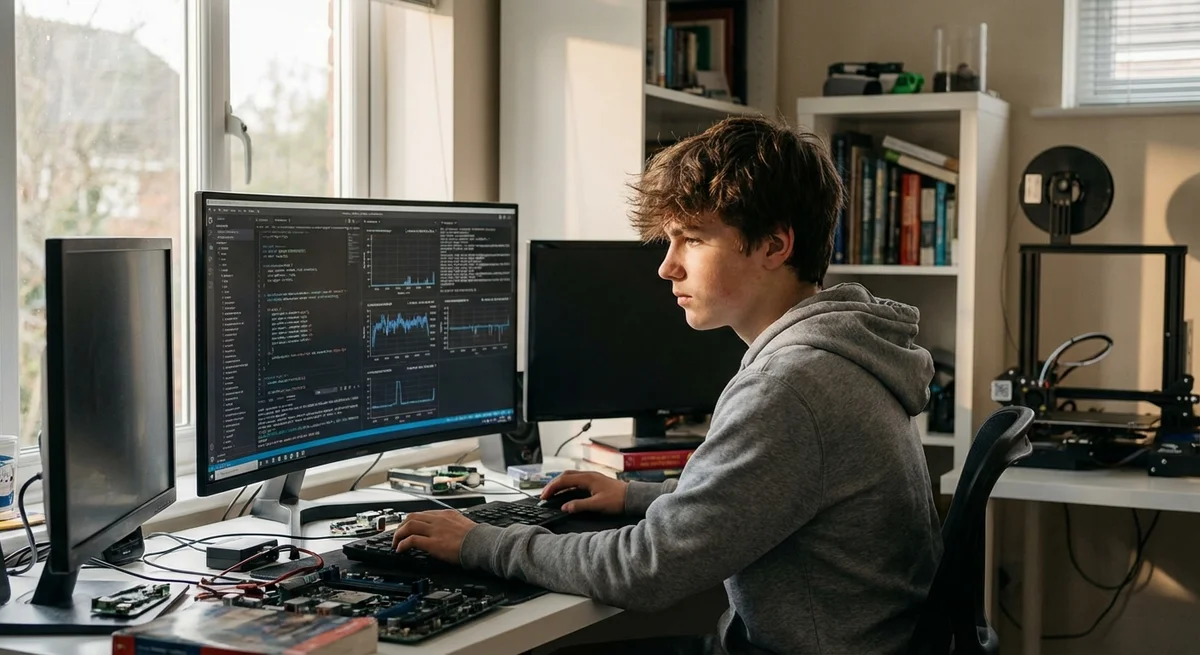
Picture a typical 17-year-old teenager. At this age, thoughts are usually occupied with exams, video games, or summer plans. But in a world where artificial intelligence is becoming an accessible tool, the rules of the game for 'child prodigies' have dramatically changed.
News that an ordinary high school student was able to solve a complex mathematical problem that professionals had failed to crack for years, using the power of AI, shocked the professional community. And this is not just another story about the successful use of ChatGPT for homework. It's about a fundamental shift in how humanity will make scientific discoveries in the coming decade.
For a long time, mathematics was considered the last bastion protected from neural networks. Unlike writing essays or creating paintings, you cannot 'be slightly wrong' here. A mathematical proof is either one hundred percent correct or absolutely useless.
Large language models suffered for a long time from so-called hallucinations, presenting plausible-looking nonsense as truth. However, the integration of neural networks with formal verification systems, such as Lean, opened a new era. It was at this intersection of technologies and human intuition that a breakthrough occurred that made Terence Tao himself — a man called the 'Mozart of mathematics' — leave an enthusiastic review.
Why is this important right now? We are at a transition point from 'stochastic parrots' to systems capable of deep reasoning. When Jeff Dean from Google applauds a schoolboy, he does so not out of politeness.
For giants like DeepMind, this confirms their hypothesis: AI can be not just an assistant, but a full-fledged partner in exploring uncharted areas of science. This is the democratization of genius. Now, to challenge academic institutions, you don't need to wait for decades for your turn in a laboratory — you just need a sharp mind, access to an API, and an understanding of how to properly pose a task to an algorithm.
The context of this event is rooted in years of opposition between human intuition and computational power. Previously, automated theorem proving was the domain of a narrow group of scientists and required writing the most complex code by hand. Today's tools allow the use of natural language to direct the search for solutions.
The schoolboy in this case acted as an architect and strategist who understood the structure of the problem, while AI took on routine but incredibly complex work of sifting through and checking logical chains. This is the very 'centaur' that Harry Kasparov once spoke of in relation to chess, only now on the scale of all world science. What does this mean for the industry as a whole?
First, the entry threshold to high science is rapidly falling. If a 17-year-old boy can attract the attention of the greatest minds on the planet, then the traditional 'student-professor' hierarchy is beginning to crack at the seams. Second, we are seeing the emergence of a new market of tools for scientists.
These are no longer just text editors, but full-fledged cognitive accelerators. Companies that are the first to create convenient interfaces for interaction between humans and logical AI engines will become new market leaders, leaving behind those who simply make 'smart chatbots'. The main point: AI has finally stopped being a toy for content generation and has become a tool for the search for truth.
If schoolchildren are starting to solve problems at the level of the Fields Medal, then in five years the landscape of science will change beyond recognition. Are we ready for a world where discoveries are made at the click of a button?
Need AI working inside your business — not just in your newsfeed?
I build production AI for companies — custom CRM, internal tools, autonomous agents, workflow automation. Owned by you, shaped to your process, no per-seat tax. Built by Zhemal Khamidun, CPO of AlpinaGPT (AI platform, 6,000+ users).
The AI world, distilled — once a week
Seven stories that actually mattered, hand-picked. No noise, no reposts, no press releases.
Done! Check your inbox for a confirmation.