A Bunker for Algorithms: Why Trump Wants a Secret Facility Beneath the White House
News of construction beneath the White House usually means tighter security, but in the AI era security is first of all about data and the speed at which it is processed. With the project's details classified, the industry is guessing: is the administration building its own sovereign AI cluster? In a race with China, a pocket supercomputer right under the Oval Office looks like a logical, if unsettling, move. This is not just a shelter from physical threats. It is a headquarters for managing the algorithms that will shape US policy in the years ahead.
AI-processed from Futurism; edited by Hamidun News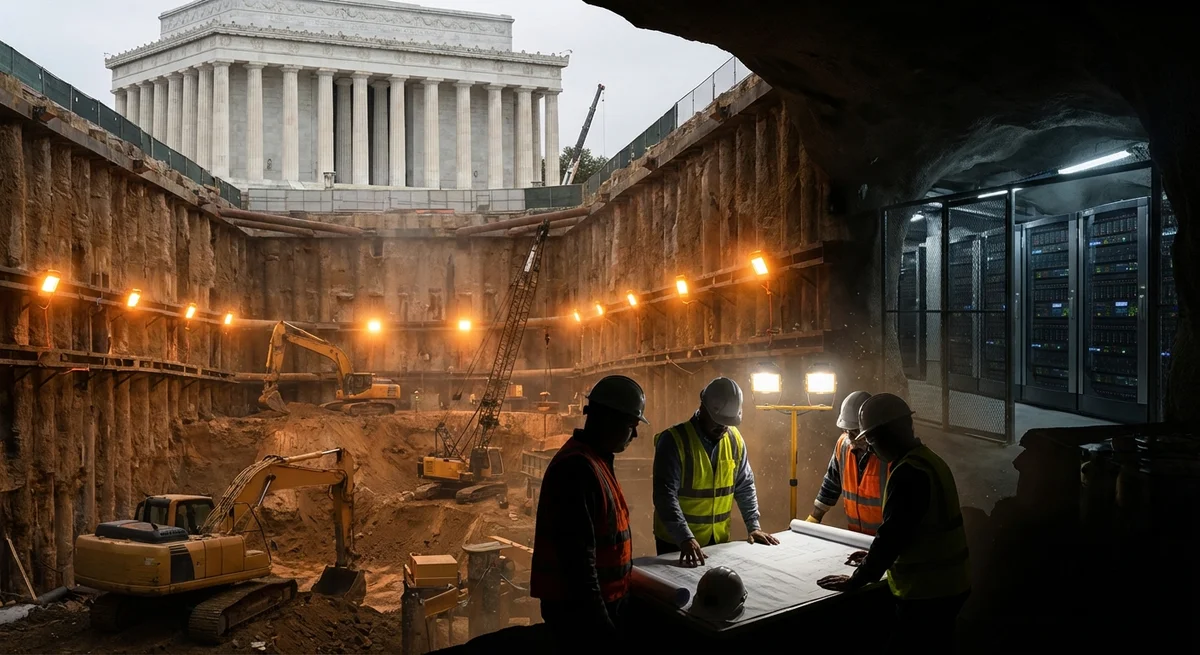
The sound of jackhammers beneath the White House's East Wing is not routine sewer repair or a foundation upgrade. Washington is whispering about a facility so complex that its scale goes far beyond ordinary security reinforcement. Where earlier presidents built bunkers to survive a nuclear winter, Trump seems to be building something that can withstand a technological winter. We are entering an era in which the physical protection of the head of state is inseparable from digital protection, or more precisely, from owning computing capacity that does not depend on the whims of Silicon Valley.
Historically, the White House already has the famous PEOC, the Presidential Emergency Operations Center, where Dick Cheney took shelter during the September 11 attacks. But old concrete walls will not help in a world where the outcome of a conflict is decided in milliseconds by high-frequency trading algorithms or autonomous decision-making systems. Modern conditions demand something different: huge server halls, liquid cooling systems and direct access to classified government databases. Trump has always liked large-scale projects, and the idea of turning the basement of the country's main building into a sovereign data center fits his philosophy of strength neatly.
Why now? The answer lies in growing distrust between the state apparatus and the big tech giants. Despite the outward friendship with Elon Musk, the administration understands the risks of depending on Microsoft's cloud services or Google's servers. If you want to use AI to analyze intelligence in real time or simulate military scenarios, you cannot send those queries to a public cloud. You need your own silicon, your own chips and your own closed perimeter. The construction under the East Wing may be an attempt to create the Manhattan Project for AI that people have talked about in the corridors of power for so long.
Of course, the question of scale arises. Fitting a full Stargate-class cluster from Microsoft into the basement of a historic building is impossible. But building a high-speed control node linked to larger military data centers spread across the country is entirely feasible. It is a kind of digital brain that has to sit within walking distance of the commander in chief. We are watching the concept of sovereign AI move from theoretical debate to poured concrete. It is a signal to the whole world: the US does not intend to hand control of future technologies to private corporations, even if those corporations are in California.
For the industry, this means a new round of government orders for hardware. Where Nvidia once supplied chips to gamers and startups, the government is now becoming the main buyer, in volumes that are hard to imagine. This changes the rules of the game for business and raises new ethical questions. How safe is it to concentrate such power in the hands of the executive branch? If algorithms affecting the lives of millions run in a bunker that no one outside a narrow circle can access, the notion of AI transparency is gone for good.
Ultimately, the construction under the East Wing is a symbol of a new era, one in which power is measured not only by the number of aircraft carriers but also by the number of teraflops under the president's feet. Trump is laying the foundation for governing the country in a world where AI becomes the main instrument of politics, the economy and war. And if that means digging up half of Washington, he will do it without hesitation.
The takeaway: sovereign AI is ceasing to be theory and becoming a physical object beneath the White House. Are we about to see the world's first president whose decrees are optimized by a neural network in real time?
- Nov 2, 2026Bun creator uses Claude Code to port 750K lines from Zig to Rust in 11 days
- Nov 2, 2026The Verge reviewer builds a $50 Meta Muse Charm alternative with Claude Code
- Nov 1, 202616 models tested on 7 search tools: Exa averaged 10.5 out of 14, SearXNG about 3
- Nov 1, 2026Google's StreamVibe video agent beats other models by 10.7% on response timing and quality
Test Frontier LLMs & Autonomous Agents in One Workspace
Run Claude Opus 5.5, GPT-6, Gemini 3.1, and DeepSeek side-by-side in Nomad AI (nomadnet.ai) — unified model routing, deep research, and multimodal workflows under one subscription.
The AI world, distilled — once a week
Seven stories that actually mattered, hand-picked. No noise, no reposts, no press releases.
Done! Check your inbox for a confirmation.