Singapore Buys Its Ticket to the Big League: Why a City-State Is Putting a Billion Into AI
Singapore is allocating 1 billion Singapore dollars (about $786 million) to AI development over five years. Digital Development Minister Josephine Teo confirmed that the money will go to research centers and talent. With regional neighbors closing in, Singapore is betting on sovereign technology. It is a signal to the world: small countries can set the rules of the game if they have brains and a budget. While the giants fight over the cloud, Singapore is laying the foundation for its own models and workforce.
AI-processed from 36Kr (36氪); edited by Hamidun News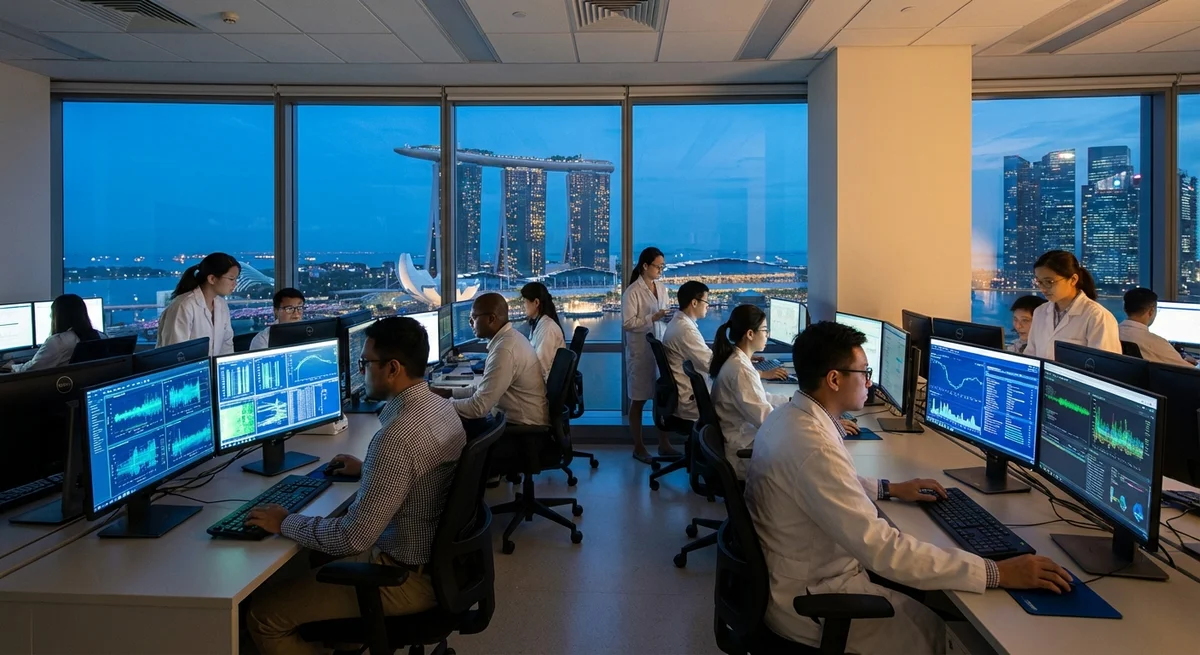
While Silicon Valley and Beijing argue over whose chatbot is bigger, a small but highly ambitious state on the equator has decided it is time to get out the checkbook. Singapore has officially announced its intention to invest more than 1 billion Singapore dollars (about 786 million US dollars) in building its own artificial intelligence ecosystem over the next five years. If you thought this city-state would stop at convenient taxes and futuristic gardens, Josephine Teo, Minister for Digital Development and Information, is ready to change your mind. The authorities understand that in the new reality, the status of a financial hub means nothing without a strong technological backbone.
Why does a country where everything already runs like a Swiss watch need this? The answer lies in a fashionable but critically important term: sovereign AI. In a world where access to NVIDIA hardware and OpenAI's proprietary algorithms is becoming a matter of national security, Singapore does not want to depend on the mood of overseas giants or on political winds.
The money will go not just to buying GPUs at industrial scale, but to building full-fledged research centers and, far more important, to developing homegrown talent. After all, what is the point of huge compute clusters if nobody is there to run them? The government plans to literally "vacuum up" the best minds in the region, offering conditions that are hard to turn down.
Singapore has flirted with high tech for a long time, but the current tranche is a key part of the updated National AI Strategy 2.0. The country's leadership has realized that the era of simply consuming other people's tools is over. Now it must either build its own or accept the role of a digital colony that pays rent on every API request. Most of the investment is directed at supporting public-sector research, which looks like an attempt to lay a solid foundation on which local tech unicorns can grow in the future.
What is interesting is how Singapore sets its priorities. Instead of trying to outdo GPT-4 at writing dubious poetry or generating pictures of cats, it focuses on deep practical applications: from optimizing the port's extremely complex logistics to personalized healthcare. With severely limited human resources, automation for Singapore is not a whim or a way to save on salaries, but the only way to avoid vanishing from the map of global leaders. If you cannot physically grow the population, all that is left is to grow the number of "digital hands" and brains.
Of course, 800 million dollars over five years is not the kind of sum Microsoft or Google deal in, whose R&D budgets exceed the GDP of some countries. Still, for a territory the size of half of Saint Petersburg, it is a colossal commitment. Singapore is betting on surgical precision and targeted strikes in critical areas. It is creating an environment where startups can get direct access to government data and compute without selling their souls to venture capitalists at the earliest stages. That makes a unique incubator in which science and business are tightly interwoven.
What does this mean for the rest of the world, and for the rest of us? Most likely, we will see the birth of a powerful new hub that will bridge Western technology and the fast-growing Asian market. Singapore has always been masterful at sitting on two chairs, profiting from neutrality, and AI will be no exception. While the US and China build digital barriers and impose chip sanctions, Singapore is building open centers of expertise. It is a great opportunity for developers and researchers who feel cramped by rigid regulation or the unwieldy corporate bureaucracy of Western companies.
The bottom line: Singapore has finally stopped playing catch-up and started building its own digital sovereignty. Is a billion enough to compete with OpenAI on equal terms? Unlikely. But to become an indispensable node in the global neural-network web and secure a comfortable future in the age of algorithms? Quite enough. It seems we will soon hear about large language models with a distinctive Singaporean accent.
- Nov 2, 2026Arca gives AI agents finance tasks lasting up to 10 days, but leaves the trades to humans
- Nov 2, 2026Meta's Muse assistant keeps dossiers on loved ones and gets root on Ubuntu by default
- Nov 1, 2026Local models lose to Opus and Codex: 0.21 on a MacBook versus 1.00 for Codex
- Nov 1, 2026Kimi scores 96.2% on a 1C database analytics test and emerges as a fallback if Claude access is blocked
Test Frontier LLMs & Autonomous Agents in One Workspace
Run Claude Opus 5.5, GPT-6, Gemini 3.1, and DeepSeek side-by-side in Nomad AI (nomadnet.ai) — unified model routing, deep research, and multimodal workflows under one subscription.
The AI world, distilled — once a week
Seven stories that actually mattered, hand-picked. No noise, no reposts, no press releases.
Done! Check your inbox for a confirmation.