The Rubik's Cube: A Testing Ground for Intelligence and AI
For half a century, the Rubik's Cube has served as a metaphor for complex systems. Since the 1980s, AI researchers have used it as a formalized discrete world for algorithms and machine learning. This piece traces how Rubik's Cube research has evolved.
AI-processed from Habr AI; edited by Hamidun News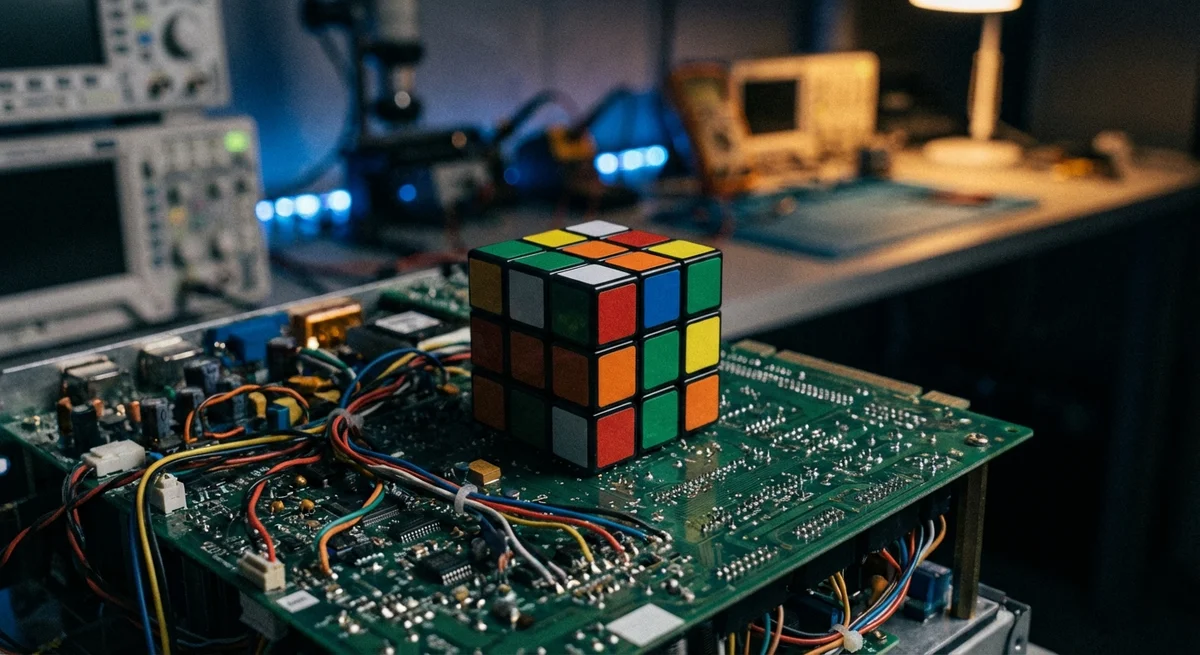
The Rubik's Cube has long outgrown its role as a puzzle. It has become a universal metaphor for complex systems, standing in for challenges in politics, management, and even our understanding of human intelligence. For more than half a century, it has symbolized problems that demand analysis, patience, and systems thinking. Few people realize, though, how much this toy has influenced the development of artificial intelligence.
AI pioneers took notice of the Rubik's Cube almost as soon as it appeared. In the early 1980s, mathematicians and programmers saw it as an ideal formalized discrete world, with strict rules and an enormous search space. Unlike chess or Go, the Rubik's Cube has a finite, if very large, number of states, which makes it an ideal testing ground for developing and evaluating algorithms.
The first computer-generated solutions relied on classical algorithmic approaches. Programmers built heuristic search methods that could find optimal move sequences for solving the puzzle. This early work laid the groundwork for the more sophisticated algorithms now used across many areas of AI.
Machine learning gave the Rubik's Cube a second life. Neural networks proved capable not only of solving the puzzle but also of learning strategies that outperform human ones. Reinforcement learning lets agents explore the state space on their own and find optimal solutions without being explicitly programmed.
The cube's influence on AI extends beyond puzzle-solving algorithms. It has become an important tool for studying the general principles of intelligent behavior. Research in this area helps clarify how to build systems that can learn, adapt, and solve complex problems in fields ranging from robotics to finance.
The Rubik's Cube still inspires researchers today. It remains a relevant testing ground for new AI algorithms and approaches. Growing compute power and new machine learning methods are opening up fresh ways to tackle this classic puzzle. And who knows what discoveries still lie ahead.
In short, the Rubik's Cube is a childhood toy that doubles as a powerful tool for advancing artificial intelligence. Its history shows how a simple problem can drive scientific research and lead to important discoveries that shape the technologies of the future.
- Nov 2, 2026Steering vectors in LLM fine-tuning improved SFT and distillation across three seeds
- Nov 2, 2026EDU-Jev 4B grades student work with 67.6% accuracy, beating commercial APIs by 9.4 points
- Oct 28, 2026Anthropic reveals how it builds Claude with Claude: the brain separate from the hands
- Oct 28, 2026Bayer Launches Multi-Agent Engine on AgentCore: 80% of Questions Handled Without Engineers
Test Frontier LLMs & Autonomous Agents in One Workspace
Run Claude Opus 5.5, GPT-6, Gemini 3.1, and DeepSeek side-by-side in Nomad AI (nomadnet.ai) — unified model routing, deep research, and multimodal workflows under one subscription.
The AI world, distilled — once a week
Seven stories that actually mattered, hand-picked. No noise, no reposts, no press releases.
Done! Check your inbox for a confirmation.