Gemini 4 Argon Teaches Apollo 2 Humanoid to Play Cornhole: 7 Hits in a Row
Google DeepMind has published an internal test of Gemini 4 Argon. The model watched a video of a person playing cornhole, built a virtual scene in MuJoCo, calculated the physics and whole-body control, and handed the result to Apptronik's Apollo 2 humanoid. In the real world, the robot tossed the bags into the target seven times in a row. According to DeepMind, the Video-to-Sim-to-Real pipeline cuts weeks of manual modeling down to a few hours. The test was internal, and there is no independent verification or attempt statistics yet. • Input: a single video of a person. Output: a working policy for a humanoid. • Result: 7 hits in a row on a real robot. • Claimed gain: from weeks to a few hours.
AI-processed from YouTube: Google DeepMind; edited by Hamidun News
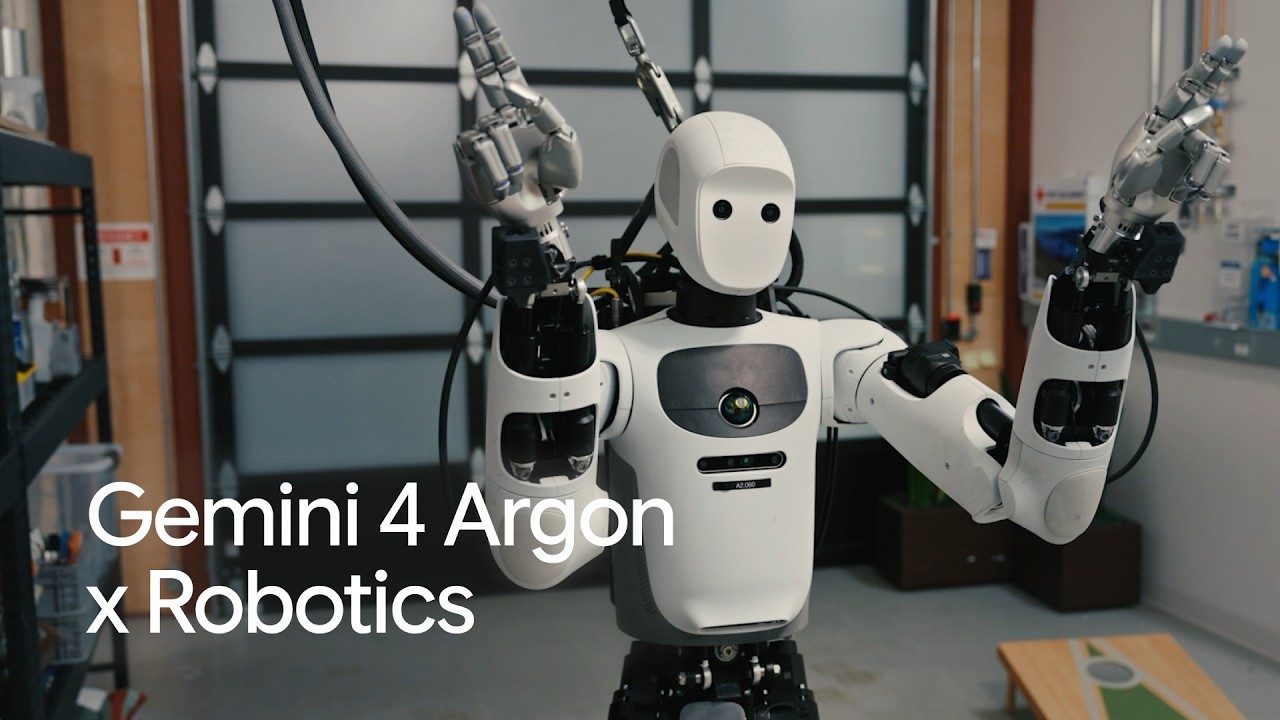
Google DeepMind has shown an internal robotics test of Gemini 4 Argon. The model watched a video of a person playing cornhole and prepared control for Apptronik's Apollo 2 humanoid. In the real world, the robot tossed the bags into the target seven times in a row. DeepMind claims the Video-to-Sim-to-Real pipeline compresses weeks of manual modeling into a few hours.
From Video to Simulation to the Real Floor
Cornhole looks simple: you toss a bag of grain into a hole in an inclined board. For a humanoid, it combines several tasks at once. The robot has to grasp the bag, shift its weight, choose a trajectory, and release the object at exactly the right moment. A mistake at any stage sends the throw wide.
According to DeepMind's description, the chain works like this. Researchers give Gemini 4 Argon a video of a player. The model draws on its video understanding and advanced reasoning to build a virtual scene in the MuJoCo physics engine. It then calculates the physics of the throw and the control parameters for the whole body. The finished solution is transferred to Apollo 2 in the real world.
The key element here is not the throw itself but the step in the middle. Previously, a team of engineers built such a simulation by hand: taking measurements, modeling objects, tuning contact parameters. DeepMind says this now takes a few hours.
What the Numbers Say
- Model: Gemini 4 Argon.
- Robot: Apollo 2 humanoid made by Apptronik.
- Simulator: MuJoCo.
- Input data: a video of a person playing cornhole.
- Real-world result: seven hits in a row.
- Claimed time savings: from weeks of manual modeling to a few hours.
- Test format: internal, conducted by DeepMind researchers.
What Is Left Off Camera
The video's description leaves many questions open. DeepMind does not state the distance to the board or the size of the target. It is unknown how many attempts preceded the seven-throw streak, or whether a human took part in calibration. It is not disclosed what exactly the model outputs: controller code, trajectories, or policy parameters. It is also unclear how the gap between simulation and reality, the main problem of the sim-to-real approach, was closed.
A streak of seven hits looks good on video but does not replace statistics. A proper evaluation needs a success rate over a long sample, variance across conditions, and behavior when the bag or the lighting changes. There is no independent verification yet.
Still, the direction is clear. The main bottleneck in physical AI today lies in data and training environments. Teleoperation is expensive, and building simulations by hand is slow. If a language model with video understanding can really build a working physical scene from an ordinary clip, then any video on the internet becomes a potential training environment. The question shifts from "where do we get data" to "how accurately does the model reconstruct the physics."
What Teams Should Do
Roboticists should review their own development cycle and see where the time goes: data collection, scene modeling, or transfer to the real world. If most of the cost is in modeling, the video-to-simulation approach is worth testing on your own tasks. MuJoCo is open, and you can try reconstructing scenes from video right now with available multimodal models, without waiting for partner access to Gemini 4 Argon.
Such systems should be judged on repeatability across a long series of runs, not on the best run. For those following the humanoid market, two things are worth watching: whether DeepMind and Apptronik publish metrics, and whether the pipeline opens to outside developers. For now, this is a strong demonstration, but not a product.
Access Frontier LLMs & Multimodal AI in One Workspace
Discover NomadNet AI (nomadnet.ai) — unified access to frontier language models, research synthesis, and multimodal workflows.
The AI world, distilled — once a week
Seven stories that actually mattered, hand-picked. No noise, no reposts, no press releases.
Done! Check your inbox for a confirmation.