DeepLearning.AI and Qdrant Release a Free Course on AI Assistants with On-Device Memory
DeepLearning.AI has published a course called Building AI Assistants with On-Device Memory. It was built with Qdrant and is taught by Dylan Couzon. The core idea: the assistant runs without a network connection and without a remote server, and all of its memory is stored on the device. Enrollment is free. The description lists no syllabus, no duration and no hardware requirements, so it is too early to judge how deep the material goes. The topic is practical, though: agents accumulate more and more personal data, and where that data lives is becoming an architectural question. • The course is free • Partner: Qdrant • Memory stays on the device
AI-processed from YouTube: DeepLearningAI; edited by Hamidun News
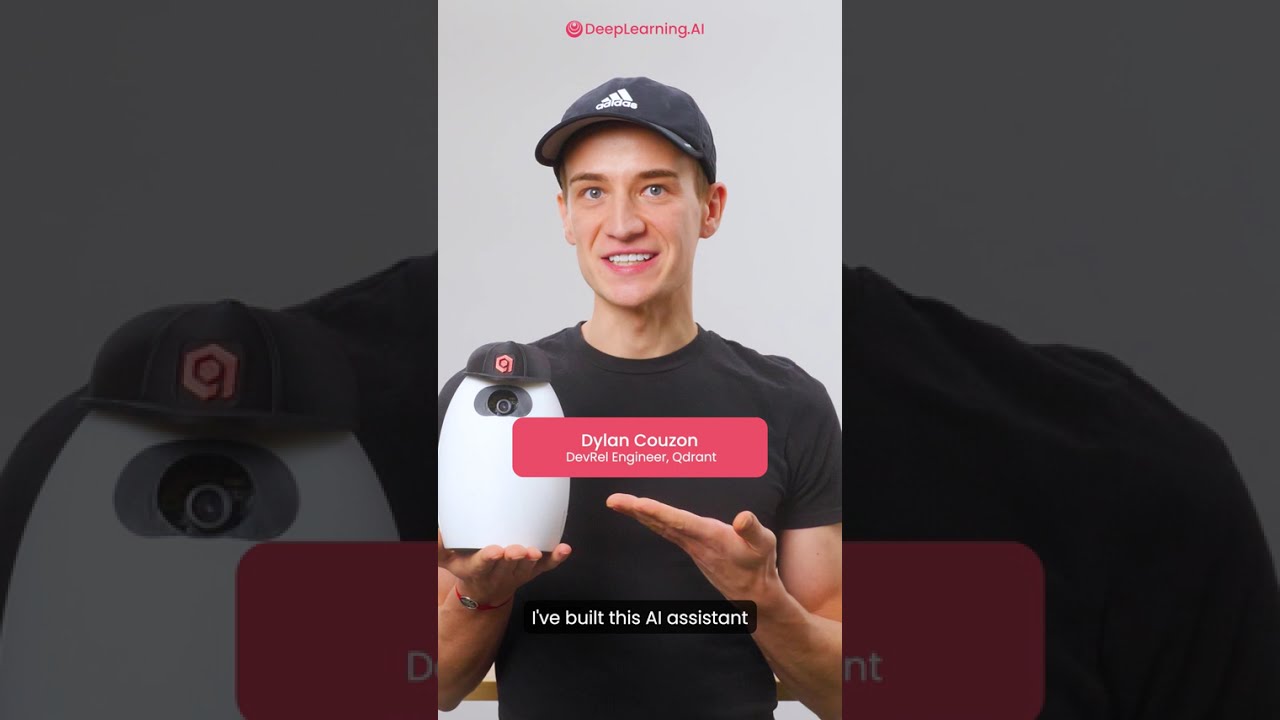
DeepLearning.AI has released a short course, Building AI Assistants with On-Device Memory. It was prepared jointly with Qdrant, it is taught by Dylan Couzon, and enrollment is free. The promise is stated bluntly: zero network connections, zero remote servers, and the assistant's memory never leaves the device.
The announcement is very terse. It reads more like a topic pitch than a detailed syllabus, so below we cover what is known for certain first, then the context that explains why such a course is needed.
What we know about the course
The format is standard for DeepLearning.AI: a hands-on mini-course from Andrew Ng's platform with an industry partner. Here the partner is Qdrant, the developer of an open-source vector database. Databases of this type store embeddings, meaning numerical representations of text, and quickly find the ones closest in meaning. For an assistant, this is the basis of long-term memory: past conversations, notes and documents are turned into vectors, and when a new query arrives, the relevant fragments are retrieved from them.
The key condition of the course is that this entire loop runs locally. The course is free, and judging by the hashtags on the video, the topic is framed around agents and learning from scratch.
Specs from the description:
- Title: Building AI Assistants with On-Device Memory
- Organizer: DeepLearning.AI
- Partner: Qdrant
- Instructor: Dylan Couzon
- Price: free
- Network and remote server: not required
- Where memory is stored: on the device only
Why local memory has become an engineering problem of its own
As long as an assistant answered one-off questions, memory was optional. Agents are different. They run projects, remember preferences, and read email and files, and over time the storage builds up a portrait of its owner. If that storage is in the cloud, developers immediately face questions about privacy, legal requirements, request latency and the infrastructure bill. Offline scenarios such as an airplane, a warehouse or a closed perimeter are not covered by cloud memory at all.
A local setup removes some of these problems but creates others. A typical stack looks like this: a small language model, a local embedding model, an embedded vector index, and a layer that decides what to write and what to retrieve. All of it runs into limits on RAM, disk and power consumption. That is why such systems usually require thinking about vector quantization, index size and a forgetting policy. This is the industry's general pattern, not the course content: the announcement does not reveal the syllabus.
Qdrant has its own interest in this niche. The company is known for its server-side engine, and embedded and edge scenarios are a logical extension for it. A course with this partner will likely show how to fit its tool into a local agent. That is an assumption, not a stated fact.
What the description leaves out
There is no duration, no lesson list and no list of models. It does not say what hardware the course was built on and runs on: a laptop, a smartphone or a single-board computer. It does not say how quality is handled: small local models are noticeably weaker than cloud ones, and memory without good retrieval turns into a warehouse from which nothing can be pulled out. Whether the learner ends up with a working prototype or a demonstration of the idea depends on the answers to these questions.
Where a developer should start
Before enrolling, decide why you need locality. If the requirement is strict, as in medicine, law or corporate data, the course is worth completing in full, and you should test the example on your own hardware right away. If privacy is merely desirable, it is enough to watch the first lessons and judge how well the approach carries over to your stack.
After finishing, it is worth measuring three things: the memory footprint as the database grows to tens of thousands of records, search time on the weakest target device, and answer quality with and without memory. These numbers will show whether abandoning the cloud is justified. The course is free, so entry costs nothing. The only costs here are time and an honest test on real hardware.
Delegate Deep Research, Coding & Workflows to an AI Agent
Deploy autonomous multi-step execution with NomadNet Agent (agent.nomadnet.ai) — automated web research, data synthesis, code generation, and complex task orchestration.
The AI world, distilled — once a week
Seven stories that actually mattered, hand-picked. No noise, no reposts, no press releases.
Done! Check your inbox for a confirmation.