MIT Technology Review: 2026 was the year of AI platforms, not standalone models
MIT Technology Review held the EmTech AI 2026 conference, where the central theme was a change of era: the AI industry is no longer competing through standalone language models and is moving toward building ecosystems. In the new race, the winner is not the best benchmark but the depth of integration into the corporate stack and high vendor switching costs. MIT TR called this platform shift the main trend of 2026.
AI-processed from MIT Technology Review; edited by Hamidun News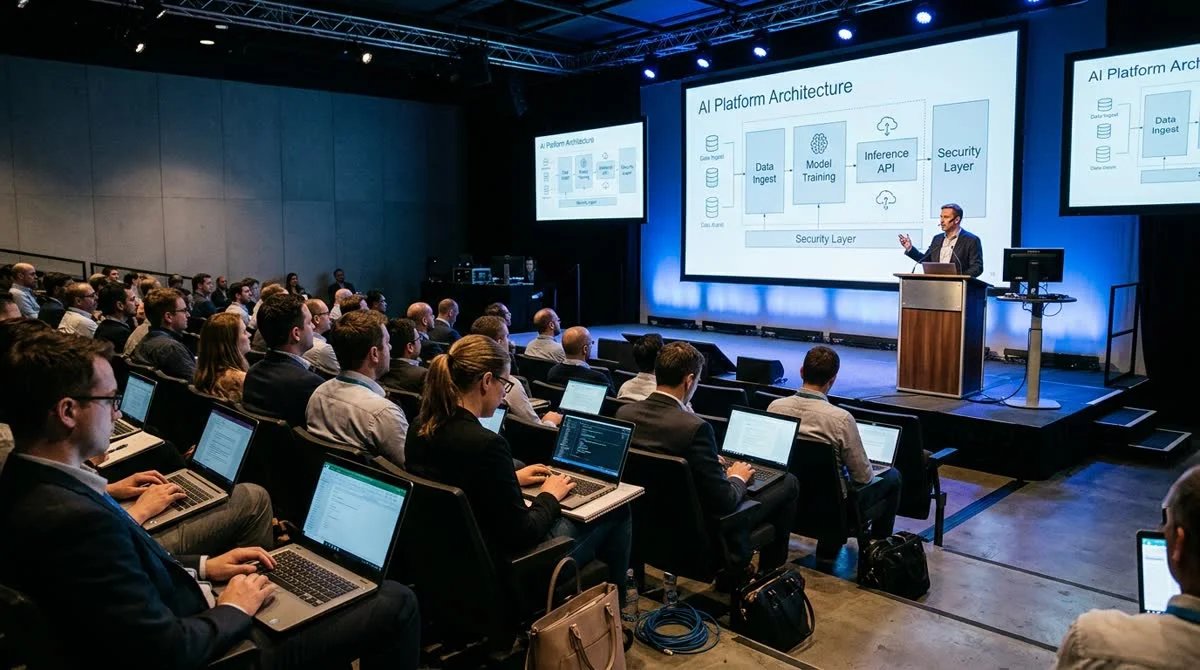
MIT Technology Review on July 8, 2026 opened a key chapter of the annual EmTech AI 2026 conference — "The Rise of AI Platforms." This is a signal from one of the world's leading tech media outlets: the center of gravity in the AI industry has shifted — companies no longer compete with individual language models, they build ecosystems.
Why Platform Replaces Model
In 2023–2024, the AI market developed along a clear logic: OpenAI released GPT-4o, Google released Gemini, Anthropic released Claude 3. Customers compared models by benchmarks — who translates more accurately, writes code better, hallucinates less. The choice was determined by answer quality and token cost.
By 2026, this competition did not disappear, but ceased to be the determining factor. A customer who once embedded an AI tool in their work stack — corporate email, CRM, code editor, document management — very rarely changes it. The cost of switching becomes prohibitively high as soon as AI penetrates multiple workflows simultaneously. This is the main competitive variable of 2026.
An AI platform is an integration layer that combines language models of various sizes, agentic task execution, long-term corporate memory, access control, and developer tools into a single product. The difference between a model and a platform is roughly the same as between a standalone application and an operating system: in the long term, the most entrenched ecosystem wins, not the best component.
The indicative difference is already visible today: a company working with a language model through an API can switch vendors in a few days. A company that has fully transitioned to an AI platform with corporate memory, custom agents, and deep integrations — cannot. It is precisely this asymmetry that the largest players monetize.
How the Balance of Power Changes
The transition to platform logic puts players in fundamentally different positions — depending on how deeply they are already embedded in the corporate stack.
Cloud giants — Microsoft, Google, Amazon — are in a privileged position: AI is embedded in products with multimillion-user bases. Microsoft Copilot lives in Office and Teams, Google Gemini lives in Workspace, AWS Bedrock and Azure AI live in the cloud infrastructure of thousands of companies. For them, an AI platform is an organic upsell to already loyal customers, requiring no additional customer acquisition.
AI labs are forced to build their own platform products to avoid becoming API suppliers for larger players. OpenAI expands its ecosystem with Operator and Projects products, Anthropic develops its enterprise direction with access management and team memory, Google DeepMind monetizes Gemini through direct B2B integrations.
Startups face a strategic crossroads: build a vertical platform for a specific industry — medicine, law, finance — or embed themselves in others' ecosystems as a specialized layer, accepting dependence on solutions from a larger player.
What the Conference Says About the Industry
EmTech AI conference is MIT Technology Review's annual flagship forum, which traditionally brings together researchers, investors, and corporate leaders. MIT TR's editorial team does not set trends — it reflects existing consensus. If the main chapter of 2026 is titled "The Rise of AI Platforms," this means the platform shift is already being recorded at the level of data and real corporate budgets, not forecasts.
For corporate buyers, this is a practical signal: choosing an AI vendor in 2026 is a strategic decision for several years ahead. You need to evaluate not the accuracy of a specific model today, but the sustainability of the ecosystem in the long term: API compatibility, product roadmap, and exit conditions.
What It Means
The AI race of 2026 is platform-based, not model-based. The winner is not the one with the best benchmark, but the one most deeply embedded in the workflow, accumulating corporate context and more expensive to replace. Companies that understand this logic now will choose AI partners strategically — and will not become hostages to hasty integrations a year from now.
Want to stop reading about AI and start using it?
AI News is a curated feed of AI/tech news. Hamidun Academy teaches you to use AI systematically in your work.
The AI world, distilled — once a week
Seven stories that actually mattered, hand-picked. No noise, no reposts, no press releases.
Done! Check your inbox for a confirmation.