LingBot-Vision: Ant Group's Free Vision Model
Robbyant, Ant Group's robotics unit, has open-sourced LingBot-Vision, a family of ViT models for dense spatial perception. The core idea: masked boundary modeling turns object contours into a native training signal, with no manual labeling. The 1B-parameter backbone outperforms larger models and serves as the foundation for LingBot-Depth 2.0.
AI-processed from MarkTechPost; edited by Hamidun News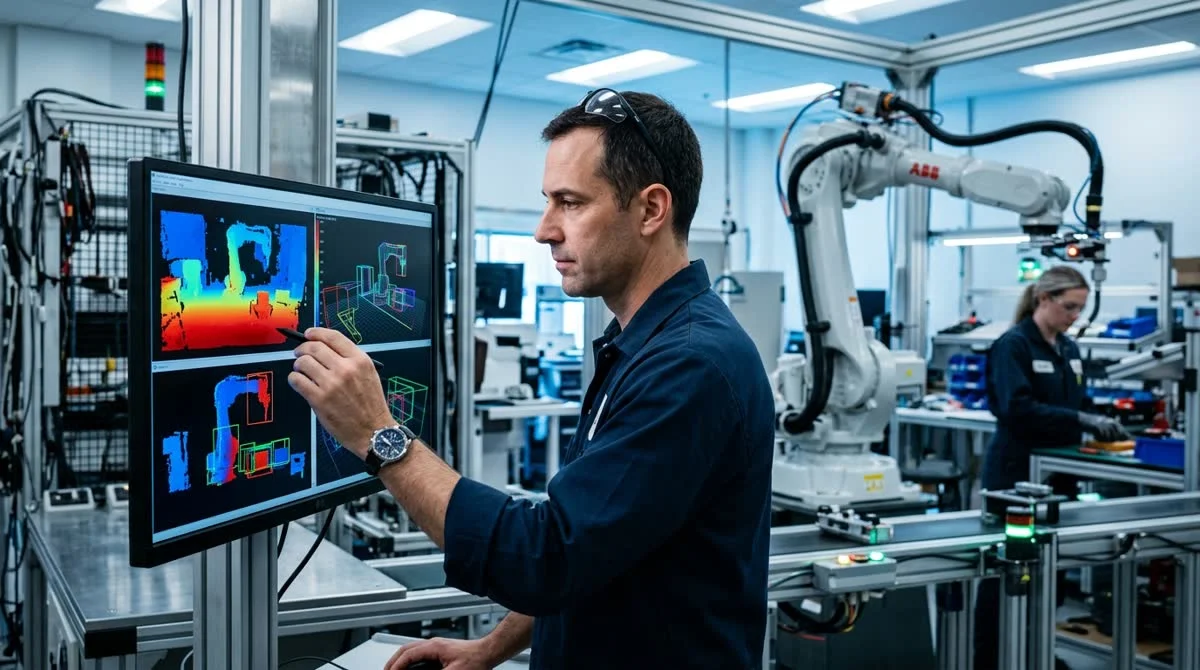
Ant Group has released LingBot-Vision for free: an open-source family of 1B-parameter vision models for spatial perception in robotics.
What masked boundary modeling is
In classic masked autoencoder approaches, the training signal comes from hidden pixel patches: the model reconstructs masked regions of an image and builds a general understanding of visual content. LingBot-Vision switches the signal: the prediction target is object boundaries themselves.
The idea rests on a simple observation: contours between objects carry dense spatial information, such as where an object ends, how the scene's geometry is organized and what shape the surfaces have. The model learns to recognize and reconstruct exactly these contours. For robotic systems this type of knowledge is critical: a robot needs not merely to recognize that a table is in front of it, but to understand precisely where the table begins and ends in space.
The method is fully self-supervised: no manual labeling is required. The model extracts the training signal directly from image structure, which makes data preparation fundamentally cheaper than with supervised approaches.
Why a 1B model beats larger ones
Robbyant's key result: on dense spatial perception tasks, the 1B LingBot-Vision backbone matches or outperforms larger models. It is notable that this is a ViT architecture: Vision Transformer backbones typically benefit from scaling, so strong results at 1 billion parameters point above all to the efficiency of the training signal itself.
Key characteristics of the model:
- Parameters: 1 billion (1B ViT backbone)
- Training method: masked boundary modeling without manual labeling
- Target task: dense spatial perception
- Role in the ecosystem: initialization for LingBot-Depth 2.0
- Open release date: July 7, 2026
Dense spatial perception covers depth estimation, understanding of surface geometry and precise detection of objects in three-dimensional space, which is where boundary information gives the biggest gain. LingBot-Vision also provides the base weights for LingBot-Depth 2.0, a depth perception system from the same Robbyant ecosystem. That points to a systematic approach: Ant Group is steadily building an interconnected stack of vision components for robotics applications.
Open code to grow a niche
Ant Group is a fintech giant, the parent company of Alipay and one of China's largest technology players. Robbyant is its division focused on robotic systems and AI for the physical world.
The open release of LingBot-Vision fits a visible strategy among major Chinese AI labs: publish competitive models openly and shape standards in targeted niches. Releasing code and weights lowers the barrier to entry for teams working on robotic perception, industrial computer vision and autonomous systems. The masked boundary modeling approach is also open to adaptation: researchers can experiment with other types of structural signals on top of the same architectural base.
What this means
LingBot-Vision shows that in spatial perception tasks, the right training signal matters more than model scale. For engineers and researchers working on 3D perception and robotics, it is a ready-made open-source foundation that avoids costly data labeling. Masked boundary modeling is also promising in its own right: it opens the door to experiments with types of structural information extracted from images without labels.
- Nov 1, 2026Google's StreamVibe video agent beats other models by 10.7% on response timing and quality
- Nov 1, 2026New test catches hidden AI agent collusion by measuring how a partner reacts to a paraphrase
- Nov 1, 2026Illinois compiled 12 151 open problems and tested whether AI can solve them
- Oct 31, 2026AI engineer writes a single reward function for agent teams: win rate climbs from 51% to 90%
Key Questions Answered
What masked boundary modeling is?
In classic masked autoencoder approaches, the training signal comes from hidden pixel patches: the model reconstructs masked regions of an image and builds a general understanding of visual content. LingBot-Vision switches the signal: the prediction target is object boundaries themselves. The idea rests on a simple observation: contours between objects carry dense spatial information, such as where an object ends, how the scene's geometry is organized and what shape the surfaces have. The model learns to recognize and reconstruct exactly these contours. For robotic systems
Why a 1B model beats larger ones?
Robbyant's key result: on dense spatial perception tasks, the 1B LingBot-Vision backbone matches or outperforms larger models. It is notable that this is a ViT architecture: Vision Transformer backbones typically benefit from scaling, so strong results at 1 billion parameters point above all to the efficiency of the training signal itself. Key characteristics of the model: Parameters: 1 billion (1B ViT backbone) Training method: masked boundary modeling without manual labeling Target task: dense spatial perception Role in the ecosystem: initialization for LingBot-Depth 2.0
What are the key details on Open code to grow a niche?
Ant Group is a fintech giant, the parent company of Alipay and one of China's largest technology players. Robbyant is its division focused on robotic systems and AI for the physical world. The open release of LingBot-Vision fits a visible strategy among major Chinese AI labs: publish competitive models openly and shape standards in targeted niches. Releasing code and weights lowers the barrier to entry for teams working on robotic perception, industrial computer vision and autonomous systems. The masked boundary modeling approach is also open to adaptation: researchers can
Test Frontier LLMs & Autonomous Agents in One Workspace
Run Claude Opus 5.5, GPT-6, Gemini 3.1, and DeepSeek side-by-side in Nomad AI (nomadnet.ai) — unified model routing, deep research, and multimodal workflows under one subscription.
The AI world, distilled — once a week
Seven stories that actually mattered, hand-picked. No noise, no reposts, no press releases.
Done! Check your inbox for a confirmation.