Perplexity Becomes One of the First AI Companies to Adopt Nvidia's New Vera Processor
Perplexity AI is one of the first major AI companies to commit to building on Nvidia's new Vera processor. It plans to run agentic workloads on the chip. Vera is Nvidia's first general-purpose CPU of its own, taking the company beyond the GPU accelerators that made it the world's most valuable public company. The move signals that Nvidia is serious about the server CPU market, long controlled by Intel and AMD.
AI-processed from TNW; edited by Hamidun News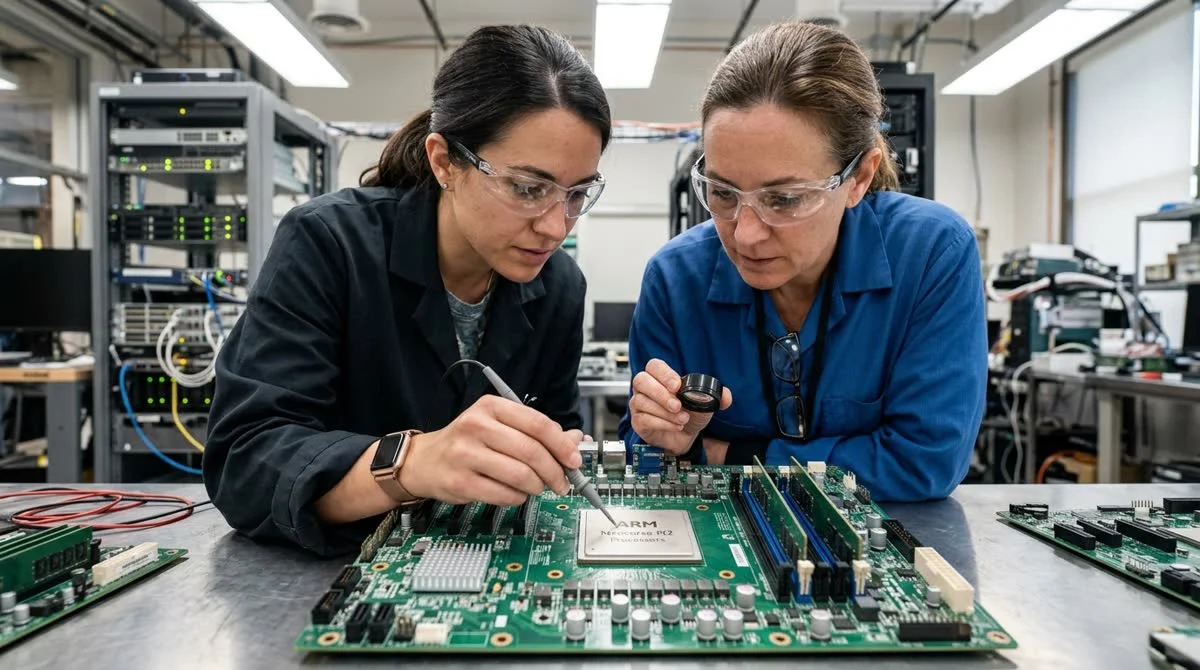
Perplexity AI has joined the first wave of major AI companies to publicly confirm plans to build on Nvidia's new Vera processor, a general-purpose CPU the chipmaker hopes will carry it beyond the GPU accelerator market that made Nvidia the world's most valuable public company. Perplexity intends to use Vera to run agentic workloads.
What is the Nvidia Vera processor
Vera is Nvidia's first in-house general-purpose CPU, built on the ARM architecture. Until now, Nvidia has dominated almost exclusively through GPUs and specialized AI accelerators: the H100 series and its successors turned the company into the main supplier of compute for OpenAI, Google, Microsoft and hundreds of AI startups. At its peak, Nvidia's market capitalization exceeded $3 trillion, making it the most valuable company in the world.
Vera shifts that direction. It is not an accelerator for matrix operations but a processor for the control layer of the infrastructure, which coordinates tasks, manages memory and orchestrates interaction between system components. Architecturally, Vera is part of the Vera Rubin platform, the generation after Blackwell, where the CPU and GPU are designed as a linked stack with a shared API for developers. Nvidia's goal is to move from selling individual accelerators to delivering a unified compute platform.
Why agentic workloads need a different CPU
Perplexity positions itself as a next-generation AI search engine, but strategically it is moving toward agentic systems: scenarios in which the AI does not just generate an answer but runs long, multi-step pipelines. It researches sources, calls external tools and APIs, verifies data and assembles the final result.
Such pipelines differ fundamentally from classic language model inference in their load profile:
- Frequent switching between tasks, a traditional strength of the CPU
- Numerous external API calls and file operations
- Management of call trees and agent memory
- Short GPU spikes on individual inference steps inside a long pipeline
A CPU optimized for AI infrastructure and tightly integrated with the GPU in a single Nvidia stack offers an architectural advantage here over standard Intel or AMD server chips, which were not originally designed for such scenarios. That is why Perplexity is choosing Vera as the basis of its agentic infrastructure: heavy computation stays on the GPU, orchestration on the CPU.
What this means
Perplexity's appearance among Vera's first backers is a signal that Nvidia is seriously pursuing the server CPU market, which Intel and AMD have controlled until now. Several conclusions follow for the AI industry.
First, leading AI companies are starting to choose chips for a specific workload profile rather than adopting a universal solution. Second, Nvidia gains a tool for locking in customers more deeply by selling a single stack, CPU plus GPU, instead of separate accelerators; this raises switching barriers and increases the average deal size. Third, Intel and AMD now face a competitor with a ready partner network and the CUDA ecosystem.
For Perplexity, it is a public demonstration of technological ambition: the company is building its own AI infrastructure rather than only renting capacity from cloud providers.
- Nov 1, 2026Voice bots built on LLMs turn to Jev, a fast classifier, for decisions in 200–500 ms
- Nov 1, 2026MoneyGate safety layer blocked all 42 fraudulent requests to local AI models
- Oct 31, 202622B-Parameter LTX-2.5 Runs on a 10 GB RTX 3080, but Takes 5 Minutes per Shot
- Oct 30, 2026Mistral opens Large 4 weights: strong at code, but Chinese models score 32 to its 26
Key Questions Answered
What is the Nvidia Vera processor?
Vera is Nvidia's first in-house general-purpose CPU, built on the ARM architecture. Until now, Nvidia has dominated almost exclusively through GPUs and specialized AI accelerators: the H100 series and its successors turned the company into the main supplier of compute for OpenAI, Google, Microsoft and hundreds of AI startups. At its peak, Nvidia's market capitalization exceeded $3 trillion, making it the most valuable company in the world. Vera shifts that direction. It is not an accelerator for matrix operations but a processor for the control layer of the infrastructure,
Why agentic workloads need a different CPU?
Perplexity positions itself as a next-generation AI search engine, but strategically it is moving toward agentic systems: scenarios in which the AI does not just generate an answer but runs long, multi-step pipelines. It researches sources, calls external tools and APIs, verifies data and assembles the final result. Such pipelines differ fundamentally from classic language model inference in their load profile: Frequent switching between tasks, a traditional strength of the CPU Numerous external API calls and file operations Management of call trees and agent memory Short G
What this means?
Perplexity's appearance among Vera's first backers is a signal that Nvidia is seriously pursuing the server CPU market, which Intel and AMD have controlled until now. Several conclusions follow for the AI industry. First, leading AI companies are starting to choose chips for a specific workload profile rather than adopting a universal solution. Second, Nvidia gains a tool for locking in customers more deeply by selling a single stack, CPU plus GPU, instead of separate accelerators; this raises switching barriers and increases the average deal size. Third, Intel and AMD now
Test Frontier LLMs & Autonomous Agents in One Workspace
Run Claude Opus 5.5, GPT-6, Gemini 3.1, and DeepSeek side-by-side in Nomad AI (nomadnet.ai) — unified model routing, deep research, and multimodal workflows under one subscription.
The AI world, distilled — once a week
Seven stories that actually mattered, hand-picked. No noise, no reposts, no press releases.
Done! Check your inbox for a confirmation.