Business AI and the climate: why Google and Amazon are missing their targets
Google and Amazon are officially falling behind their own climate commitments: AI data centers are consuming energy faster than the companies can switch to renewable sources. Meanwhile, Meta is frantically searching for new lines of business, and Americans who say infrastructure is being "forced on them against their will" are already launching recall efforts against local officials. *Meta has been designated an extremist organization and is banned in Russia.
AI-processed from Guardian; edited by Hamidun News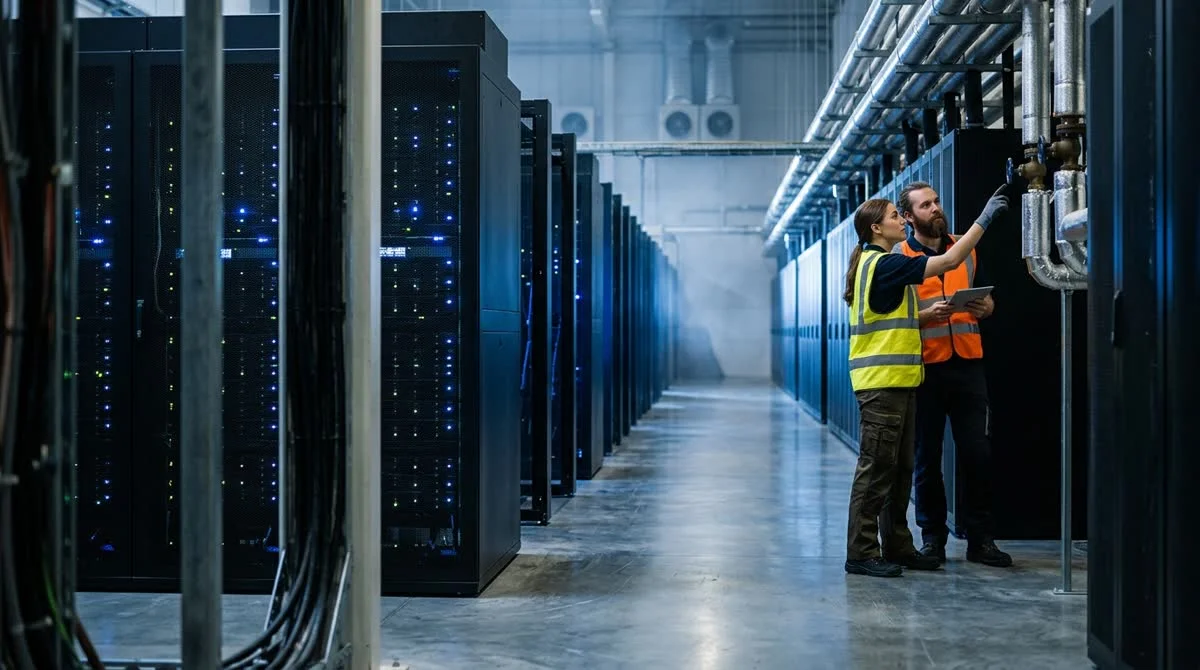
Deploying AI for business demands enormous amounts of electricity: Google and Amazon are officially behind on their own climate targets, because the energy appetite of neural networks makes net-zero pledges unattainable, The Guardian reported on 6 July 2026.
Why net-zero slipped out of reach
In the early 2020s, Google, Amazon and other tech giants publicly committed to reaching carbon neutrality by the mid-2030s. The goals looked realistic when most of the computing load came from search queries, streaming and cloud services.
The race for AI leadership upended their energy balances. Training and running inference on large language models requires thousands of GPU servers working around the clock, and electricity consumption has proved an order of magnitude higher than for traditional cloud operations. The companies cannot expand their share of renewable generation as fast as their computing capacity is growing.
The Guardian states that Google's and Amazon's net-zero commitments have "moved out of reach." A similar story is playing out outside the US: according to the publication, Scotland's flagship AI project, billed as a model of green energy, has no realistic plan for switching to renewables.
Data centers versus local communities
The energy burden is not only a corporate and climate problem but also a source of acute social conflict. In the US, residents of regions where large data centers are being built openly say the facilities are "forced on them against their will" without regard for local opinion.
The protest has taken on a political dimension: Americans are launching recall procedures against local officials who approved the construction of AI infrastructure. Rising electricity rates, strain on the grid and environmental consequences are what residents associate with corporate AI projects. Data centers are no longer seen as neutral infrastructure and are becoming a symbol of the unequal distribution of the benefits and costs of technological progress.
What is happening at Meta
Alongside the climate crisis, The Guardian reports on Meta's strategic scramble: the company is searching "frantically" for new lines of business. Details have not been disclosed publicly, but describing the situation as "frantic moves" points to serious pressure on its core business model.
Meta is in a particularly difficult position: its advertising model faces competitive pressure, regulatory risks are growing, and its bet on the metaverse has not yet lived up to expectations. The AI bet has become a requirement for staying competitive, and at the same time a source of new environmental and reputational risks.
Meta is not an exception. The entire Big Tech sector faces an equation with incompatible variables: aggressive AI scaling and meeting ESG commitments cannot be reconciled without fundamentally new energy solutions.
What this means
AI has become a structural climate risk for the tech sector. The faster companies expand their computing infrastructure, the further their carbon-neutrality promises recede. Investors, regulators and ordinary citizens have already noticed the contradiction, and the latter are starting to turn their discontent into direct political action. The industry needs either fundamentally different energy solutions or an honest revision of its climate commitments.
*Meta has been designated an extremist organization and is banned in Russia.
Why does business AI get in the way of climate goals?
Deploying neural networks requires enormous amounts of electricity, which contradicts pledges to reach net-zero emissions by the stated deadlines.
- Nov 1, 202616 models tested on 7 search tools: Exa averaged 10.5 out of 14, SearXNG about 3
- Nov 1, 2026Google's StreamVibe video agent beats other models by 10.7% on response timing and quality
- Nov 1, 2026OpenAI Rewrites GPT Behavior Rules: Five Values and a Chain of Command
- Nov 1, 2026Voice bots built on LLMs turn to Jev, a fast classifier, for decisions in 200–500 ms
Key Questions Answered
Why does business AI get in the way of climate goals?
Deploying neural networks requires enormous amounts of electricity, which contradicts pledges to reach net-zero emissions by the stated deadlines.
Why net-zero slipped out of reach?
In the early 2020s, Google, Amazon and other tech giants publicly committed to reaching carbon neutrality by the mid-2030s. The goals looked realistic when most of the computing load came from search queries, streaming and cloud services. The race for AI leadership upended their energy balances. Training and running inference on large language models requires thousands of GPU servers working around the clock, and electricity consumption has proved an order of magnitude higher than for traditional cloud operations. The companies cannot expand their share of renewable generat
What are the key details on Data centers versus local communities?
The energy burden is not only a corporate and climate problem but also a source of acute social conflict. In the US, residents of regions where large data centers are being built openly say the facilities are "forced on them against their will" without regard for local opinion. The protest has taken on a political dimension: Americans are launching recall procedures against local officials who approved the construction of AI infrastructure. Rising electricity rates, strain on the grid and environmental consequences are what residents associate with corporate AI projects. Da
Test Frontier LLMs & Autonomous Agents in One Workspace
Run Claude Opus 5.5, GPT-6, Gemini 3.1, and DeepSeek side-by-side in Nomad AI (nomadnet.ai) — unified model routing, deep research, and multimodal workflows under one subscription.
The AI world, distilled — once a week
Seven stories that actually mattered, hand-picked. No noise, no reposts, no press releases.
Done! Check your inbox for a confirmation.