Guardian: Britain's AI data center plans 'complete nonsense,' Scottish project questioned
Guardian journalists investigated Britain's 'AI growth zones' — data centers with 500+ MW capacity each. Finding: renewable energy commitments for the Scottish Lanarkshire project are unrealistic by 2030. Local residents call it 'smoke and mirrors,' while publication sources call the entire scheme 'complete nonsense.'
AI-processed from Guardian; edited by Hamidun News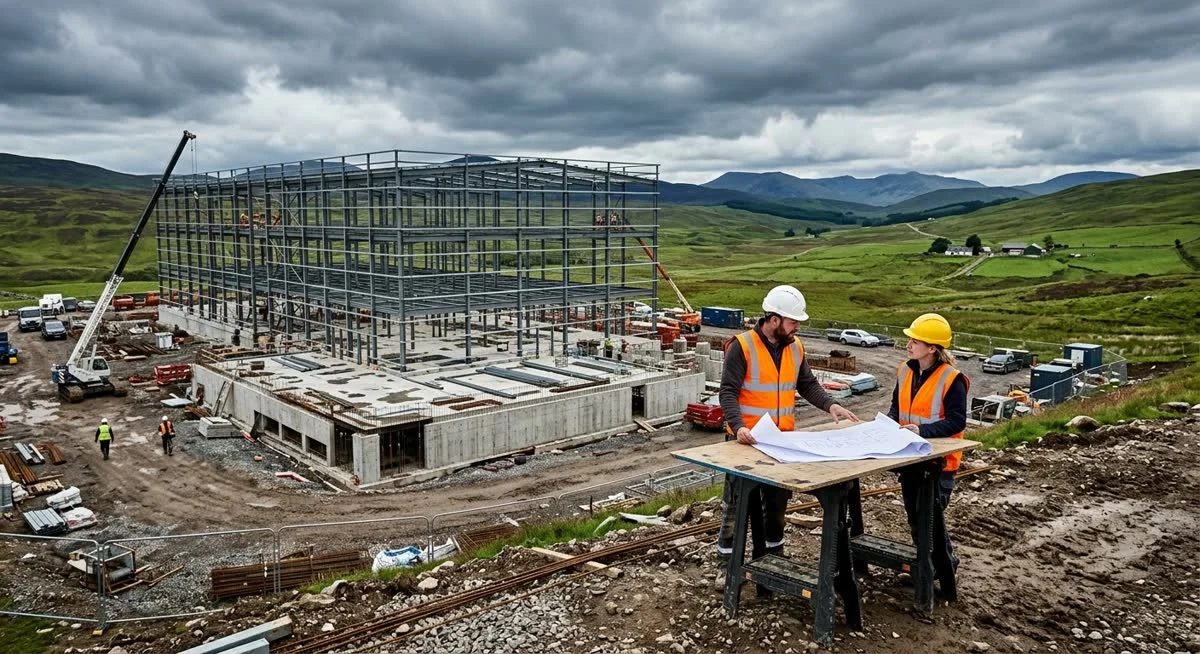
The British Government is pushing forward with an "AI Growth Zones" program—special regions where authorities help private companies build next-generation data centers with capacity exceeding 500 MW. An investigation by Guardian, published on July 6, 2026, found that behind grand announcements lie unrealistic promises, and one of the key projects—in Lanarkshire, Scotland—has no chance of meeting its commitments by 2030. One source characterized the government's calculations as "complete nonsense."
What are AI Growth Zones?
The AI Growth Zones program is part of Britain's strategy to secure a leading position in the global race for AI infrastructure. The government selects regions, provides tax breaks and administrative support, while private investors build giant data centers. The minimum threshold is 500 MW of installed capacity, which exceeds the capabilities of any operating facility in Britain.
- Minimum facility capacity—500 MW (exceeding any operating data center in the country)
- Funding—private companies with state support in site selection
- Declared power source—renewable energy
- Promised impact—thousands of jobs in regions
- First major project—Lanarkshire, Scotland
The program is designed as a response to the global data center race being led by the US, UAE, and EU countries. Britain wants to attract investment from major AI companies by offering ready-made infrastructure and regulatory incentives.
Why did the Scottish project raise concerns?
Guardian focused on the flagship project in Lanarkshire—one of the first regions included in the program. Journalists found that the data center has no realistic prospect of fulfilling the promise to operate on renewable energy by 2030. The thousands of jobs publicly promised to residents, according to the publication's assessment, will also not materialize within the stated timeframe.
Residents of the village selected for construction are already disappointed. Guardian documented that initial hopes for economic revival have given way to anxiety and distrust of official statements.
"Smoke and mirrors," is how local residents characterized what is happening, according to
Guardian's July 5, 2026 report.
Where does the program's logic break down?
A 500+ MW data center is a colossal consumer of electricity. Connecting to renewable sources within reasonable timeframes in Britain is extremely difficult: the queue for grid connection stretches for years. Network capacity is limited, and building such a large consumer requires years of infrastructure expansion work.
Guardian points out that the problem is systemic and not limited to Lanarkshire: similar contradictions between promises and implementation are found throughout the program.
"At best—vague, at worst—complete nonsense," is how an unnamed
Guardian source described the logic of the government's plans.
What does this mean
Guardian's investigation calls into question the entire strategic logic of Britain's AI infrastructure policy. The AI Growth Zones program currently looks more like political marketing than an achievable industrial plan. If the government does not reconsider the realism of timelines and does not offer a concrete roadmap for power supply, the country's most ambitious data centers risk remaining on paper.
Need AI working inside your business — not just in your newsfeed?
I build production AI for companies — custom CRM, internal tools, autonomous agents, workflow automation. Owned by you, shaped to your process, no per-seat tax. Built by Zhemal Khamidun, CPO of AlpinaGPT (AI platform, 6,000+ users).
The AI world, distilled — once a week
Seven stories that actually mattered, hand-picked. No noise, no reposts, no press releases.
Done! Check your inbox for a confirmation.