MAI Builds an Autonomous Loader Robot That Makes Decisions Without Human Input
The Moscow Aviation Institute (MAI) has developed an autonomous loader robot for digital factories. Unlike standard AGVs, which follow rails or floor markings, it navigates space freely and decides on its own which route to take, with no operator involved. The developers summed up the principle this way: "Not like a tram on rails."
AI-processed from CNews AI; edited by Hamidun News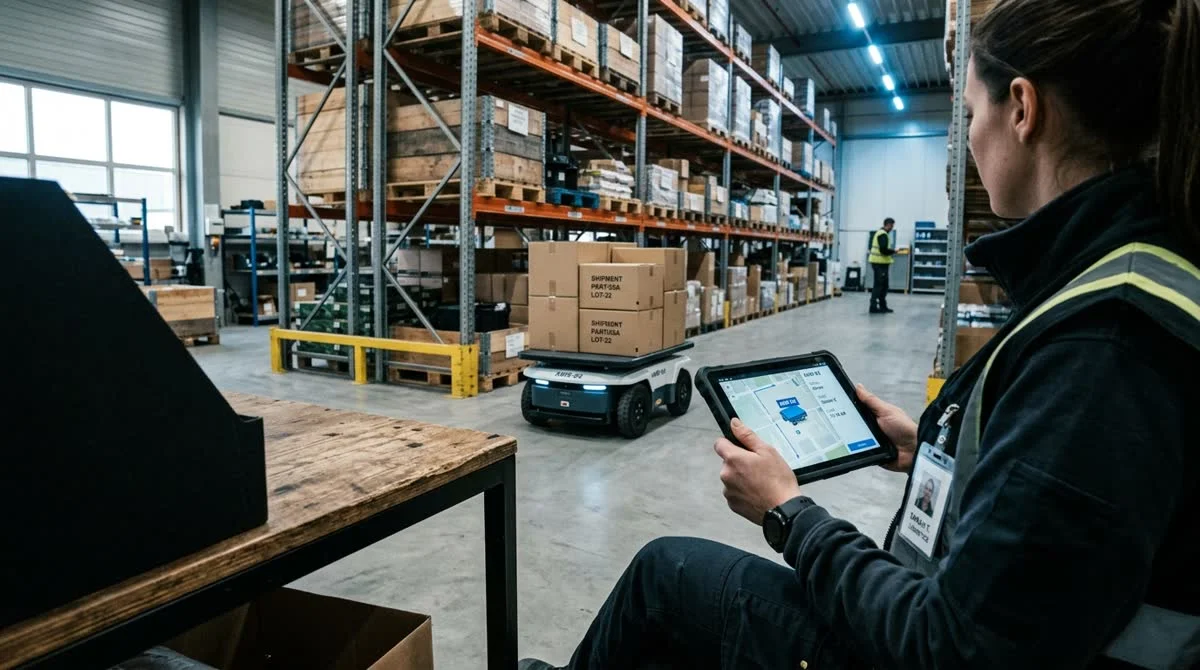
On 2 July 2026, the Moscow Aviation Institute (MAI) unveiled a prototype of an autonomous loader robot designed for "digital factories." The machine works without human involvement: it moves around the production floor on its own, plans routes and decides how to optimize them in real time.
How this robot differs from conventional AGVs
Automated guided vehicles (AGVs) have long been the standard in warehouse automation. Their operating principle is simple: the cart follows a magnetic strip, rails or a pre-marked floor and does not deviate from its set route. Any obstacle means a stop: the cart waits for an operator.
MAI's developers described the fundamental difference in a few words: "Not like a tram on rails." The robot navigates dynamically. It uses sensors to build a map of the space as it moves, picks the best route itself and rebuilds it when an obstacle appears, without waiting for an operator's command.
This class of systems is called AMR, or Autonomous Mobile Robot. Unlike AGVs, AMRs need no floor infrastructure: no rails, magnetic strips or QR markers. If the shop-floor layout changes, there is no need to stop production to re-mark it; updating the map in software is enough.
How autonomous navigation works
Most modern AMRs use SLAM (Simultaneous Localization and Mapping). A combination of lidars, video cameras and ultrasonic sensors lets the robot build a map of its surroundings and determine its position on it precisely, in real time.
Decision-making is the next level of complexity. It is not enough to know where you are: the robot must choose the best route among constantly shifting obstacles, prioritize tasks and avoid collisions with other robots and people. This is what MAI's developers mean when they call the robot's decision-making "independent."
What kind of facilities the robot is built for
The target segment is "digital factories": plants where a significant share of operations is already automated and tied into a single management system. At such sites, the autonomous loader slots into the overall robotic chain: it receives tasks from the control system, carries them out and reports its status, all without an operator.
In-plant logistics remains one of the last major areas of manual labor even at highly automated factories. Loader robots with autonomous navigation can fill this gap: reduce reliance on manual labor, cut downtime and move staff to more complex tasks.
MAI is one of the country's leading technical universities, with a strong base in aerospace engineering and unmanned systems. In recent years the institute has been expanding its robotics work: mobile-robot navigation algorithms overlap heavily with the control methods for unmanned aerial vehicles that MAI has long developed.
What this means
The MAI project is one of the few public examples of Russian technical universities joining the global trend toward autonomous industrial robotics. How quickly the prototype becomes a commercial product will depend on the next steps: a partnership with an industrial customer and the first pilot deployments. For now, only a description of the concept is publicly available; technical specifications, navigation methods and timelines have not been disclosed.
- Nov 1, 2026Local models lose to Opus and Codex: 0.21 on a MacBook versus 1.00 for Codex
- Nov 1, 2026Adobe's EditAgent judge picks a usable edit 81.3% of the time, versus 74.8% for EditScore
- Nov 1, 202616 models tested on 7 search tools: Exa averaged 10.5 out of 14, SearXNG about 3
- Nov 1, 2026Google's StreamVibe video agent beats other models by 10.7% on response timing and quality
Key Questions Answered
How this robot differs from conventional AGVs?
Automated guided vehicles (AGVs) have long been the standard in warehouse automation. Their operating principle is simple: the cart follows a magnetic strip, rails or a pre-marked floor and does not deviate from its set route. Any obstacle means a stop: the cart waits for an operator. MAI's developers described the fundamental difference in a few words: "Not like a tram on rails." The robot navigates dynamically. It uses sensors to build a map of the space as it moves, picks the best route itself and rebuilds it when an obstacle appears, without waiting for an operator's co
How autonomous navigation works?
Most modern AMRs use SLAM (Simultaneous Localization and Mapping). A combination of lidars, video cameras and ultrasonic sensors lets the robot build a map of its surroundings and determine its position on it precisely, in real time. Decision-making is the next level of complexity. It is not enough to know where you are: the robot must choose the best route among constantly shifting obstacles, prioritize tasks and avoid collisions with other robots and people. This is what MAI's developers mean when they call the robot's decision-making "independent."
What kind of facilities the robot is built for?
The target segment is "digital factories": plants where a significant share of operations is already automated and tied into a single management system. At such sites, the autonomous loader slots into the overall robotic chain: it receives tasks from the control system, carries them out and reports its status, all without an operator. In-plant logistics remains one of the last major areas of manual labor even at highly automated factories. Loader robots with autonomous navigation can fill this gap: reduce reliance on manual labor, cut downtime and move staff to more complex
Test Frontier LLMs & Autonomous Agents in One Workspace
Run Claude Opus 5.5, GPT-6, Gemini 3.1, and DeepSeek side-by-side in Nomad AI (nomadnet.ai) — unified model routing, deep research, and multimodal workflows under one subscription.
The AI world, distilled — once a week
Seven stories that actually mattered, hand-picked. No noise, no reposts, no press releases.
Done! Check your inbox for a confirmation.