Trump Backs Minimal AI Regulation: Some Standards, but as Few as Possible
On July 2, 2026, Donald Trump publicly laid out his position on AI regulation: certain standards are needed, but they should come with minimal restrictions. His main argument is competition with China: excessive rules would slow American AI companies and hand a rival the advantage. The president did not name any specific legislative initiatives.
AI-processed from Bloomberg Tech; edited by Hamidun News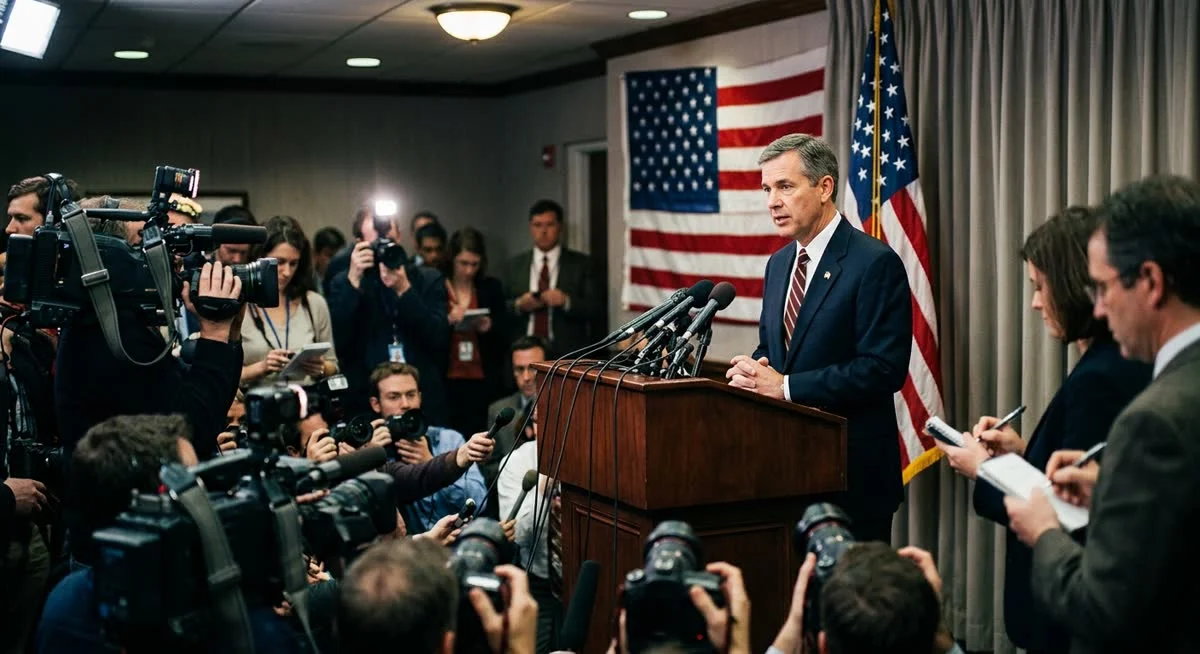
US President Donald Trump said on July 2, 2026 that he accepts the need for certain standards in the AI industry, but insists on minimal regulation. According to the president, excessive restrictions can undermine the competitive position of American companies in their rivalry with China.
What exactly did Trump say about AI regulation?
The president allowed that basic AI standards may exist, but immediately drew a red line: any rules must be minimal and must not create barriers for business. In his argument, Trump deliberately sidestepped ethical considerations, such as safety, disinformation or user rights, and focused solely on economic logic.
The key thesis is simple: the US and China are locked in a fierce technology race, and restrictions that bind only the American side will inevitably hand an advantage to the competitor. From this standpoint, deregulation becomes an element of national strategy rather than mere business lobbying.
Trump did not specify any legislative initiatives, a list of acceptable standards or a timeline.
How does this fit the administration's course?
The July remarks are a logical continuation of Trump's AI policy over the past year and a half. In January 2025, after returning for a second term, he signed an executive order repealing key AI measures of the Biden administration, including transparency requirements and mandatory safety assessments for the largest models.
In international forums, including the G7, the G20 and dedicated AI forums, the US has consistently avoided binding multilateral standards, preferring vague, non-binding declarations.
This approach differs fundamentally from the European model. Since 2025, the European Union has been steadily bringing the AI Act into force, the world's first binding AI law, which sets strict requirements for developers and operators of high-risk systems. The US and the EU are moving steadily in opposite regulatory directions.
The largest American AI companies, OpenAI, Anthropic, Google, Meta*, and Microsoft, support the minimalist course. In their view, strict federal legislation risks handing the initiative to Chinese competitors, who work with state support and lighter regulatory burdens.
Why do critics see minimal regulation as a risk?
Opponents of this position point to the other side of the coin. The absence of mandatory standards for safety, transparency and accountability means all these questions are left entirely to companies' discretion. According to a number of congress members and the academic community, industry self-regulation is systematically insufficient.
In the case of social media, voluntary commitments without legislative backing ultimately led to years of litigation and reputational crises. A number of AI researchers believe that without basic rules, a similar scenario will repeat itself in the AI industry.
What this means
Trump's position cements the alignment: large-scale federal AI legislation in the US is unlikely in the foreseeable future. For tech giants, this is a predictable and convenient environment for investment and development. For international AI regulation, it is a signal that no single global standard will emerge in the coming years: the US, the EU and China are building their own, fundamentally incompatible rules of the game.
*Meta is designated an extremist organization and banned in Russia.
- Nov 1, 2026OpenAI Rewrites GPT Behavior Rules: Five Values and a Chain of Command
- Nov 1, 2026Google admits AI Mode cuts search revenue, shares fall 15%
- Oct 31, 2026Author puts his script before an AI jury: the verdict cost 850 thousand tokens
- Oct 31, 2026Anthropic: Fold Subagents Back Into a Single Loop — One Customer's Tasks Ran Twice as Fast
Key Questions Answered
What exactly did Trump say about AI regulation?
The president allowed that basic AI standards may exist, but immediately drew a red line: any rules must be minimal and must not create barriers for business. In his argument, Trump deliberately sidestepped ethical considerations, such as safety, disinformation or user rights, and focused solely on economic logic. The key thesis is simple: the US and China are locked in a fierce technology race, and restrictions that bind only the American side will inevitably hand an advantage to the competitor. From this standpoint, deregulation becomes an element of national strategy rat
How does this fit the administration's course?
The July remarks are a logical continuation of Trump's AI policy over the past year and a half. In January 2025, after returning for a second term, he signed an executive order repealing key AI measures of the Biden administration, including transparency requirements and mandatory safety assessments for the largest models. In international forums, including the G7, the G20 and dedicated AI forums, the US has consistently avoided binding multilateral standards, preferring vague, non-binding declarations. This approach differs fundamentally from the European model. Since 2025
Why do critics see minimal regulation as a risk?
Opponents of this position point to the other side of the coin. The absence of mandatory standards for safety, transparency and accountability means all these questions are left entirely to companies' discretion. According to a number of congress members and the academic community, industry self-regulation is systematically insufficient. In the case of social media, voluntary commitments without legislative backing ultimately led to years of litigation and reputational crises. A number of AI researchers believe that without basic rules, a similar scenario will repeat itself
Test Frontier LLMs & Autonomous Agents in One Workspace
Run Claude Opus 5.5, GPT-6, Gemini 3.1, and DeepSeek side-by-side in Nomad AI (nomadnet.ai) — unified model routing, deep research, and multimodal workflows under one subscription.
The AI world, distilled — once a week
Seven stories that actually mattered, hand-picked. No noise, no reposts, no press releases.
Done! Check your inbox for a confirmation.