Japan officially approved the plan: 10 million AI robots in 18 industries by 2040
Japan has officially converted robotization plans into a state strategy. The government approved: 10 million AI robots in 18 industries by 2040, a unified national AI model as the basis of the architecture, funding up to 1 trillion yen ($6.1 billion) over five years — this is how the country responds to an acute labor shortage.
AI-processed from AI News; edited by Hamidun News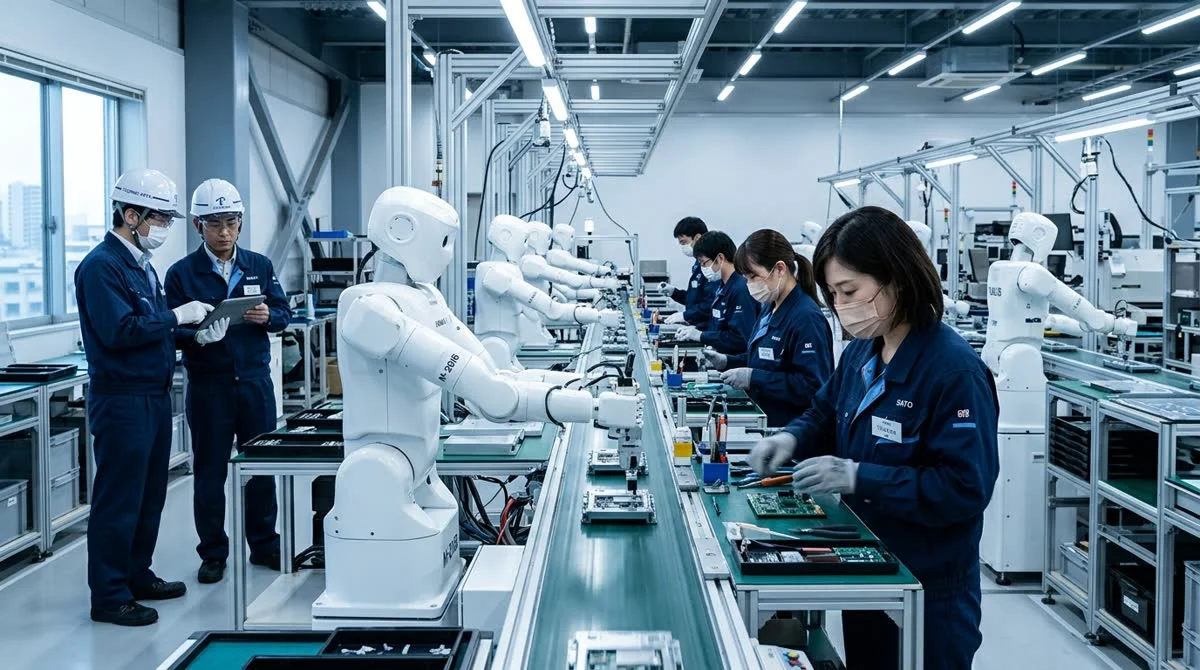
The Japanese government in early July 2026 officially approved a national robotics strategy: 10 million AI robots should be deployed across 18 sectors of the economy by 2040. State funding for the program will reach up to 1 trillion yen — approximately $6.1 billion — over the next five years.
What's Included in the National Strategy?
The figures that have been actively cited in Japanese and international business media in recent months have received official status. The conceptual document has become a fixed state strategy with concrete targets and funding behind them.
- 10 million AI robots by 2040
- 18 economic sectors covered by the plan: construction, agriculture, medicine, logistics, and others
- Up to 1 trillion yen (~$6.1 billion) — state funding over 5 years
- At the core of the technical architecture — a unified national AI model for all robots
The central technological focus of the plan is precisely the unified AI platform, not just the quantity of machines. The state is developing a common model that manufacturers and enterprises will be able to integrate without having to build the AI component from scratch for each specific application. This fundamentally distinguishes the Japanese approach from a chaotic market where companies from different sectors solve similar problems in complete isolation from each other.
Why Does Japan Need 10 Million Robots?
The answer lies in demographics. Japan has been recording one of the lowest birth rates among developed economies for decades, and the share of citizens over 65 years old is steadily approaching one-third of the population. The number of working-age Japanese is declining every year, and by 2040 the gap between economic needs and the actual number of workers will only grow.
The consequences are already being felt. The construction industry cannot fill vacancies for skilled workers. The agricultural sector is aging along with its farmers. Elderly care faces chronic staff shortages. Logistics faces a shortage of drivers and warehouse operators.
Japan is historically unprepared to fill the demographic gap through mass immigration: the country's immigration policy remains one of the most conservative among OECD members. In these circumstances, automation is not one of several options, but the main lever for maintaining economic productivity.
What Does a Unified AI Model for the Entire Country Mean?
The architectural choice in favor of a common platform instead of a set of fragmented sector-specific systems creates several practical consequences.
For robot manufacturers — it lowers the entry threshold: integrating a ready-made AI component is cheaper and faster than developing intelligence from scratch for each task. For enterprises — standardization of training, configuration, and maintenance processes. For the state — the ability to centrally manage updates and control the security of the entire fleet.
Japan has historically been one of the key producers of industrial robots. The transition to AI-driven machines opens a new round of competition — where countries compete not only for the quality of the "hardware," but also for the software intelligence that controls it.
What This Means
The approval of the national strategy makes Japan one of the largest state markets for AI robotics with a horizon through 2040. Concrete funding figures and a unified technology platform send a clear signal to global AI and robotics companies: demand is determined, funds are reserved, rules of the game are established.
Need AI working inside your business — not just in your newsfeed?
I build production AI for companies — custom CRM, internal tools, autonomous agents, workflow automation. Owned by you, shaped to your process, no per-seat tax. Built by Zhemal Khamidun, CPO of AlpinaGPT (AI platform, 6,000+ users).
The AI world, distilled — once a week
Seven stories that actually mattered, hand-picked. No noise, no reposts, no press releases.
Done! Check your inbox for a confirmation.