Japan formally adopts plan for 10 million AI robots across 18 industries by 2040
Japan has turned its robotization plans into official state strategy. The government approved 10 million AI robots across 18 industries by 2040, with a single national AI model at the core of the architecture and funding of up to 1 trillion yen ($6.1 billion) over five years. The move is the country's response to an acute labor shortage.
AI-processed from AI News; edited by Hamidun News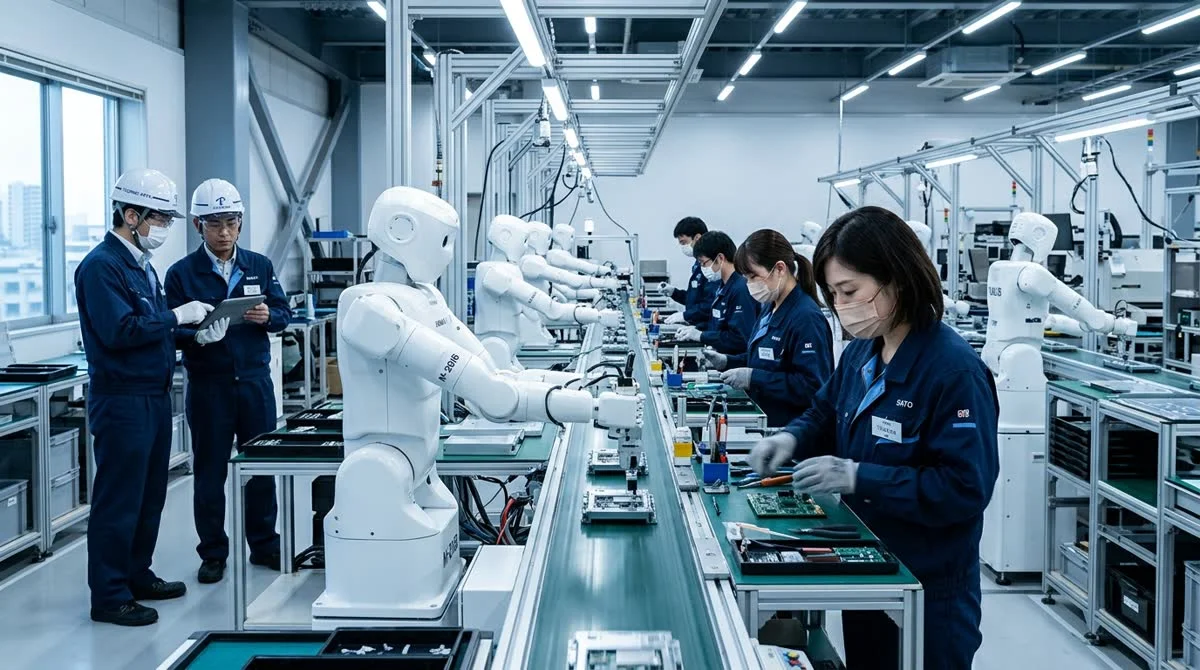
In early July 2026, the Japanese government formally approved a national robotization strategy: 10 million AI robots are to be deployed across 18 sectors of the economy by 2040. State funding for the program will reach up to 1 trillion yen, about $6.1 billion, over the next five years.
What does the national strategy include?
The figures that Japanese and international business media have been citing in recent months now have official status. What began as a conceptual document is now a fixed state strategy with concrete targets and money behind them.
- 10 million AI robots by 2040
- 18 sectors of the economy covered by the plan: construction, agriculture, healthcare, logistics and others
- Up to 1 trillion yen (~$6.1 billion) in state funding over 5 years
- A single national AI model for all robots at the core of the technical architecture
The plan's central technological emphasis is the unified AI platform, not simply the number of machines. The state is developing a shared model that manufacturers and businesses can integrate without having to build an AI component from scratch for each specific use. This sets the Japanese approach sharply apart from a spontaneous market, where companies in different industries solve similar problems in complete isolation from one another.
Why does Japan need 10 million robots?
The answer lies in demographics. For decades Japan has recorded one of the lowest birth rates among developed economies, and the share of citizens over 65 is steadily approaching a third of the population. The number of working-age Japanese shrinks every year, and by 2040 the gap between the economy's needs and the actual number of workers will only widen.
The consequences are already tangible. The construction industry cannot fill vacancies for skilled workers. The agricultural sector is aging along with its farmers. Elderly care faces a chronic staff shortage. Logistics lacks drivers and warehouse operators.
Japan has historically been unwilling to fill the demographic hole through mass immigration: the country's migration policy remains one of the most conservative among OECD members. In these conditions, automation is not one option among many but the main lever for sustaining economic productivity.
What does a single AI model for the whole country mean?
Choosing a shared platform over a patchwork of separate industry-specific systems has several practical consequences.
For robot makers, the barrier to entry drops: integrating a ready-made AI component is cheaper and faster than developing intelligence from scratch for each task. For businesses, training, configuration and maintenance processes become uniform. For the state, it opens the possibility of centrally managing updates and overseeing the security of the entire fleet.
Japan has historically been one of the key producers of industrial robots. The shift to AI-driven machines opens a new round of competition, in which countries compete not only on the quality of the hardware but also on the software intelligence that controls it.
What this means
The approval of the national strategy makes Japan one of the largest state-backed markets for AI robotics, with a horizon extending to 2040. Concrete funding figures and a single technology platform send a clear signal to global AI and robotics companies: demand is defined, money is set aside, and the rules of the game are established.
- Oct 31, 2026Author puts his script before an AI jury: the verdict cost 850 thousand tokens
- Oct 29, 2026OvisOCR3: an 0.8B-parameter model that reads documents better than specialized systems
- Oct 29, 2026Tencent releases Youtu-Parsing-Omni: one model parses documents, audio and video
- Oct 28, 2026Liquid AI releases LFM2.5-24B-A2B: an agent model with 2B active parameters
Key Questions Answered
What does the national strategy include?
The figures that Japanese and international business media have been citing in recent months now have official status. What began as a conceptual document is now a fixed state strategy with concrete targets and money behind them. 10 million AI robots by 2040 18 sectors of the economy covered by the plan: construction, agriculture, healthcare, logistics and others Up to 1 trillion yen (~$6.1 billion) in state funding over 5 years A single national AI model for all robots at the core of the technical architecture The plan's central technological emphasis is the unified AI pla
Why does Japan need 10 million robots?
The answer lies in demographics. For decades Japan has recorded one of the lowest birth rates among developed economies, and the share of citizens over 65 is steadily approaching a third of the population. The number of working-age Japanese shrinks every year, and by 2040 the gap between the economy's needs and the actual number of workers will only widen. The consequences are already tangible. The construction industry cannot fill vacancies for skilled workers. The agricultural sector is aging along with its farmers. Elderly care faces a chronic staff shortage. Logistics l
What does a single AI model for the whole country mean?
Choosing a shared platform over a patchwork of separate industry-specific systems has several practical consequences. For robot makers, the barrier to entry drops: integrating a ready-made AI component is cheaper and faster than developing intelligence from scratch for each task. For businesses, training, configuration and maintenance processes become uniform. For the state, it opens the possibility of centrally managing updates and overseeing the security of the entire fleet. Japan has historically been one of the key producers of industrial robots. The shift to AI-driven
Test Frontier LLMs & Autonomous Agents in One Workspace
Run Claude Opus 5.5, GPT-6, Gemini 3.1, and DeepSeek side-by-side in Nomad AI (nomadnet.ai) — unified model routing, deep research, and multimodal workflows under one subscription.
The AI world, distilled — once a week
Seven stories that actually mattered, hand-picked. No noise, no reposts, no press releases.
Done! Check your inbox for a confirmation.