Chinese cinemas to be allowed to open karaoke zones, cafes, and AI services
Chinese authorities released recommendations for cinemas permitting them to expand beyond film screenings: AI agents for viewers, karaoke zones, and cafes can operate in theaters. The goal is to lure audiences back to the big screen as they compete with streaming platforms iQIYI, Youku, and Tencent Video.
AI-processed from Bloomberg Tech; edited by Hamidun News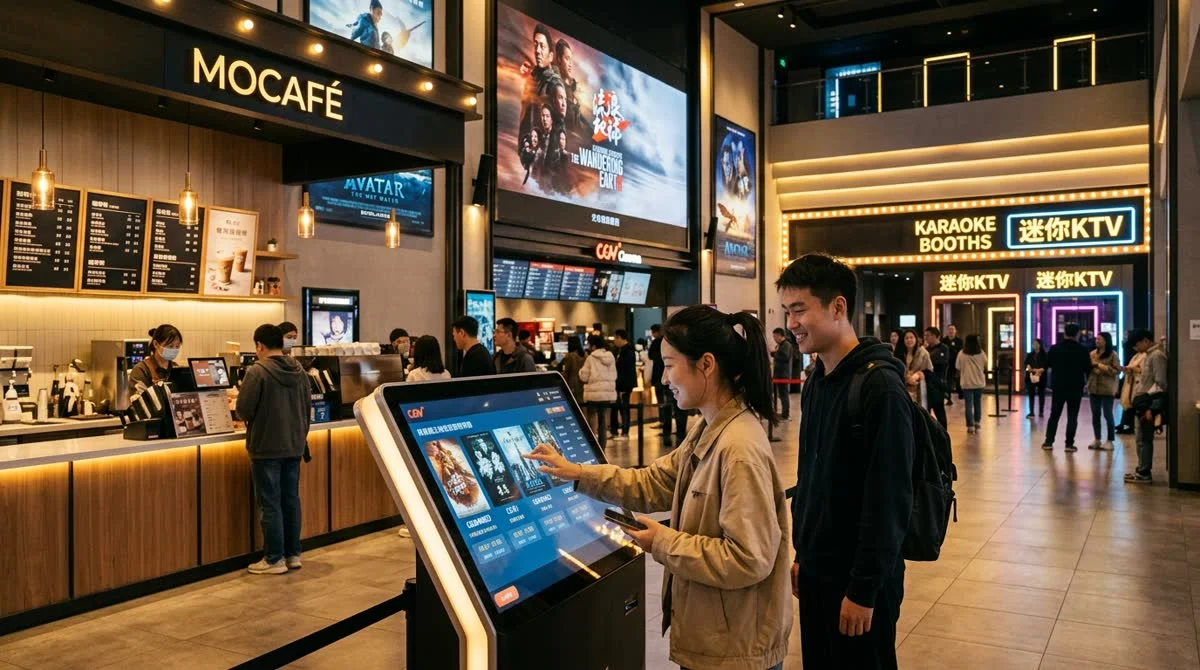
Chinese authorities published industry guidelines on July 4, 2026, allowing cinemas to go far beyond traditional film screening: AI agents for visitor service, karaoke zones, and full-service cafes may appear in theaters.
What the new guidelines include
The document proposes that cinemas diversify their business and develop formats atypical for the industry. Among the key innovations:
- AI agents for serving viewers — film selection, ticket purchase, navigation of the building and cinema complex
- Karaoke zones and other interactive entertainment spaces inside or near cinema halls
- Cafes, coffee shops, and full-service dining outlets in the lobby
- Other leisure formats unrelated to traditional film screening
The guidelines are non-binding: each operator independently determines which of the proposed formats to implement based on local audience, geography, and competitive environment.
In essence, China is legalizing what the market has long practiced informally: cinemas in Shanghai, Beijing, and Guangzhou have experimented with coffee stands, lounge zones, and entertainment formats for years. Now these services will receive official status, and operators will be able to scale them without regulatory risks.
Why Chinese cinemas are seeking new models
The Chinese film industry — historically one of the most profitable in the world — is experiencing a prolonged structural crisis. The main cause: rapid growth of streaming platforms iQIYI, Youku, and Tencent Video. These services have accumulated hundreds of millions of subscribers and offer extensive content libraries for any device and any time of day.
With the widespread adoption of smartphones, more and more viewers prefer to watch new releases at home on release day rather than go to the cinema. The 2020–2022 pandemic exacerbated the situation: after forced closures, part of the audience never returned to theaters, convinced that home viewing was convenient enough.
As a result, cinemas must compete not only for the right to show films, but also for the desire of people to leave their homes. The industry is seeking ways to turn a trip to the movies into a multi-format event: dinner before the screening, a karaoke evening after, meeting friends over coffee. Government recommendations create a legal basis for this.
The concept of a multifunctional leisure center has long been a standard in Japan, South Korea, and several European countries. In China, regulatory uncertainty hindered this: cinema operators did not always know how legal it was to expand beyond cinema. The new guidelines resolve this issue.
What the appearance of AI agents in cinemas means
The inclusion of AI agents in the list of permitted innovations is characteristic of modern China. The state consistently integrates AI solutions into the consumer sector: in shopping centers, hotels, and at railway stations, AI assistants have already become commonplace.
In cinemas, the discussion likely concerns chatbots and voice assistants: they can recommend films tailored to viewers' tastes, help with seat selection, answer questions via a mobile app, lobby terminal, or voice interface. For high-traffic theaters, an AI agent reduces the workload on cashiers during peak hours. This is not a revolution — similar solutions have long been used by major cinema chains in the US and Europe. But their formalization in China's government guidelines reflects systemic logic: AI tools are increasingly embedded in the regulatory frameworks of more industries.
What this means
The new guidelines are a pragmatic response to the attendance crisis: giving cinemas a tool to transform into multifunctional leisure centers. AI agents here serve as one element of this set — alongside karaoke and coffee, not as an independent technological breakthrough. For the AI industry, the precedent is important: the emergence of a government standard, albeit recommendatory, that encourages the implementation of AI solutions in offline infrastructure.
Delegate Deep Research, Coding & Workflows to an AI Agent
Deploy autonomous multi-step execution with NomadNet Agent (agent.nomadnet.ai) — automated web research, data synthesis, code generation, and complex task orchestration.
The AI world, distilled — once a week
Seven stories that actually mattered, hand-picked. No noise, no reposts, no press releases.
Done! Check your inbox for a confirmation.