Wall Street Researchers: AI in Hedge Funds Creates New Systemic Risks
Wall Street researchers are sounding the alarm: AI proved not to be a market magician, but a potential source of new instability. When hundreds of hedge funds use identical models trained on similar data, their trading decisions synchronize—and a single market shock can trigger a cascading market collapse. Several new academic papers raise precisely this question.
AI-processed from Bloomberg Tech; edited by Hamidun News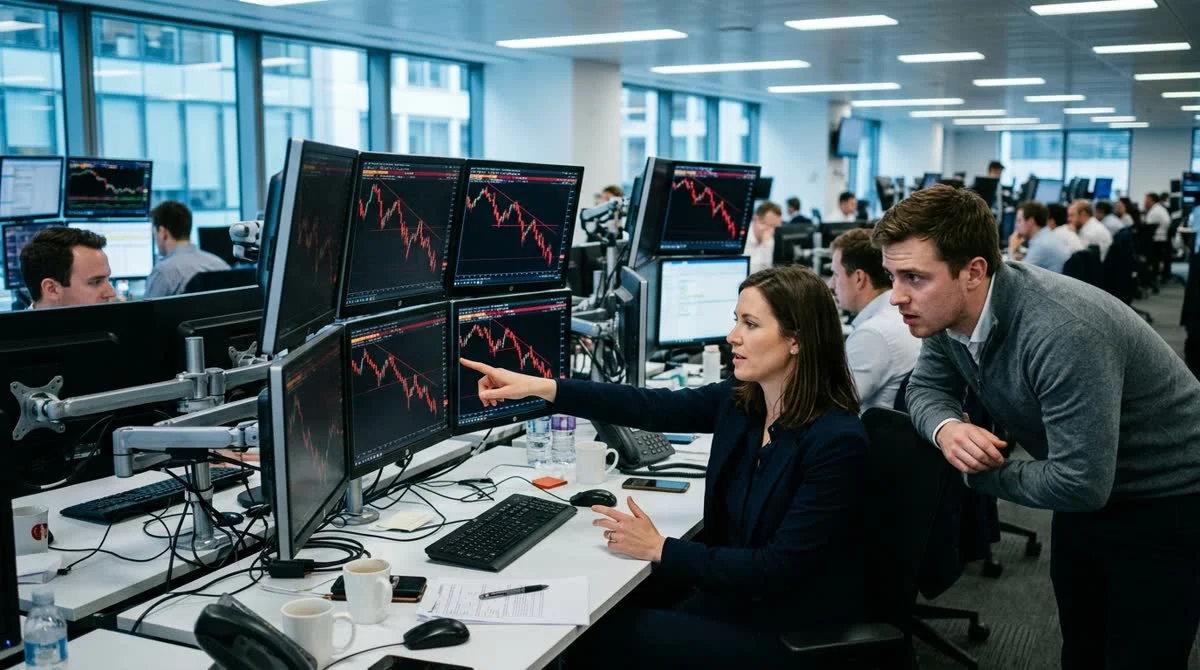
Wall Street researchers are warning of a dangerous scenario taking shape in the financial industry: the mass adoption of identical AI tools in hedge funds is creating a new type of systemic risk that simply did not exist before. Bloomberg reported this on July 1, 2026, citing a series of new academic papers.
Why identical AI across thousands of funds is a systemic threat
When hundreds of hedge funds simultaneously launch similar AI algorithms trained on comparable datasets, their trading decisions become correlated. This is classic "herd behavior" — but at a scale and with a level of synchronization that was technically unattainable before.
Traditional financial models are built on a fundamental assumption: market participants make independent decisions. It is precisely the diversity of strategies, analytical approaches, and time horizons that creates liquidity and stabilizes prices. When buyers and sellers come to a deal with different views on an asset's value, the market functions normally. AI tools undermine this assumption at its core: if models are trained on similar datasets, respond to the same market signals, and optimize similar objective functions, the market loses exactly the diversity of opinion that made it resilient to shocks.
The picture is compounded by concentration: the market for AI trading tools is consolidating around a few major providers. Where previously each fund had its own team of quant analysts with unique proprietary models, now everyone can subscribe to the same service.
What new research shows
Bloomberg reports on several academic papers attempting to model the consequences of mass AI adoption in trading. Researchers are asking the same question: what will happen to the market if all participants use the same AI tool?
The answers are preliminary but alarming. When algorithms synchronously process identical signals and reach similar conclusions, they begin to amplify market movements rather than smooth them. In crisis moments — sharp index declines, unexpected geopolitical news, regulatory surprises — AI algorithms are capable of simultaneously issuing identical sell commands, turning a managed correction into an avalanche-like collapse.
Particularly troubling is the speed of reaction. Panicked humans also make similar mistakes, but with different delays and in different sequences. AI algorithms respond to the same signal almost instantaneously and simultaneously, which fundamentally changes the temporal dynamics of market shocks.
Another problem is behavior in extreme situations that did not exist in the training data. At the moment of true market uncertainty, when human experience and intuition would be especially valuable, algorithms can behave unpredictably and counterproductively.
AI is not a market wizard, but a risk amplifier
Bloomberg's article title is ironically apt: AI "is not a market wizard." Practice shows that under normal conditions, models are quite functional, but they create new tail risks. Tail risks are rare but catastrophic events that standard probability distributions systematically underestimate.
Regulators are beginning to pay attention to this. Systemic risk, traditionally associated with banks in the too-big-to-fail category, can now be reproduced through algorithms in the too-similar-to-fail category: not one huge organization, but thousands of medium-sized ones making identical decisions at the same moment in time. The Federal Reserve, SEC, and their European counterparts are studying how AI affects asset correlation under stress conditions — so far without concrete regulatory solutions.
What this means
The problem of AI homogeneity in finance is a particular case of a broader question about the concentration of technological infrastructure. The more market participants rely on the same fundamental models, the higher the risk of synchronized cascading failure precisely when stability is needed most.
Need AI working inside your business — not just in your newsfeed?
I build production AI for companies — custom CRM, internal tools, autonomous agents, workflow automation. Owned by you, shaped to your process, no per-seat tax. Built by Zhemal Khamidun, CPO of AlpinaGPT (AI platform, 6,000+ users).
The AI world, distilled — once a week
Seven stories that actually mattered, hand-picked. No noise, no reposts, no press releases.
Done! Check your inbox for a confirmation.