Queue emerges from stealth with $12.6 million and a robotic pharmacy without a pharmacist
Silicon Valley startup Queue emerged from stealth on July 1, 2026 with a working prototype of an autonomous pharmacy and a $12.6 million seed round. The machine takes sealed vials, counts pills on its own, verifies the prescription, and dispenses the package — all in about a minute. No pharmacist or operator is involved in the process.
AI-processed from TNW; edited by Hamidun News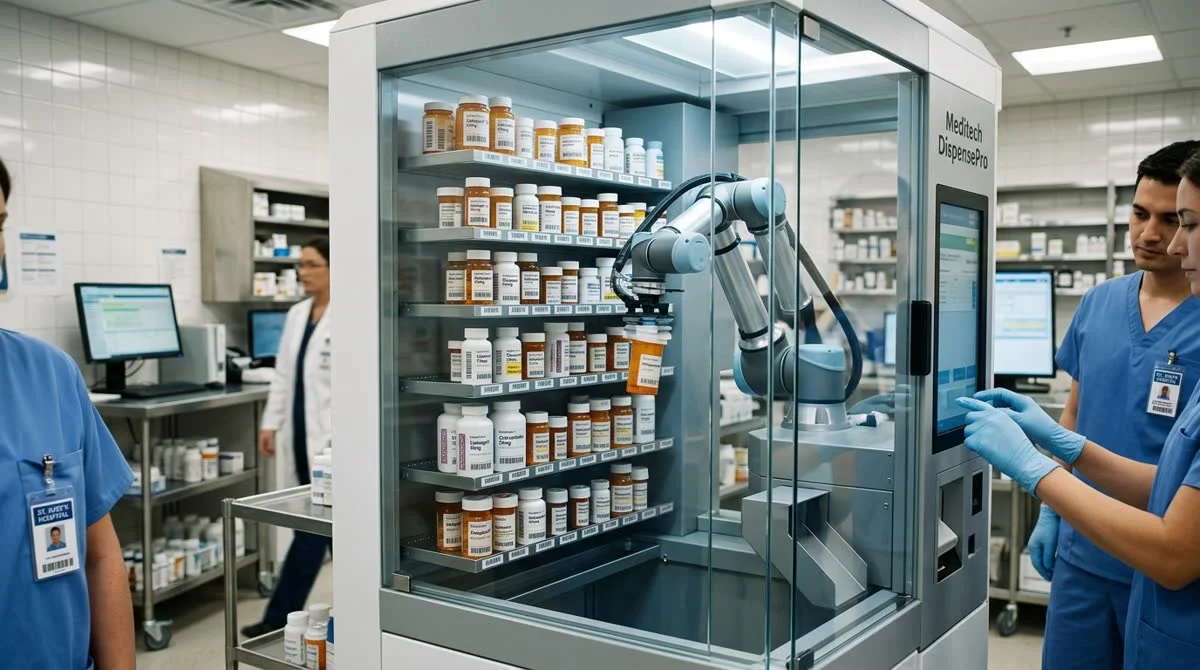
Queue, a Silicon Valley startup, emerged from stealth on July 1, 2026, with a working prototype of a fully autonomous pharmacy and announced the close of a $12.6 million seed round. This is the first publicly unveiled device capable of executing the entire pharmacy cycle — from receiving a vial to dispensing a prescription — without a pharmacist or operator.
How Queue's pharmacy robot works
The machine receives sealed medication vials, identifies the drug, counts out the required number of tablets or capsules, verifies the dosage against the prescription, and packages the completed order. The entire cycle takes about one minute. Neither a pharmacist nor a counter operator is required.
The fact of a fully autonomous cycle distinguishes Queue from most existing pharmacy robots. Competitors — such as ScriptPro and Omnicell — operate within hospital pharmacies under constant staff supervision: they automate vial storage and dispensing, but leave final verification and dispensing to a licensed pharmacist. Queue targets a fundamentally different model — public dispensing points without on-site staff. The company has not yet disclosed details of its verification technology.
- Date of emergence from stealth — July 1, 2026
- Seed round amount — $12.6 million
- Processing time per prescription — approximately 1 minute
- Product format — autonomous pharmacy device without operator
- Company is based in Silicon Valley
$12.6 million is a substantial amount for a seed round, especially considering that Queue is building a hardware product. Development, certification, and manufacturing of physical machines require significantly greater capital expenditures than software. This indicates that investors believe in the path to scaling.
Why regulatory barriers are the main challenge for Queue
Prescription drugs are strictly regulated in most countries. In the US, the FDA and state pharmacy boards require that every prescription be verified by a licensed pharmacist who bears professional and legal responsibility. It is this requirement that has ensured the presence of a live specialist behind every pharmacy counter for decades.
Queue will apparently take one of two paths. The first is remote oversight: a licensed pharmacist remotely verifies each prescription while the device physically dispenses the drug. This model already works in several US telepharmacy services. The second path is to pursue special regulatory approval for fully autonomous operation without remote oversight. This takes years and requires extensive safety data.
In parallel, Queue must address integration with electronic prescription systems. In the US, most prescriptions are transmitted to pharmacies electronically, and the device's ability to work with existing e-prescribing infrastructure will largely determine the speed of its adoption.
Where such machines are needed
Pharmacist shortages are a growing problem in the US: pharmacies in small towns and remote areas are closing, and attracting and retaining a licensed specialist there is costly. Chronic overwork of pharmacists in chain pharmacies is one risk factor for tablet-counting errors, and automation of this operation theoretically reduces such risk.
Obvious niches for Queue are corporate campuses, shopping centers, airports, and outpatient clinics. If the company can clear regulatory hurdles and validate safety in real-world conditions, the business model looks scalable: the device operates 24 hours a day and takes no days off.
What this means
Queue is another bet on automating highly regulated professions traditionally protected by the requirement of a live specialist. The $12.6 million in seed funding will allow the company to conduct regulatory work and initial pilots, but the main test — obtaining approval for commercial operation — still lies ahead.
Delegate Deep Research, Coding & Workflows to an AI Agent
Deploy autonomous multi-step execution with NomadNet Agent (agent.nomadnet.ai) — automated web research, data synthesis, code generation, and complex task orchestration.
The AI world, distilled — once a week
Seven stories that actually mattered, hand-picked. No noise, no reposts, no press releases.
Done! Check your inbox for a confirmation.