Meta launched Pocket — an app for creating mini-games via text prompts
Without an official announcement, Meta launched Pocket — an experimental AI app where users create interactive mini-games via text prompts and share them. No programming: you describe the idea in text and get a finished game. The release came without press releases or advertising — a typical Meta tactic for testing early experiments. *Meta is recognized as an extremist organization and banned in Russia.
AI-processed from TechCrunch; edited by Hamidun News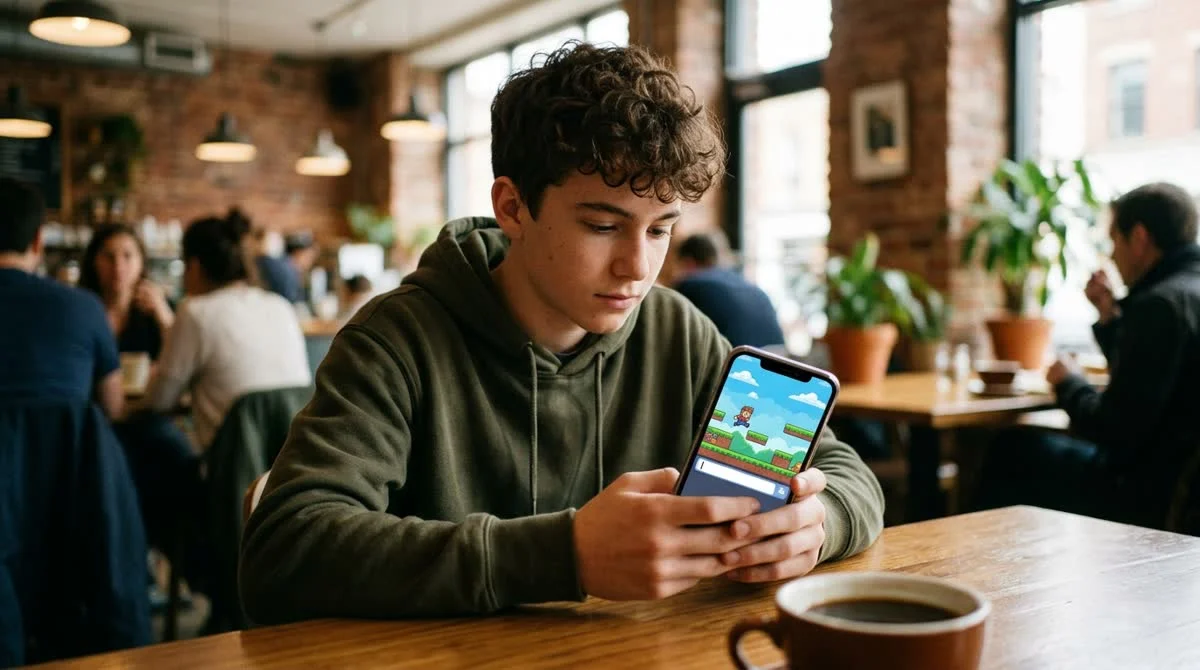
On July 2, 2026, Meta quietly launched Pocket — an experimental AI application that allows users to create interactive mini-games through text prompts and share them with others.
What Pocket Can Do
The principle is simple: a user describes a game idea in text and receives a ready-made interactive mini-game. No programming, no engines, no manual assets. The only requirement is the ability to articulate a request in natural language.
In the traditional game development pipeline, even a small game requires an engine, programming skills, assets, and time. Pocket aims to compress this pipeline into a single text prompt — thereby opening game authorship to an audience previously locked out of the industry.
A key feature of the application is built-in game sharing. Users can share created content with others, transforming Pocket from a personal generator into a social platform. If a viral culture of mini-games develops around the app, it could become an audience retention mechanic similar to TikTok's video model.
Why Meta Launched Pocket Quietly
The company released no press releases and held no media briefings — the news emerged through third-party sources. This approach is typical for Meta's experimental launches: launch without inflated expectations, collect real user behavior data, and make investment decisions.
If engagement metrics are weak, the product is quietly discontinued. If they're strong, the technology is integrated into the existing ecosystem: Facebook Gaming, Instagram, or Horizon Worlds. Meta has repeatedly attempted to enter gaming: Facebook Instant Games, a streaming platform, VR games for Quest. None of these formats became a mass product. AI-generated games represent a fundamentally different approach: not building a platform with an editor, but eliminating the need for an editor altogether.
Why Vibe Coding in Games Is Technically Complex
"Vibe coding" — development through dialogue with AI, without manual code writing — became mainstream in 2025 for utilities, landing pages, and scripts. But interactive games are qualitatively more complex: mechanics, physics, progression, visual style, and user feedback — all of this AI must generate entirely.
Even a simple platformer requires correct jump handling, collision detection with platforms, and basic progression. An AI capable of generating this from a text description is on a fundamentally different level than a standard text or image generator. The fact that Pocket claims such functionality in a real product signals genuine progress in multimodal generation.
Roblox is already working on AI tools for user-generated content creation. If Pocket demonstrates viability, Meta will have a competitive position in the rapidly growing segment of user-generated game platforms.
What This Means
Pocket is an early signal that Meta is betting on AI as a tool to lower barriers for game content creation. If the experiment gains an audience, it could become the foundation for a full Roblox competitor — but one built on text prompts rather than visual editors.
*Meta has been recognized as an extremist organization and is banned in Russia.
Need AI working inside your business — not just in your newsfeed?
I build production AI for companies — custom CRM, internal tools, autonomous agents, workflow automation. Owned by you, shaped to your process, no per-seat tax. Built by Zhemal Khamidun, CPO of AlpinaGPT (AI platform, 6,000+ users).
The AI world, distilled — once a week
Seven stories that actually mattered, hand-picked. No noise, no reposts, no press releases.
Done! Check your inbox for a confirmation.