Chip Stock Selloff Reaches South Korea as Investors Question the AI Rally
The selloff in chipmaker stocks spread to South Korea on July 2, 2026, with the KOSPI index closing lower alongside global exchanges. Investors are again asking whether the months-long rally in AI stocks has gone too far. The decline hit markets from the US to Asia, with memory makers at the center of the selloff.
AI-processed from Bloomberg Tech; edited by Hamidun News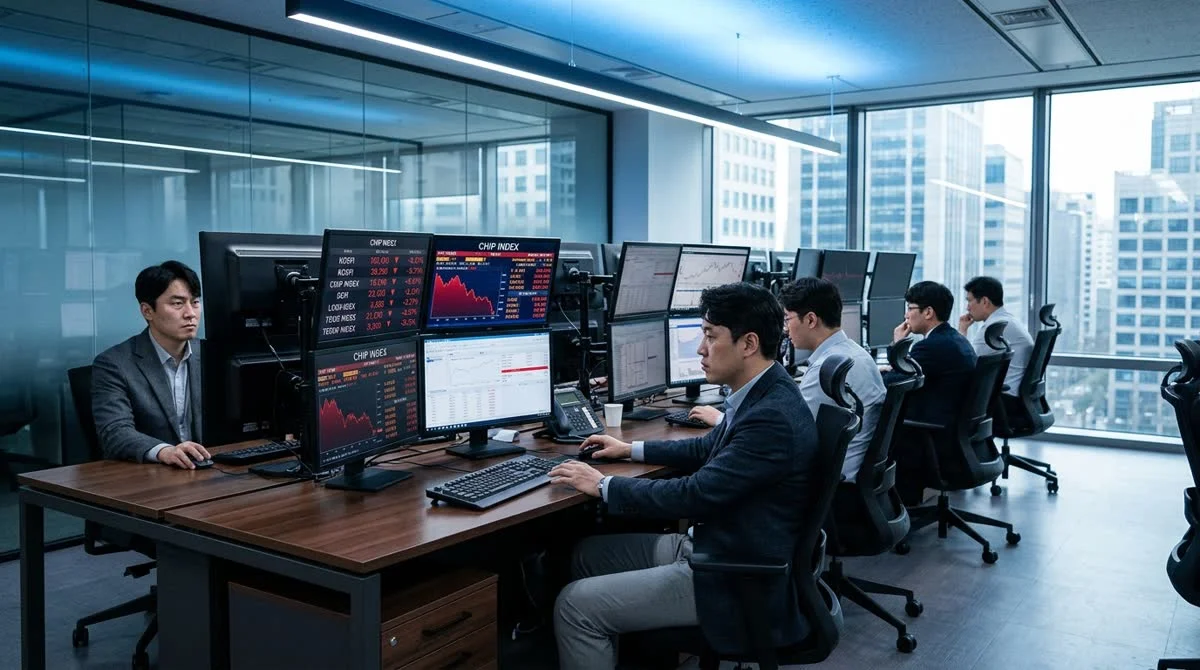
The selloff in chipmaker stocks spread to South Korea's stock market on July 2, 2026, with the KOSPI index closing lower alongside global exchanges. The drop revived fears that the months-long rally in AI stocks has gone too far.
How the selloff reached Korea
South Korea holds a key place in the global semiconductor supply chain. Its leading chipmakers produce a significant share of the world's DRAM and NAND memory capacity, which is used directly in servers that train AI models. That is why a global selloff in chips shows up immediately in the KOSPI: whenever interest in semiconductors cools, tech stocks drag the whole index down.
The decline swept exchanges across Asia, following US markets, where the wave of profit-taking began earlier. Investors exited positions that had climbed steadily for several months on the back of AI enthusiasm. Bloomberg analysts recorded synchronized moves in markets from New York to Seoul.
Why are investors talking about overheated AI stocks?
The concerns have been building for some time: AI stocks have comfortably outperformed the broader market for several years. Makers of high-performance chips became the main beneficiaries of the AI boom, with demand for compute to train and run large language models setting records quarter after quarter. Hyperscalers, cloud platforms and hundreds of AI startups ramped up purchases of GPUs and specialized accelerators, pushing share prices higher.
Skeptics keep asking the same question: when will the enormous capital spending on AI infrastructure start converting into comparable profit? There is no convincing answer yet, so the sector remains sensitive to any negative signal. The history of tech markets, from the dot-com boom of the late 1990s to the blockchain wave, shows that market optimism regularly runs ahead of actual financial results.
- The selloff hit global exchanges on July 2, 2026
- Chipmaker stocks in the US and Asia were at the center of the decline
- South Korea was hit as the world's leading supplier of memory for AI servers
- Investors doubt that current valuations of AI stocks match companies' real earnings
What this means
A synchronized correction from US exchanges to the KOSPI points to a global, not local, reassessment of risk in the sector. The market is starting to demand concrete evidence of AI monetization: growth stories are no longer enough.
The upcoming quarterly reports from the largest tech companies will be the main test of whether operating reality confirms current market valuations.
Key Questions Answered
Why are investors talking about overheated AI stocks?
The concerns have been building for some time: AI stocks have comfortably outperformed the broader market for several years. Makers of high-performance chips became the main beneficiaries of the AI boom, with demand for compute to train and run large language models setting records quarter after quarter. Hyperscalers, cloud platforms and hundreds of AI startups ramped up purchases of GPUs and specialized accelerators, pushing share prices higher. Skeptics keep asking the same question: when will the enormous capital spending on AI infrastructure start converting into compar
How the selloff reached Korea?
South Korea holds a key place in the global semiconductor supply chain. Its leading chipmakers produce a significant share of the world's DRAM and NAND memory capacity, which is used directly in servers that train AI models. That is why a global selloff in chips shows up immediately in the KOSPI: whenever interest in semiconductors cools, tech stocks drag the whole index down. The decline swept exchanges across Asia, following US markets, where the wave of profit-taking began earlier. Investors exited positions that had climbed steadily for several months on the back of AI
What this means?
A synchronized correction from US exchanges to the KOSPI points to a global, not local, reassessment of risk in the sector. The market is starting to demand concrete evidence of AI monetization: growth stories are no longer enough. The upcoming quarterly reports from the largest tech companies will be the main test of whether operating reality confirms current market valuations.
Test Frontier LLMs & Autonomous Agents in One Workspace
Run Claude Opus 5.5, GPT-6, Gemini 3.1, and DeepSeek side-by-side in Nomad AI (nomadnet.ai) — unified model routing, deep research, and multimodal workflows under one subscription.
The AI world, distilled — once a week
Seven stories that actually mattered, hand-picked. No noise, no reposts, no press releases.
Done! Check your inbox for a confirmation.