JetBrains rethinks the IDE: its next main user is an AI agent
The "IDE is obsolete" mantra keeps getting louder: Claude Code, Codex, and OpenCode run directly in the terminal, with no complex interfaces. JetBrains disagrees. The company proposes rethinking what a development environment is for: the IDE is needed not by the human, but by the AI agent. An agent with access to the IDE's semantic analysis, dependency graph, and refactorings works more precisely than an agent with nothing but a terminal.
AI-processed from Habr AI; edited by Hamidun News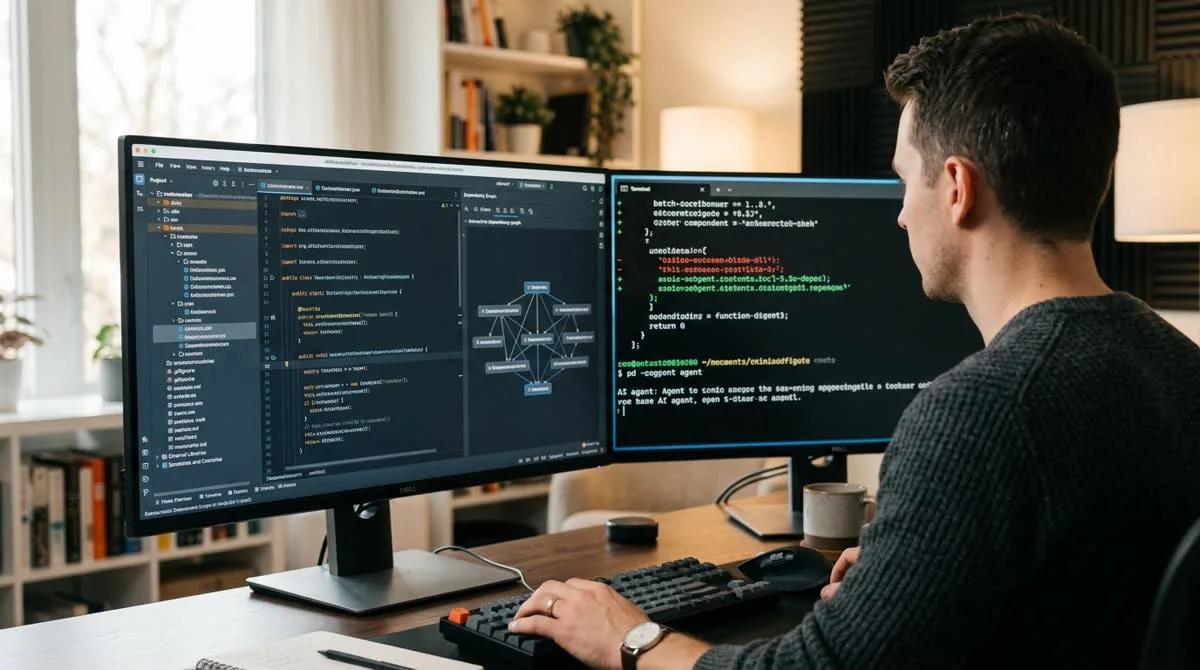
The OpenIDE team published an analysis on Habr of JetBrains' position in the debate over the future of the development environment. While part of the community declares the end of the IDE era, JetBrains proposes reframing the question: the IDE's next main user will be an AI agent, not a human.
Why the "IDE is dead" thesis is gaining ground
In recent years, the AI coding community has settled on a firm view: the professional development environment is obsolete. Developers who work with Claude Code, Codex, or OpenCode straight from the terminal describe the setup like this: an agent needs only grep, bash, and edit, plus a few good prompts. Complex interfaces, UI inspectors, built-in refactorings, and the debugger look like leftovers from the era of writing code by hand.
The approach has picked up an informal name, "vibe coding": development driven by intent rather than by direct control of the code. Open a terminal, describe the task, get a diff — no windows, no clicking through menus.
In this picture, JetBrains is often cast as a dinosaur: a company that set the bar for professional tooling for years but now looks late to the party with AI Chat and Junie.
What the "terminal vs. IDE" argument misses
The thesis has a fundamental blind spot: it looks at the development environment only from the human's point of view. AI agents working through the terminal see code as text, with no semantic understanding of the project's structure.
JetBrains offers an alternative thesis: the IDE is not an interface for humans but a tooling layer with deep knowledge of the project — exactly what an AI agent needs.
What grep and bash fundamentally cannot do:
- Semantic code analysis that accounts for types and contracts
- A dependency graph across modules and symbols
- Safe refactorings that preserve invariants across the entire codebase
- Navigation by meaning, not by lines in a file
- Direct integration with the debugger, test runner, and build system
An agent with access to these tools through the IDE makes precise changes instead of guessing context from neighboring files.
Why the agent needs the IDE, not just the human
JetBrains has been building its AI integration along exactly these lines for several years. AI Chat (formerly AI Assistant) and Junie place the agent inside the IDE rather than outside it, giving it direct access to the environment's structural tools.
The OpenIDE team, which published the analysis, takes the same position: not a single developer they know has removed the IDE from their work machine, even though all or nearly all of them already use AI agents. The IDE remains the place where both the human and the agent get the full context of the project.
"Today we'll talk not about why a human needs an IDE, but about why an agent needs one," — the
OpenIDE team on Habr.
What this means
The "terminal vs. IDE" framing risks turning out to be a false dichotomy. AI agents with access to the IDE's semantic tooling work more precisely than those that only see the text of files. If JetBrains follows through on this model consistently, the development environment won't disappear — it will get a new main user.
- Nov 1, 2026New test catches hidden AI agent collusion by measuring how a partner reacts to a paraphrase
- Nov 1, 2026Illinois compiled 12 151 open problems and tested whether AI can solve them
- Oct 31, 2026AI engineer writes a single reward function for agent teams: win rate climbs from 51% to 90%
- Oct 31, 2026SkillMem stores an AI agent skill in 9.6 KB and speeds up a team 4.2x
Key Questions Answered
Why the "IDE is dead" thesis is gaining ground?
In recent years, the AI coding community has settled on a firm view: the professional development environment is obsolete. Developers who work with Claude Code, Codex, or OpenCode straight from the terminal describe the setup like this: an agent needs only grep, bash, and edit, plus a few good prompts. Complex interfaces, UI inspectors, built-in refactorings, and the debugger look like leftovers from the era of writing code by hand. The approach has picked up an informal name, "vibe coding": development driven by intent rather than by direct control of the code. Open a term
What the "terminal vs. IDE" argument misses?
The thesis has a fundamental blind spot: it looks at the development environment only from the human's point of view. AI agents working through the terminal see code as text, with no semantic understanding of the project's structure. JetBrains offers an alternative thesis: the IDE is not an interface for humans but a tooling layer with deep knowledge of the project — exactly what an AI agent needs. What grep and bash fundamentally cannot do: Semantic code analysis that accounts for types and contracts A dependency graph across modules and symbols Safe refactorings that pres
Why the agent needs the IDE, not just the human?
JetBrains has been building its AI integration along exactly these lines for several years. AI Chat (formerly AI Assistant) and Junie place the agent inside the IDE rather than outside it, giving it direct access to the environment's structural tools. The OpenIDE team, which published the analysis, takes the same position: not a single developer they know has removed the IDE from their work machine, even though all or nearly all of them already use AI agents. The IDE remains the place where both the human and the agent get the full context of the project. "Today we'll talk
Build & Ship Production AI Agents Without Boilerplate Code
Start your free 72-hour trial at Hamidun Academy (academy.hamidun.com) — interactive lessons on Claude Code & Cursor, live Tech Radar, and production agent templates.
The AI world, distilled — once a week
Seven stories that actually mattered, hand-picked. No noise, no reposts, no press releases.
Done! Check your inbox for a confirmation.