AI assesses Russians' job suitability from their faces — developers move into the public sector
A new AI system in Russia supposedly determines applicants' job suitability from a facial photo in seconds — without interviews or tests. The developers are already in talks with HR departments at security agencies and state-owned enterprises. Critics compare it to the dystopia «Idiocracy».
AI-processed from Habr AI; edited by Hamidun News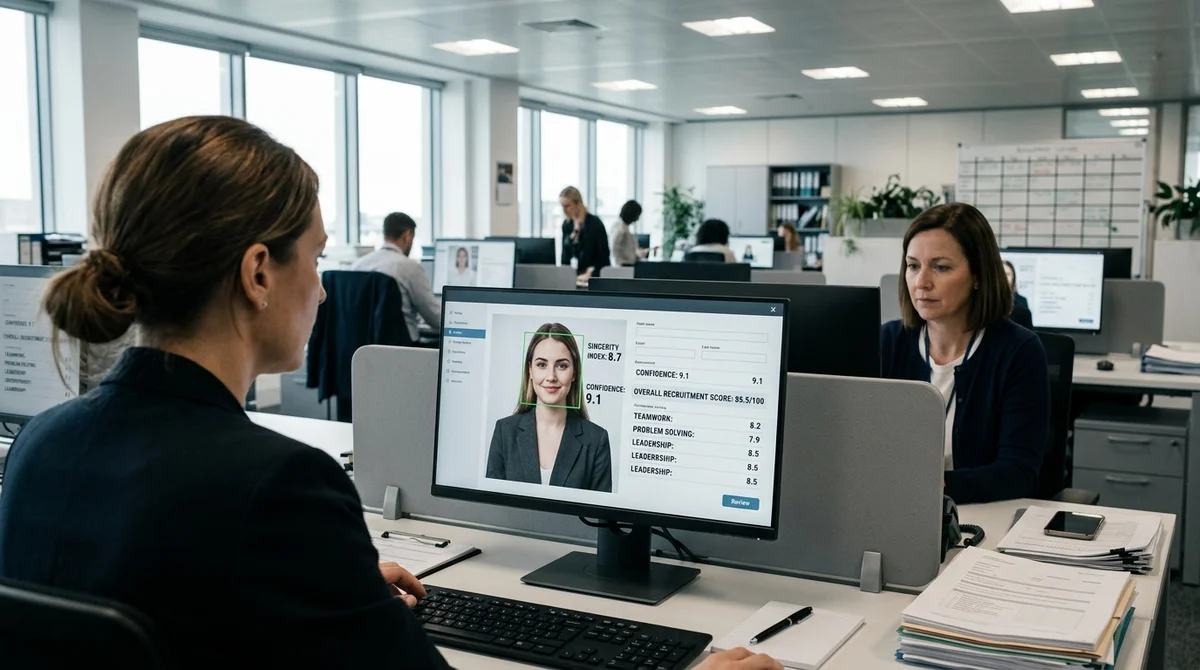
In Russia, a technology has emerged that allegedly determines a person's professional suitability from a facial photograph in seconds. The developers have announced negotiations with government agencies — and if they succeed, the tool may become part of state hiring procedures. The story sounds like a dystopia, but it's already happening.
What is this system
The technology is based on a neural network trained to analyze facial features and draw conclusions about a candidate's professional qualities. According to the developers, the system assesses reliability, stress resilience, leadership inclination, and a number of other parameters — the result is provided as numerical scores within seconds, without questionnaires, interviews, or psychological tests. The algorithm, according to its creators, was trained on a database of tens of thousands of cases of real employees for whom performance indicators were documented.
This, they claim, distinguishes the system from physiognomy and makes it "scientific." There is no independent verification of this data in the public domain. The key argument in negotiations with clients is speed and scalability.
Traditional candidate screening takes minutes or hours. The algorithm handles it in seconds and never gets tired. For organizations with high hiring volumes, this looks attractive — especially if you don't delve into the question of what the algorithm actually measures.
To state level
According to CNews, the developers are conducting active negotiations with HR departments of state enterprises and law enforcement agencies. If pilots succeed, the technology risks becoming part of standardized hiring procedures in the public sector. This fundamentally changes the scale of the problem. Corporate HR with algorithmic screening is one thing. State hiring, where the decision affects a person's access to service, benefits, and social status — is quite another. Specific consequences of such a scenario:
- An algorithm makes the decision to hire or reject, not a person with responsibility
- The candidate doesn't know what in their face affected the evaluation
- The employer can cite "objective AI" without explaining reasons for rejection
- Contesting an algorithmic decision in court is extremely difficult without disclosing the model
- Systemic errors and biases automatically scale across the entire public sector
Why science opposes it
The academic community established long ago: facial features do not predict professional effectiveness. This is not a debatable issue — it is an established consensus documented in hundreds of peer-reviewed papers on psychology, organizational behavior, and HR analytics. The link between appearance and competence is a cognitive bias called the "physical attractiveness effect," also known as the halo effect. People tend to attribute greater professionalism to those who are physically more attractive. When a neural network is trained on hiring data collected by humans, it reproduces exactly this bias — only faster and with the appearance of mathematical objectivity.
"Any algorithm trained on historical hiring data reproduces historical
biases — only faster and at larger scale" — a standard conclusion from research on algorithmic bias in HR.
Tellingly, in the European Union, biometric systems for automatic candidate assessment are de facto prohibited in the hiring context under the AI Act. In the United States, companies have lost lawsuits over algorithmic screening with proven discriminatory effects. Russia has no comparable legal barrier yet.
What this means
The story with "AI by face" is a telling example of how the marketing packaging of a neural network product allows selling an unscientific tool to large clients. The technological authority of AI creates an illusion of objectivity where none exists and cannot exist. The main risk is not that the system works — but that it will be applied precisely because it looks convincing, and no one has time to understand the details. The state scale multiplies the potential damage many times over: thousands of people could receive job rejection based on the shape of their nose or the distance between their eyes — without even knowing that a machine evaluated them at all.
Need AI working inside your business — not just in your newsfeed?
I build production AI for companies — custom CRM, internal tools, autonomous agents, workflow automation. Owned by you, shaped to your process, no per-seat tax. Built by Zhemal Khamidun, CPO of AlpinaGPT (AI platform, 6,000+ users).
The AI world, distilled — once a week
Seven stories that actually mattered, hand-picked. No noise, no reposts, no press releases.
Done! Check your inbox for a confirmation.