LangChain: why model neutrality protects businesses from vendor lock-in
LangChain explained why vendor lock-in in AI is not about the models, but about the infrastructure around them. Labs capture the stack through incompatible tool calling formats, memory systems, and orchestrators. When you want to switch from GPT to Claude, it turns out you have to rewrite the entire agent. LangChain's answer: an open, neutral framework where model choice is a config parameter, not an architectural rewrite.
AI-processed from LangChain Blog; edited by Hamidun News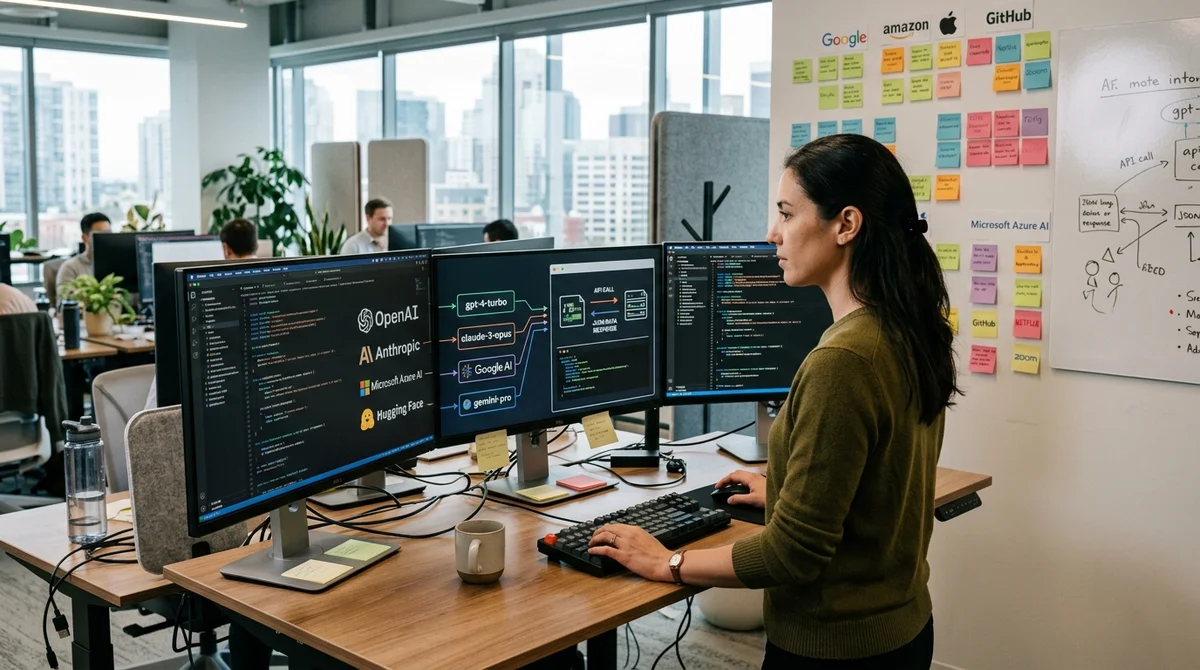
LangChain published analytical material about "model neutrality" — the ability of a system to freely switch between AI providers without rewriting the architecture. According to the team, this is where the main strategic risk lies for companies building AI agents.
Where Dependency Really Arises
Intuitively, vendor lock-in seems to be about choosing a model: decide to use GPT-5 instead of Claude, and you're locked in. But LangChain points to a different place where real dependency grows. True lock-in is created at the level of "harness" — the instrumental wrapper of an agent that manages tool call formats, memory systems, orchestrators, and prompt structures.
If this stack is proprietary, switching models ceases to be a one-line configuration change. It turns into an architectural overhaul lasting weeks — with the risk of breaking everything already running in production. This is real dependency: when technically you can leave, but economically you cannot afford to.
The problem is amplified by the fact that in 2025, the AI market offers more powerful models than ever before. Theoretically, companies have a choice between GPT-5, Claude 4, Gemini 2.5, and dozens of specialized solutions.
In practice, many find themselves locked into one ecosystem — not because it's the best, but because they arrived there first.
How Laboratories Embed Dependency
Major AI companies don't just sell tokens — they build ecosystems that are profitable not to leave. This is rational business strategy, and it's implemented through the infrastructure layer:
- Tool calling — tool call formats at OpenAI, Anthropic, and Google are incompatible, even though they solve the same problem
- Memory systems — contextual storage and vector indexes are tied to a specific platform
- Prompt formats — structures of system instructions differ so much that agent migration requires manual work
- Cloud integrations — direct connectors to provider services that don't exist in neutral libraries
- Monitoring and tracing — analytics tools that only work within the native ecosystem
The result: a company that chose "the fastest path to the first agent" discovers a year later that the cost of migration exceeds the benefit of switching to a cheaper or more powerful model.
Neutral Framework as a Solution
LangChain positions itself as an architectural answer to this problem. As an open-source project, it's built on top of the model layer, not around a specific provider. The framework's abstractions work with any compatible model through a single interface. In practice, this means that model switching remains a configuration parameter, not a code rewrite. Business logic — tools, call chains, memory management — is described once and doesn't depend on who's under the hood.
"Model neutrality is practical insurance: for when prices go up, APIs change, or a better model emerges," emphasizes the
LangChain team.
This is especially important in the context of 2025–2026, when token pricing remains unstable and APIs update without backward compatibility. New powerful models emerge every few months — often from unexpected players. A company able to switch providers in hours under the hood of its agents always operates with the best price-to-quality ratio on the market.
What This Means
The AI model market is unstable: today's leader isn't necessarily tomorrow's. Choosing a framework for agents is a strategic decision with multi-year consequences. A proprietary stack accelerates early sprints but creates a dependency that will only get more expensive. In this logic, an open neutral framework is not just a technical choice, but insurance against market changes that are impossible to predict. Model neutrality is cheaper to bake into architecture now than to rewrite infrastructure from scratch when the market changes again — and it will.
Need AI working inside your business — not just in your newsfeed?
I build production AI for companies — custom CRM, internal tools, autonomous agents, workflow automation. Owned by you, shaped to your process, no per-seat tax. Built by Zhemal Khamidun, CPO of AlpinaGPT (AI platform, 6,000+ users).
The AI world, distilled — once a week
Seven stories that actually mattered, hand-picked. No noise, no reposts, no press releases.
Done! Check your inbox for a confirmation.