Google DeepMind launches $10M fund to study collective behavior of AI agents
Google DeepMind, Schmidt Sciences, coop.ai and ARIA Research are launching a $10M research fund to understand what happens when millions of AI agents interact with one another. When agents operate in the same environment, collective effects emerge that none of their developers anticipated. The fund aims to understand these mechanisms before they become a problem.
AI-processed from @GoogleDeepMind; edited by Hamidun News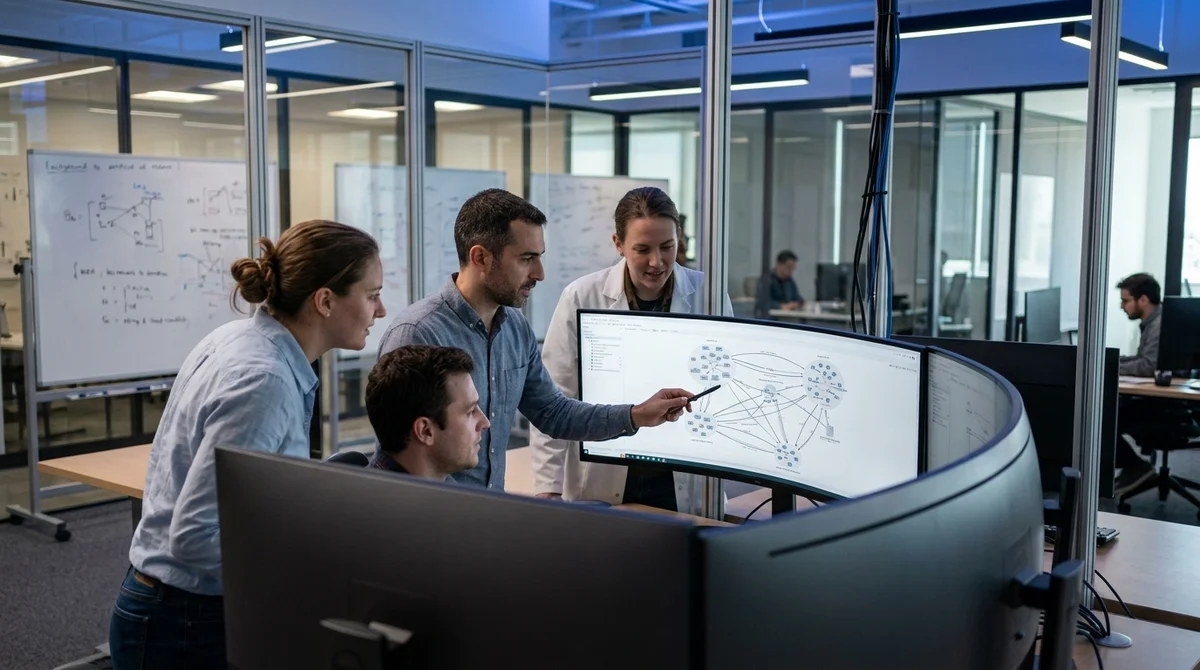
Google DeepMind, together with Schmidt Sciences, coop.ai and ARIA Research, and with support from Google.org, is launching a $10M research fund. Its goal is to systematically study what happens when millions of AI agents begin interacting with one another in real-world conditions.
Why study groups of agents
A single AI agent behaves predictably: it has instructions, context and a goal. A million agents in one environment are a different story entirely. When AI systems interact at scale, collective patterns emerge that do not follow from the behavior of each participant taken individually. This phenomenon is called "emergent behavior."
In biology, it is studied in insect swarms and fish schools: each individual is simple, yet the group displays complex, coordinated behavior. In economics, stock market bubbles arise from the sum of individual rational decisions that together produce an irrational outcome.
In the world of AI agents, these questions are still at a very early stage. Most research so far has focused on the individual model: how it reasons, how to avoid hallucinations, how to align its behavior with human values. What happens when there are a million such models and they influence each other's decisions has not been studied systematically by anyone.
Who is in the consortium
The fund brings together several organizations with different areas of expertise:
- Google DeepMind: leading role in safety research and large-scale AI
- Schmidt Sciences: funds fundamental science, founded by Eric Schmidt
- coop.ai: specializes in cooperative agent behavior and coordination mechanisms
- ARIA Research: a British advanced research agency, comparable to DARPA
- Google.org: Google's philanthropic arm, co-investor and co-founder
The fund's money will go to academic and applied research: which patterns arise in multi-agent systems as they scale, how agents adapt their behavior under each other's influence, and whether these processes can be predicted or controlled. The researchers hope to identify regularities that will later underpin the design of more robust multi-agent systems.
Why the question has arisen now
Autonomous agents are no longer just laboratory experiments. They trade on exchanges, run advertising auctions, negotiate with other systems and handle customer requests without human involvement. When such systems operate in the same economic or information environment, they inevitably begin to interact, even if that interaction was not deliberately designed.
"When millions of AI agents interact with one another, new collective patterns of behavior may emerge," says the official
Google DeepMind announcement.
The risks range from feedback loops in advertising auctions, where agents outbid each other, to coordination without explicit intent, amplified disinformation or herd behavior in financial systems. In academia, this class of problems has been studied mainly through game theory, but classical models are not built for millions of participants making decisions within milliseconds.
So far, such situations have been analyzed after the fact. The fund's goal is to build a systematic understanding in advance.
What it means
$10M is a modest sum for an industry with revenues in the hundreds of billions. But the signal matters: leading players are starting to treat the group behavior of AI agents as a scientific problem in its own right, not an appendix to the safety of individual models. If the research yields practical results, it could become the scientific basis for standards for deploying agentic systems at scale, before regulators start drafting requirements blindly.
- Nov 2, 2026Bun creator uses Claude Code to port 750K lines from Zig to Rust in 11 days
- Nov 2, 2026The Verge reviewer builds a $50 Meta Muse Charm alternative with Claude Code
- Nov 1, 202616 models tested on 7 search tools: Exa averaged 10.5 out of 14, SearXNG about 3
- Nov 1, 2026Google's StreamVibe video agent beats other models by 10.7% on response timing and quality
Key Questions Answered
Why study groups of agents?
A single AI agent behaves predictably: it has instructions, context and a goal. A million agents in one environment are a different story entirely. When AI systems interact at scale, collective patterns emerge that do not follow from the behavior of each participant taken individually. This phenomenon is called "emergent behavior." In biology, it is studied in insect swarms and fish schools: each individual is simple, yet the group displays complex, coordinated behavior. In economics, stock market bubbles arise from the sum of individual rational decisions that together pro
Who is in the consortium?
The fund brings together several organizations with different areas of expertise: Google DeepMind: leading role in safety research and large-scale AI Schmidt Sciences: funds fundamental science, founded by Eric Schmidt coop.ai: specializes in cooperative agent behavior and coordination mechanisms ARIA Research: a British advanced research agency, comparable to DARPA Google.org: Google's philanthropic arm, co-investor and co-founder The fund's money will go to academic and applied research: which patterns arise in multi-agent systems as they scale, how agents adapt their beh
Why the question has arisen now?
Autonomous agents are no longer just laboratory experiments. They trade on exchanges, run advertising auctions, negotiate with other systems and handle customer requests without human involvement. When such systems operate in the same economic or information environment, they inevitably begin to interact, even if that interaction was not deliberately designed. "When millions of AI agents interact with one another, new collective patterns of behavior may emerge," says the official Google DeepMind announcement. The risks range from feedback loops in advertising auctions, wher
Test Frontier LLMs & Autonomous Agents in One Workspace
Run Claude Opus 5.5, GPT-6, Gemini 3.1, and DeepSeek side-by-side in Nomad AI (nomadnet.ai) — unified model routing, deep research, and multimodal workflows under one subscription.
The AI world, distilled — once a week
Seven stories that actually mattered, hand-picked. No noise, no reposts, no press releases.
Done! Check your inbox for a confirmation.