Google DeepMind Releases DiffusionGemma, a 26B MoE Model That Generates Text Up to 4x Faster
Google DeepMind has open-sourced DiffusionGemma, an experimental 26-billion-parameter MoE model that generates text through diffusion rather than step-by-step autoregression. On GPUs, speed increases by up to 4x. The model is open and available for research. The new approach could change how language models are built, especially where response speed matters.
AI-processed from MarkTechPost; edited by Hamidun News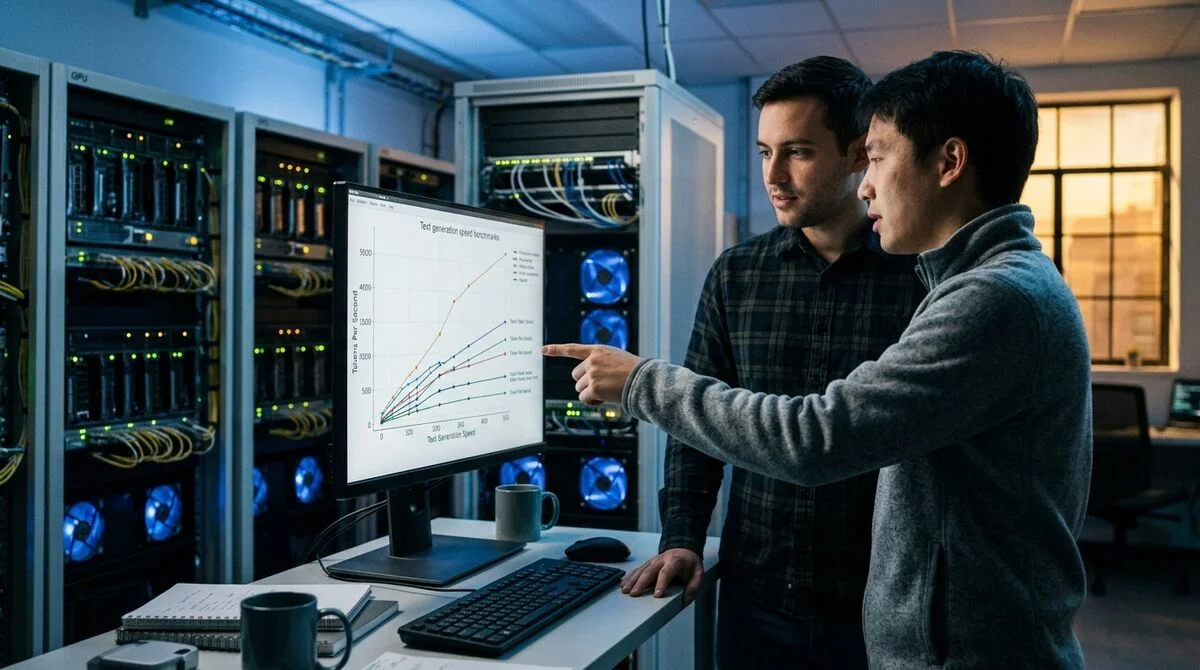
Google DeepMind has released DiffusionGemma, an experimental open language model with 26 billion parameters that uses text diffusion instead of conventional autoregressive generation. On GPUs, it runs up to four times faster than standard approaches.
What is text diffusion
Most modern language models generate text token by token, left to right. That is how GPT-4, Gemini, Llama and virtually all large LLMs work. The approach is reliable and well understood, but it has a fundamental limitation: inference time grows linearly with the length of the response. The longer the text, the longer the wait and the higher the GPU costs.
DiffusionGemma works differently. The model starts with a noisy or masked output and refines it iteratively until coherent text emerges, much as diffusion models such as Stable Diffusion generate images. The key difference from autoregression is parallelism: instead of a strict sequence, a diffusion decoder can work across the whole context at once. That is what delivers a multiple-fold speedup on modern GPUs.
Text diffusion has been researched for several years, but until now there have been practically no large-scale open models of this kind. DiffusionGemma is one of the first serious public experiments of this scale from a major lab, and that alone makes it worth attention.
Architecture: 26B with MoE
DiffusionGemma is built on a Mixture of Experts (MoE) architecture. Unlike "dense" models, where all parameters are used for every request, MoE activates only a subset of expert blocks, depending on the input. This allows a large parameter count at relatively low inference compute cost.
Key characteristics of the model:
- 26B parameters in total (MoE architecture)
- Only a portion of parameters is activated during inference
- Text diffusion instead of autoregression
- Up to 4x faster generation on GPUs
- Open access for researchers
- Experimental status, not a product release
Combining MoE and diffusion is a nontrivial architectural bet. MoE cuts the load by reducing the number of active parameters; diffusion cuts it by reducing the number of generation steps. In theory, the two improvements work together.
Why this changes the picture
Inference speed is one of the main practical problems of large language models. For end users, a long wait is annoying. For inference providers, it means direct GPU-time costs that feed straight into the cost of running the service.
Current solutions, such as quantization, speculative decoding and optimized kernels, deliver gains of around 1.5–2x. DiffusionGemma claims 4x, and does so through a fundamentally different generation mechanism. If this holds up in real-world conditions, it would be a change of approach, not an optimization.
Google DeepMind is publishing the model openly as a research artifact. This gives the academic community a chance to study a 26B-scale diffusion text decoder. Whether a product version based on this architecture will follow remains an open question.
What this means
DiffusionGemma signals that autoregression is no longer the only workable paradigm in language modeling. If the diffusion approach scales without degrading quality, the response speed of AI tools could grow several-fold without a proportional rise in infrastructure costs.
How the community studies and benchmarks the model is worth watching over the coming months.
- Nov 1, 202616 models tested on 7 search tools: Exa averaged 10.5 out of 14, SearXNG about 3
- Nov 1, 2026Google's StreamVibe video agent beats other models by 10.7% on response timing and quality
- Nov 1, 2026OpenAI Rewrites GPT Behavior Rules: Five Values and a Chain of Command
- Nov 1, 2026Voice bots built on LLMs turn to Jev, a fast classifier, for decisions in 200–500 ms
Key Questions Answered
What is text diffusion?
Most modern language models generate text token by token, left to right. That is how GPT-4, Gemini, Llama and virtually all large LLMs work. The approach is reliable and well understood, but it has a fundamental limitation: inference time grows linearly with the length of the response. The longer the text, the longer the wait and the higher the GPU costs. DiffusionGemma works differently. The model starts with a noisy or masked output and refines it iteratively until coherent text emerges, much as diffusion models such as Stable Diffusion generate images. The key difference
What are the key details on Architecture: 26B with MoE?
DiffusionGemma is built on a Mixture of Experts (MoE) architecture. Unlike "dense" models, where all parameters are used for every request, MoE activates only a subset of expert blocks, depending on the input. This allows a large parameter count at relatively low inference compute cost. Key characteristics of the model: 26B parameters in total (MoE architecture) Only a portion of parameters is activated during inference Text diffusion instead of autoregression Up to 4x faster generation on GPUs Open access for researchers Experimental status, not a product release Combining
Why this changes the picture?
Inference speed is one of the main practical problems of large language models. For end users, a long wait is annoying. For inference providers, it means direct GPU-time costs that feed straight into the cost of running the service. Current solutions, such as quantization, speculative decoding and optimized kernels, deliver gains of around 1.5–2x. DiffusionGemma claims 4x, and does so through a fundamentally different generation mechanism. If this holds up in real-world conditions, it would be a change of approach, not an optimization. Google DeepMind is publishing the mode
Test Frontier LLMs & Autonomous Agents in One Workspace
Run Claude Opus 5.5, GPT-6, Gemini 3.1, and DeepSeek side-by-side in Nomad AI (nomadnet.ai) — unified model routing, deep research, and multimodal workflows under one subscription.
The AI world, distilled — once a week
Seven stories that actually mattered, hand-picked. No noise, no reposts, no press releases.
Done! Check your inbox for a confirmation.