LangChain: как инженерия агентных циклов делает AI-агентов надёжными
Надёжный AI-агент — это не просто хорошая модель. LangChain опубликовала разбор «инженерии циклов»: как проектировать agent loop, чтобы агент стабильно…
AI-processed from LangChain Blog; edited by Hamidun News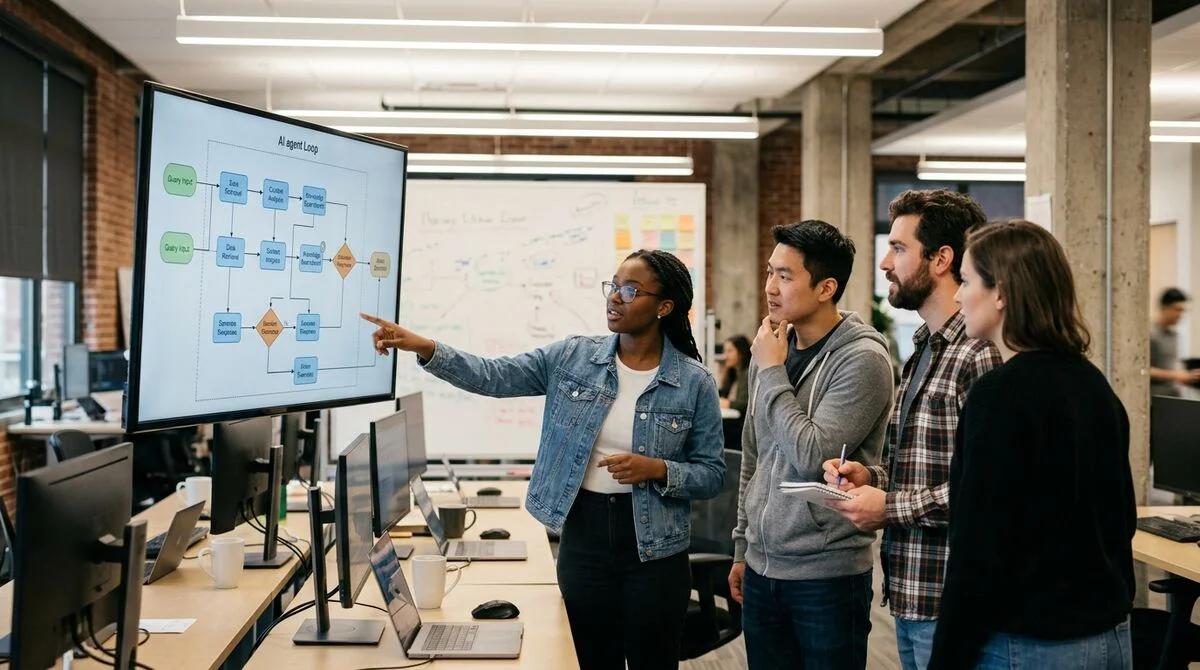
LangChain has published an analysis of one of the key architectural decisions when building AI agents: how to properly design an "agent loop" and why reliability in production depends on this, not on model choice.
Why models are not enough
Most developers face the same problem: an agent works well in a demo but breaks on real-world tasks. LangChain argues that the problem is rarely in the model itself. The problem lies in the absence of a well-thought-out harness that surrounds the model and manages the execution flow. An agent is not simply a call to an LLM with tools. It is a controlled iterative process: observes state, selects an action, receives a result, updates state, repeats. Reliability is determined by how carefully this cycle is designed.
Anatomy of the agent loop
The basic cycle consists of four steps that repeat until task completion:
- Observation — the agent receives the current context: the task, history, results from previous tool calls
- Reasoning — the LLM decides what to do next: call a tool, ask for clarification, or finish
- Action — tool invocation or final response
- Update — the result is written to state, the cycle continues
Key insight: each level should have its own observation tools. Without logging at every step, it is impossible to understand where exactly the agent is failing.
Stacking and extending cycles
Complex agents use nested loops with different decision horizons. The outer loop manages the overall task: breaks it into subtasks, tracks progress, decides when to finish. Inner loops solve specific subtasks — search, code generation, verification. LangChain identifies several extension patterns.
Reflection loops — the agent checks its own output before returning it to the user.
Validation loops — a separate cycle verifies results, for example running tests for generated code.
Escalation loops — if the agent cannot solve a task in N steps, it passes control to a human.
Each layer adds reliability but increases latency. The engineer's task is to find a balance between thoroughness and speed.
LangChain primitives for instrumentation
LangGraph allows describing agent cycles as a state graph (StateGraph), where each node is a cycle step and edges are transitions between them. This provides three practical advantages. First, transparency: every transition is logged, any failure can be reproduced. Second, control: you can add "breakpoints" where a human verifies the agent's decision before continuing. Third, testability: each node is tested in isolation without running the entire agent. LangSmith addresses observability in production — without it, it is difficult to understand at which exact step the agent degrades under scaling.
What this means
The industry is transitioning from "call GPT-4 with tools" to full-scale agent systems engineering. Teams that invest now in cycle architecture and observability will get agents that work in production, not just in demos.
Need AI working inside your business — not just in your newsfeed?
I build production AI for companies — custom CRM, internal tools, autonomous agents, workflow automation. Owned by you, shaped to your process, no per-seat tax. Built by Zhemal Khamidun, CPO of AlpinaGPT (AI platform, 6,000+ users).
The AI world, distilled — once a week
Seven stories that actually mattered, hand-picked. No noise, no reposts, no press releases.
Done! Check your inbox for a confirmation.