Baidu: From Search Engine to Full AI Stack — the CFO on Strategy and Robotaxis
Baidu is no longer just China's Google. CFO Henry He told Bloomberg how the company built a full AI stack: its own chips, the Ernie language model, a cloud platform and the Apollo Go driverless taxis. In the interview he discussed token efficiency, China's approach to AI safety and the global robotaxi race.
AI-processed from Bloomberg Tech; edited by Hamidun News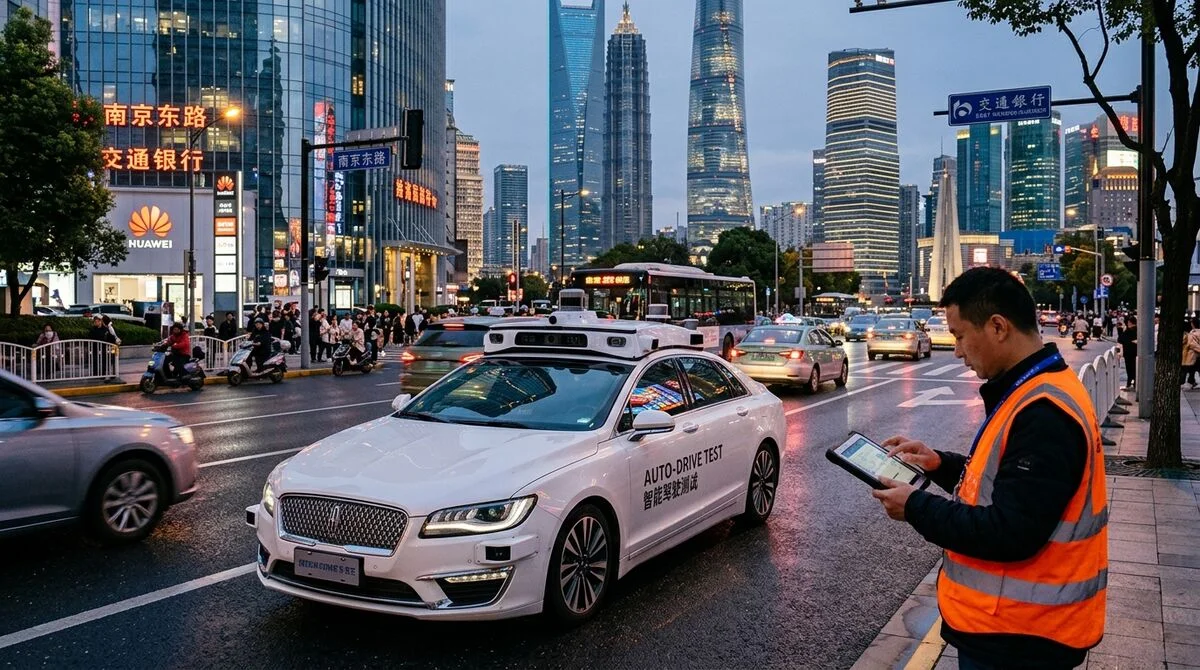
Baidu has gone from China's search leader to a company with a full AI stack, from silicon to autonomous taxis. In almost thirty years, it has fundamentally rethought its business. In an interview with Bloomberg, CFO Henry He explained what makes this transformation notable and where the company is heading.
From search engine to full stack
Founded in the late 1990s as China's answer to Google, Baidu was for a long time associated purely with internet search. Today the picture is very different. The company runs the entire vertical chain in AI: it designs its own processors, builds cloud infrastructure, develops the Ernie language model and tests Apollo Go driverless taxis on real city routes.
According to Henry He, this architecture emerged not from theory but from practical necessity. US export sanctions on chips forced Chinese companies to invest in their own semiconductor production. For Baidu this was both a threat and a catalyst. Today the company positions itself as the only Chinese player that controls every layer of the AI stack, from hardware to interface.
Ernie and the bet on token efficiency
The flagship Ernie model has gone through several generations of updates and, according to the company, outperforms foreign counterparts in some tests of Chinese-language understanding and local context.
The CFO says Baidu is betting not on model size but on "maximizing token value": getting the best result for the least computing cost. Western companies are discussing this idea more and more as well: as competition grows, raw computing power is giving way to efficiency. For Baidu, with its limited access to advanced chips, this is a necessity, and judging by He's remarks, a workable strategy.
Safety, Chinese-style
He touched on a sensitive subject: how Chinese tech companies approach AI safety and alignment. In his words, the approach differs fundamentally from the Western one. The emphasis is on practical applicability and compliance with the state, not on academic debates about existential risks from AGI.
Silicon Valley talks a lot about catastrophe scenarios. Baidu, according to the CFO, looks at the problem differently: AI should serve the concrete needs of people and the economy. That does not mean safety questions are ignored; the answers are simply shaped in a different regulatory context.
Robotaxis: a global race
Apollo Go is Baidu's flagship autonomous driving unit. The service has already completed millions of rides in several Chinese cities without drivers behind the wheel. According to He, the company has accumulated a huge body of real-world driving data on Chinese roads, which gives it a competitive edge over players only now entering the market.
Globally, the competition looks like this:
- Waymo (Alphabet) leads in the US and is expanding into new cities
- Tesla is preparing to launch Cybercab in 2026
- Pony.ai and WeRide are the main rivals inside China
- Apollo Go is betting on scale and lower ride costs
He admits the race will be long. But for a company with a full stack, from chips to cloud and software, launching new driverless routes is easier than for competitors that depend on third-party suppliers.
What this means
Baidu is one of the rare examples of a search giant that has successfully reinvented itself as a full-fledged AI player. The key question is how well this model scales outside China amid the technological fragmentation of the world. According to the CFO, in the coming years the company will focus on deepening AI integration rather than on geographic expansion.
- Nov 1, 2026Google's StreamVibe video agent beats other models by 10.7% on response timing and quality
- Nov 1, 2026OpenAI Rewrites GPT Behavior Rules: Five Values and a Chain of Command
- Nov 1, 2026Voice bots built on LLMs turn to Jev, a fast classifier, for decisions in 200–500 ms
- Nov 1, 2026Google admits AI Mode cuts search revenue, shares fall 15%
Key Questions Answered
What are the key details on From search engine to full stack?
Founded in the late 1990s as China's answer to Google, Baidu was for a long time associated purely with internet search. Today the picture is very different. The company runs the entire vertical chain in AI: it designs its own processors, builds cloud infrastructure, develops the Ernie language model and tests Apollo Go driverless taxis on real city routes. According to Henry He, this architecture emerged not from theory but from practical necessity. US export sanctions on chips forced Chinese companies to invest in their own semiconductor production. For Baidu this was bot
What are the key details on Ernie and the bet on token efficiency?
The flagship Ernie model has gone through several generations of updates and, according to the company, outperforms foreign counterparts in some tests of Chinese-language understanding and local context. The CFO says Baidu is betting not on model size but on "maximizing token value": getting the best result for the least computing cost. Western companies are discussing this idea more and more as well: as competition grows, raw computing power is giving way to efficiency. For Baidu, with its limited access to advanced chips, this is a necessity, and judging by He's remarks,
What are the key details on Safety, Chinese-style?
He touched on a sensitive subject: how Chinese tech companies approach AI safety and alignment. In his words, the approach differs fundamentally from the Western one. The emphasis is on practical applicability and compliance with the state, not on academic debates about existential risks from AGI. Silicon Valley talks a lot about catastrophe scenarios. Baidu, according to the CFO, looks at the problem differently: AI should serve the concrete needs of people and the economy. That does not mean safety questions are ignored; the answers are simply shaped in a different regula
Test Frontier LLMs & Autonomous Agents in One Workspace
Run Claude Opus 5.5, GPT-6, Gemini 3.1, and DeepSeek side-by-side in Nomad AI (nomadnet.ai) — unified model routing, deep research, and multimodal workflows under one subscription.
The AI world, distilled — once a week
Seven stories that actually mattered, hand-picked. No noise, no reposts, no press releases.
Done! Check your inbox for a confirmation.