Genesis AI says the hype around humanoids is a mistake — and unveiled Eno
As the industry pours billions into humanoids, Genesis AI has unveiled Eno, a wheeled robot with a folding tower and dexterous hands. The company считает the bet on bipedalism a mistake: most industrial tasks are solved on a horizontal plane, which is much easier to roll to than walk to. According to the developers, Eno’s foundation model delivers human-level manipulation.
AI-processed from TNW; edited by Hamidun News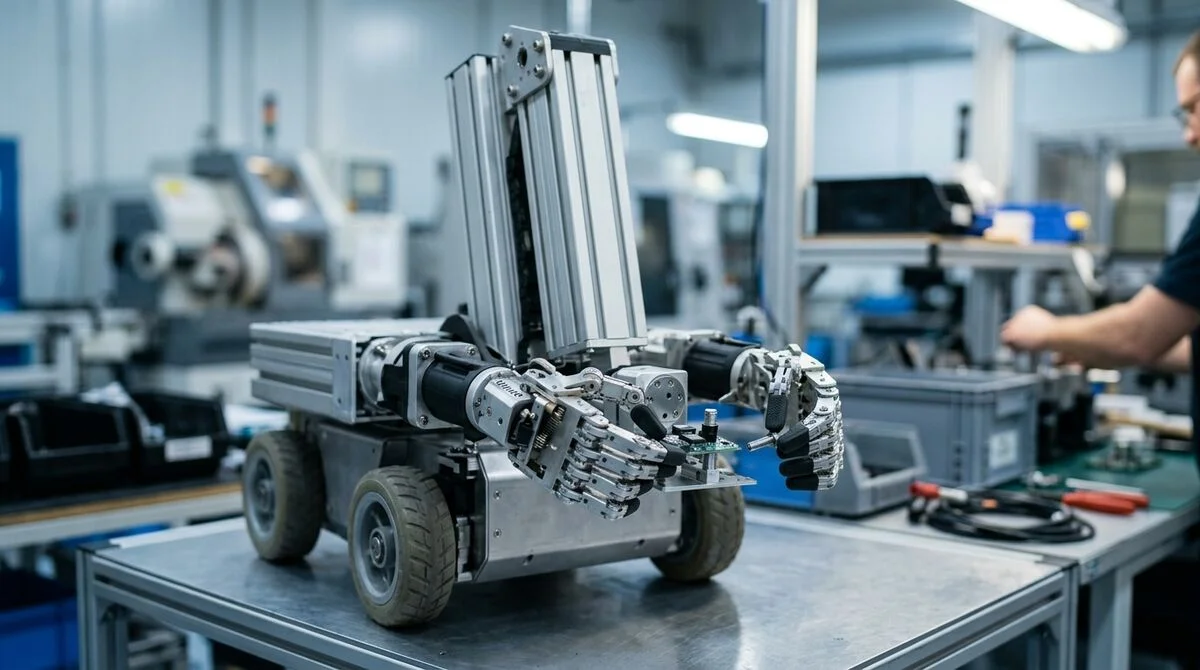
While the robotics industry pours billions into machines that walk like humans, startup Genesis AI has placed its bet on wheels. On Tuesday, the company unveiled Eno — a wheeled robot with a collapsible tower, dexterous arms, and a foundation model that developers claim is capable of manipulation at the human level. Eno is not a compromise born of resource constraints, but an intentional refutation of the industry's dominant trend.
Why Genesis AI Doesn't Believe in Humanoids
While Figure, Boston Dynamics, and dozens of startups that collectively raised billions in funding are chasing bipedal robots, Genesis AI is moving in the opposite direction. The company's position is simple: humanoid form is an expensive bet on anthropomorphism, not functionality. A wheeled platform is simpler to engineer: it has fewer degrees of freedom, lower computational requirements for maintaining balance, and higher reliability during extended operation.
Eno's collapsible tower allows it to change working height and operate in confined spaces — under warehouse shelves, inside production cells. Genesis AI's key argument: most industrial tasks are solved in the horizontal plane. Warehouses, production lines, offices, laboratories — all can be reached on wheels.
There's no need to pay for the engineering complexity of bipedal locomotion if the work environment doesn't require it.
What Eno Can Do
Eno's design was developed for real industrial scenarios:
- Collapsible tower with variable working height for operating at different levels
- Dexterous arms with human-like finger kinematics for precise grasping
- Foundation model trained on a diverse set of manipulation tasks
- Wheeled chassis with high maneuverability on flat surfaces
A foundation model in robotics is an approach in which a single neural network is trained on a diversity of tasks and objects, rather than programmed for a specific scenario. Industrial robots traditionally require costly customization for each operation. Genesis AI claims their model removes this barrier: Eno handles unpredictable objects without reprogramming.
What Matters About the Response to the Humanoid Boom
The humanoid boom rests on understandable narratives. Robots that resemble humans are psychologically easier to accept in work and living spaces. The human body form theoretically allows the use of infrastructure created for humans — stairs, doors, tools.
Aggregate investments in humanoid robots in recent years amount to billions of dollars. But in practice, the transition from impressive demonstrations to scalable industrial deployment has not yet occurred. Bipedal robots fall, require constant maintenance, and each additional joint is an additional point of failure.
The cost of ownership remains high, real commercial scenarios are mostly pilots. Genesis AI believes that the market will ultimately choose reliability and operational economics over visual resemblance to humans. If that's the case, wheeled platforms with advanced manipulators could reach the finish line before bipedal competitors.
What This Means
Eno is an early but clear signal: in robotics, the gap between hype and actual demand is widening. If Genesis AI confirms the claimed capabilities of its foundation model in industrial conditions, wheeled robots could become a pragmatic solution where bipedal competitors are still struggling with balance.
Want to stop reading about AI and start using it?
AI News is a curated feed of AI/tech news. Hamidun Academy teaches you to use AI systematically in your work.
The AI world, distilled — once a week
Seven stories that actually mattered, hand-picked. No noise, no reposts, no press releases.
Done! Check your inbox for a confirmation.