Germany bets on AI to replace retiring workers
By 2036, around 13 million baby boomer workers — engineers, doctors, logistics specialists, civil servants — will leave Germany’s labor market. Immigration will not be enough to close the gap: Bloomberg reports that Germany is increasingly turning to AI as a structural response to the demographic crisis. Automation is already being introduced in industry, healthcare, and the public sector — not as a trend, but as a matter of survival.
AI-processed from Bloomberg Tech; edited by Hamidun News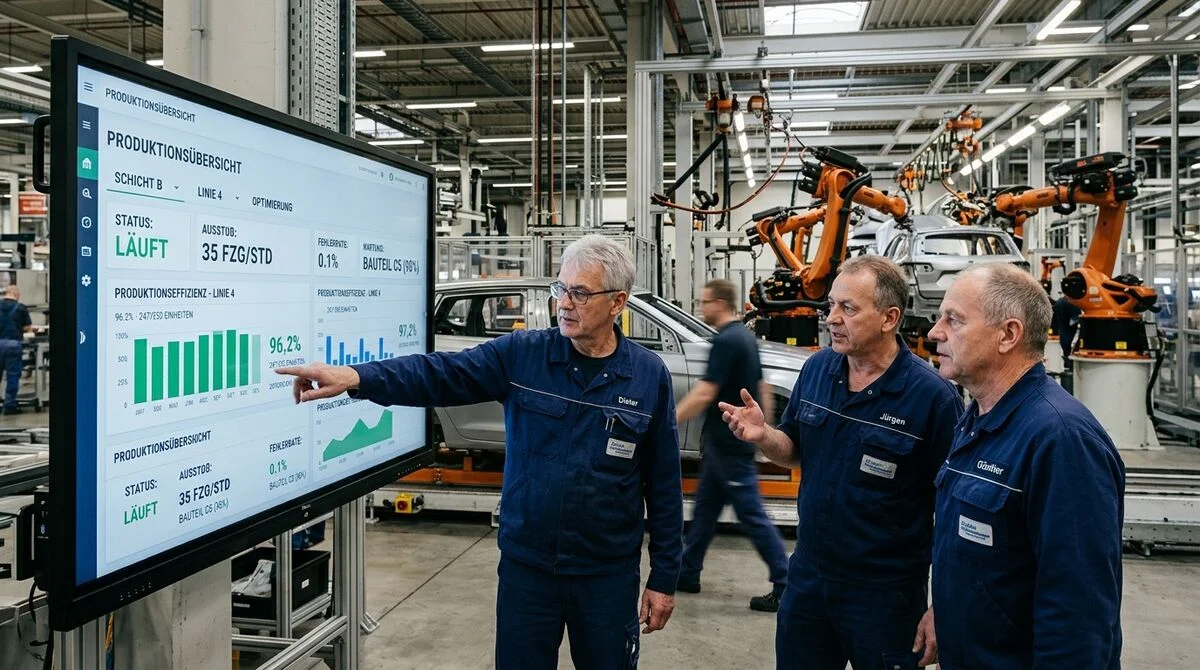
Germany is entering one of the largest demographic crises in its history: over the next decade, millions of experienced specialists will retire, and closing this gap through human resources will not be possible.
The
Demographic Gap According to estimates by German economists, by 2036 approximately 13 million baby boomer workers will leave the country's labor market. This is not abstract statistics: we're talking about specific engineers at Volkswagen and Siemens factories, doctors in hospitals, logistics professionals, accountants, and municipal employees. The average age of employed Germans already exceeds 44 years — one of the highest rates among developed economies.
Germany has long been addressing this problem using traditional tools: raising the retirement age, simplifying immigration for specialists, subsidizing retraining. But the pace of workforce attrition outpaces all these measures. According to forecasts from the Institute for Employment Research (IAB), by 2030 the country will lack between three and seven million workers — a gap that no immigration policy can close.
The German industrial model has historically been built on highly qualified personnel, and it is precisely this workforce that now faces a threat.
Where AI
Is Already Working German business and government have reached a similar conclusion: automation is not simply a competitive advantage, but a structural necessity. Bloomberg records a sharp increase in interest from German companies in AI tools specifically as an answer to the demographic challenge, rather than simply as a technological trend. AI is already being integrated into key economic sectors: * Manufacturing — roboticized production lines with AI-planning at BMW, Bosch, and Siemens factories; Industrie 4.
0 is transforming from strategy into production reality Healthcare — diagnostic support systems help doctors cope with growing patient flows amid a shortage of medical personnel Public sector — chatbots and document workflow automation in municipalities that have long experienced staff shortages Logistics — AI-based routing and partially autonomous warehouses reduce dependence on operators Finance — algorithmic processing of applications and risk-scoring replace the routine work of hundreds of analysts ## Retraining, Not Replacement The official position of the German government: AI does not "steal" jobs, but allows fewer people to accomplish more. In practice, this means large-scale workforce retraining. Bundesagentur für Arbeit (Federal Employment Agency) has launched upskilling programs that teach workers to interact with AI systems rather than compete with them.
The budget for professional retraining in 2025–2026 has increased to record levels. SAP is retraining tens of thousands of employees to work with Joule — its corporate AI platform. Deutsche Telekom, Deutsche Bank, and other major companies are investing in similar programs.
Companies that hesitate risk finding themselves in a structurally weak position by 2030, when the demographic decline reaches its deepest point.
"We need AI to work — this is no longer a question of competitive advantage, but a question of economic survival," —
Bloomberg describes the consensus among German corporations.
What
This Means Germany is the first among major Western economies to openly acknowledge: it needs AI not as a productivity bonus, but as a structural replacement for a workforce that simply does not exist. This experiment is being closely studied in Japan, South Korea, Spain, and other countries that will face similar demographic challenges in the next 10–15 years. The success or failure of Germany's bet on AI will provide an answer to a question that will soon become global.
Need AI working inside your business — not just in your newsfeed?
I build production AI for companies — custom CRM, internal tools, autonomous agents, workflow automation. Owned by you, shaped to your process, no per-seat tax. Built by Zhemal Khamidun, CPO of AlpinaGPT (AI platform, 6,000+ users).
The AI world, distilled — once a week
Seven stories that actually mattered, hand-picked. No noise, no reposts, no press releases.
Done! Check your inbox for a confirmation.