Masayoshi Son rejects Musk's orbital data centers, bets on AI compute on Earth
SoftBank founder Masayoshi Son has come out against Elon Musk's idea of building data centers in space. At the shareholder meeting on June 23, he said orbital infrastructure makes "little sense" and predicted that the AI race will be won by those betting on compute capacity on Earth. SoftBank is investing heavily in terrestrial AI infrastructure, including ARM and Stargate, and Son is clearly making the case that this choice is the right one.
AI-processed from TNW; edited by Hamidun News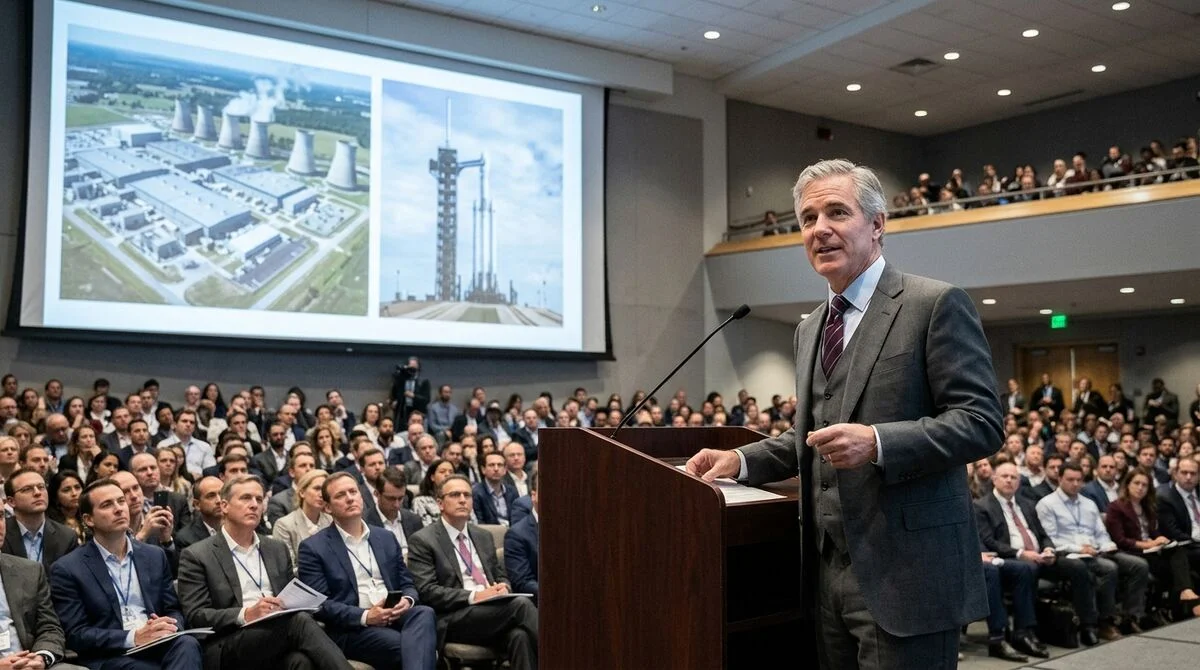
SoftBank founder Masayoshi Son has publicly questioned the viability of orbital data centers, an idea Elon Musk is actively promoting.
What Son told shareholders
At SoftBank's annual shareholder meeting on June 23, 2026, Masayoshi Son said that building computing infrastructure in space makes "little sense." In his words, the AI race will be won by those who bet on capacity on Earth, not by those looking for an alternative beyond the atmosphere.
For shareholders this is a signal of real importance: SoftBank has invested enormous sums specifically in terrestrial AI infrastructure, and Son is defending the soundness of that course. His remarks are also a polemical reply to Musk, who in recent years has spoken ever more insistently about orbital data centers as the next frontier for AI computing. In this logic SpaceX becomes not merely a transport company but also a supplier of computing capacity, literally beyond Earth.
Why orbital data centers appeal to Musk
There are physical arguments for space data centers, and some of them are convincing:
- Cooling is the main expense of server halls; in a vacuum, heat is shed by radiation, without water or compressors
- Direct access to solar energy without atmospheric losses lowers the cost of electricity
- No need to compete for land plots, obtain permits or negotiate with local authorities
- Starship is gradually lowering the cost of delivering cargo to orbit, potentially making such projects economically realistic
Musk presents this as a long-term inevitability. As AI clusters grow to gigawatt-scale power consumption, Earth's physical constraints (overloaded power grids, water scarcity, a shortage of sites) will, in his view, become a critical brake on the industry's growth.
SoftBank's bet on terrestrial infrastructure
Son's position is driven not only by technical skepticism but also by concrete financial decisions. Through the Vision Fund, SoftBank has put tens of billions of dollars into ARM, a key developer of architectures for AI chips, which power most of the world's servers. The company is also a partner in the American Stargate project, a $500 billion initiative to build AI infrastructure in the US together with OpenAI, Microsoft and Oracle. More broadly, SoftBank is actively increasing its investment in data center construction in Japan and the US.
Put differently, Son has a financial stake in the terrestrial scenario winning. But that does not make his arguments any less valid: terrestrial infrastructure already works, scales with proven methods and remains legible to investors and regulators.
"Building data centers in space makes little sense,"
Son said at the SoftBank shareholder meeting.
What this means
The debate between Son and Musk is a disagreement about time horizons: Musk plans decades ahead and is ready to accept high technical risk, while Son is focused on the next 3–5 years of the AI race. For the 2026 market, Son's statement is a weighty argument for terrestrial data centers: that is where the main investment is flowing for now, and where real competition is unfolding.
Key Questions Answered
What Son told shareholders?
At SoftBank's annual shareholder meeting on June 23, 2026, Masayoshi Son said that building computing infrastructure in space makes "little sense." In his words, the AI race will be won by those who bet on capacity on Earth, not by those looking for an alternative beyond the atmosphere. For shareholders this is a signal of real importance: SoftBank has invested enormous sums specifically in terrestrial AI infrastructure, and Son is defending the soundness of that course. His remarks are also a polemical reply to Musk, who in recent years has spoken ever more insistently abo
Why orbital data centers appeal to Musk?
There are physical arguments for space data centers, and some of them are convincing: Cooling is the main expense of server halls; in a vacuum, heat is shed by radiation, without water or compressors Direct access to solar energy without atmospheric losses lowers the cost of electricity No need to compete for land plots, obtain permits or negotiate with local authorities Starship is gradually lowering the cost of delivering cargo to orbit, potentially making such projects economically realistic Musk presents this as a long-term inevitability. As AI clusters grow to gigawatt
What are the key details on SoftBank's bet on terrestrial infrastructure?
Son's position is driven not only by technical skepticism but also by concrete financial decisions. Through the Vision Fund, SoftBank has put tens of billions of dollars into ARM, a key developer of architectures for AI chips, which power most of the world's servers. The company is also a partner in the American Stargate project, a $500 billion initiative to build AI infrastructure in the US together with OpenAI, Microsoft and Oracle. More broadly, SoftBank is actively increasing its investment in data center construction in Japan and the US. Put differently, Son has a fina
Test Frontier LLMs & Autonomous Agents in One Workspace
Run Claude Opus 5.5, GPT-6, Gemini 3.1, and DeepSeek side-by-side in Nomad AI (nomadnet.ai) — unified model routing, deep research, and multimodal workflows under one subscription.
The AI world, distilled — once a week
Seven stories that actually mattered, hand-picked. No noise, no reposts, no press releases.
Done! Check your inbox for a confirmation.