How two students from St. Petersburg made it to AAAI, the major AI conference in Singapore
Two students from St. Petersburg made it to AAAI, one of the world's leading AI conferences, held this year in Singapore. They went through the full cycle: they submitted a research paper, survived the rebuttal, a written response to reviewers' criticism, and presented at a poster session in front of leading scientists. The article explains in detail how selection at AAAI works and what actually happens behind the scenes.
AI-processed from Habr AI; edited by Hamidun News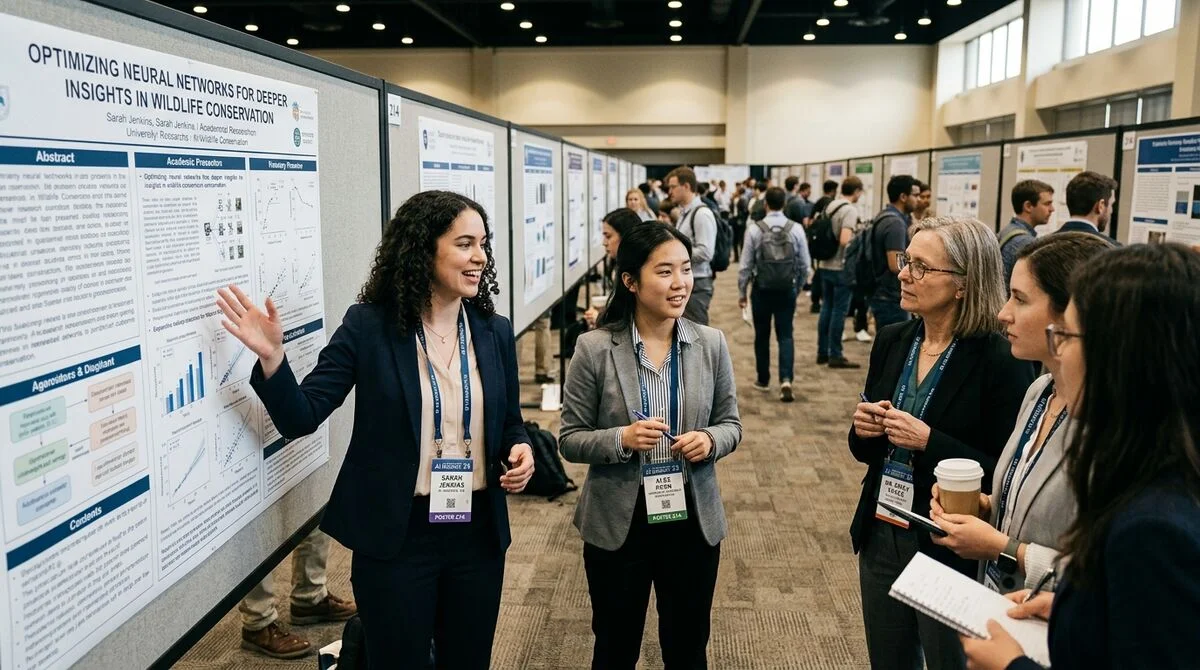
Two students from St. Petersburg went through the full academic journey: from writing a research paper and anxiously awaiting reviews to talking face to face with the world's leading scientists at the AAAI poster session in Singapore.
What AAAI is and why researchers aim for it
AAAI (Association for the Advancement of Artificial Intelligence) is one of the oldest and most respected academic AI conferences. It ranks alongside NeurIPS, ICML and ICLR: this is where work is published that later underpins products from Google, Meta and OpenAI.
Getting in is hard. The acceptance rate rarely exceeds 20%, meaning four out of five submitted papers are rejected during peer review. An accepted paper is not just a line on a résumé but an entry ticket to a community of people who set the direction of the entire industry.
This year the conference took place in Singapore. The two St. Petersburg students went there not as tourists but as authors of an accepted study. Their experience shows from the inside how the international academic world of AI works.
How selection works
The road to presenting at AAAI is far more complicated than simply "write a paper and send it in." The authors describe each stage:
- Submission: a strict format, page limits, and mandatory compliance with conference standards
- Blind review: several reviewers read the work anonymously, without knowing the authors' names
- Rebuttal: after receiving the reviews, authors can respond in writing to the criticism before the program committee makes its final decision
- Waiting: weeks of uncertainty while the committee processes thousands of submissions from around the world
- Poster session: authors of accepted papers present their research in person and talk directly with relevant attendees
The authors single out the rebuttal as a key and often underrated tool: a well-written response to reviewers' criticism can change the final decision. The students explain how to build an argument properly and what to pay attention to.
What happens on site
Singapore turned out to be more than an exotic backdrop: it was also a suitable venue for a dense exchange of ideas among scientists from around the world. Poster sessions are set up so that any attendee can walk up to an author and talk, with no appointment and no formal protocol. Leading researchers whose names appear on the most-cited papers stand nearby and are ready to discuss details. This is the fundamental difference between an in-person conference and watching recorded talks online.
"No video can replace a conversation at a poster, where a leading
scientist can pick apart your work in twenty minutes", which captures why researchers spend money and time to attend in person.
The authors also candidly cover the practical side of the trip: how to plan logistics and budget, how to navigate a program with dozens of parallel tracks, and how not to get lost among thousands of attendees.
What this means
The story of the two St. Petersburg students is a practical guide for anyone considering an international academic career in AI. Conferences at the level of AAAI remain the main gateway to the global scientific community: connections made there turn into joint projects, internships and positions at the world's leading research labs.
*Meta is designated an extremist organization and banned in the Russian Federation.
- Nov 1, 2026Local models lose to Opus and Codex: 0.21 on a MacBook versus 1.00 for Codex
- Nov 1, 2026Kimi scores 96.2% on a 1C database analytics test and emerges as a fallback if Claude access is blocked
- Nov 1, 2026OpenAI Rewrites GPT Behavior Rules: Five Values and a Chain of Command
- Nov 1, 2026Google admits AI Mode cuts search revenue, shares fall 15%
Key Questions Answered
What AAAI is and why researchers aim for it?
AAAI (Association for the Advancement of Artificial Intelligence) is one of the oldest and most respected academic AI conferences. It ranks alongside NeurIPS, ICML and ICLR: this is where work is published that later underpins products from Google, Meta and OpenAI. Getting in is hard. The acceptance rate rarely exceeds 20%, meaning four out of five submitted papers are rejected during peer review. An accepted paper is not just a line on a résumé but an entry ticket to a community of people who set the direction of the entire industry. This year the conference took place in
How selection works?
The road to presenting at AAAI is far more complicated than simply "write a paper and send it in." The authors describe each stage: Submission: a strict format, page limits, and mandatory compliance with conference standards Blind review: several reviewers read the work anonymously, without knowing the authors' names Rebuttal: after receiving the reviews, authors can respond in writing to the criticism before the program committee makes its final decision Waiting: weeks of uncertainty while the committee processes thousands of submissions from around the world Poster sessio
What happens on site?
Singapore turned out to be more than an exotic backdrop: it was also a suitable venue for a dense exchange of ideas among scientists from around the world. Poster sessions are set up so that any attendee can walk up to an author and talk, with no appointment and no formal protocol. Leading researchers whose names appear on the most-cited papers stand nearby and are ready to discuss details. This is the fundamental difference between an in-person conference and watching recorded talks online. "No video can replace a conversation at a poster, where a leading scientist can pic
Test Frontier LLMs & Autonomous Agents in One Workspace
Run Claude Opus 5.5, GPT-6, Gemini 3.1, and DeepSeek side-by-side in Nomad AI (nomadnet.ai) — unified model routing, deep research, and multimodal workflows under one subscription.
The AI world, distilled — once a week
Seven stories that actually mattered, hand-picked. No noise, no reposts, no press releases.
Done! Check your inbox for a confirmation.