G7 floats a 'trusted partners' scheme for access to American AI models
At the G7 summit in Evian, France, US allies proposed a 'trusted partners' scheme: a special status that would grant access to cutting-edge American AI models. The idea was pitched informally to US Commerce Secretary Howard Lutnick over dinner at the summit's opening. The scheme could offer vetted allies an alternative to strict export controls.
AI-processed from TNW; edited by Hamidun News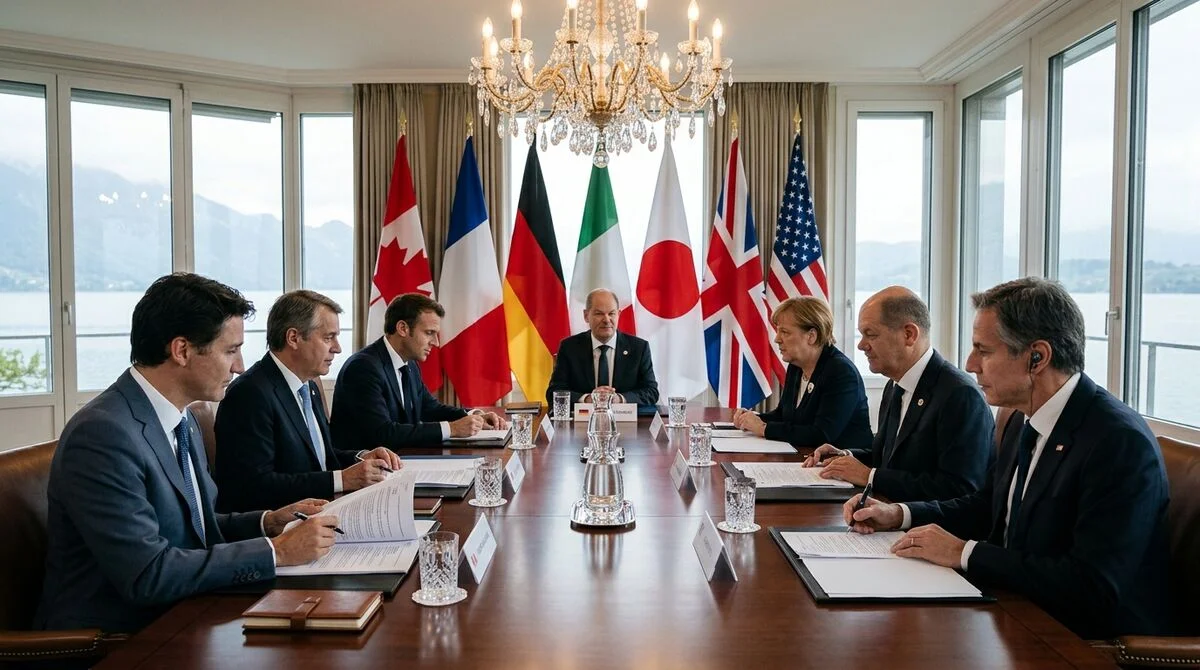
On the sidelines of the G7 summit in Évian-les-Bains, France, US allies raised an idea that could rewrite the rules for accessing American AI technology: a 'trusted partners' scheme that would give them privileged access to top-tier models.
A conversation on the sidelines
The most important questions get settled over dinner. At the G7 summit's opening on Monday, at a mountain resort on the shores of Lake Geneva, representatives from several member states approached Howard Lutnick, the US Secretary of Commerce.
The idea they pitched has a simple name: 'trusted partners.' Under the scheme, allied states — G7 members and close partners — would get a special tier of access to American AI models that export laws currently restrict or block.
This goes beyond chips: the restrictions also cover frontier language models and access to cloud AI infrastructure for government sectors.
For now, the initiative is informal, with no official communiqués or signed documents. That is typically how the negotiations that later grow into international agreements begin.
Why access to American AI is a problem for allies
Since 2022–2023, the US has steadily tightened export controls on advanced AI chips and software systems. The official goal is to keep these technologies out of the hands of China and other potentially hostile states.
The logic is clear. But the side effect has hurt Washington's closest partners. European, Japanese, Canadian, and Australian companies now face restrictions that work against them:
- Buying advanced chips for government AI projects requires special licenses and lengthy approvals
- Commercial access to some American AI platforms is restricted for strategic sectors
- Defense and intelligence programs within Western alliances stall on bureaucratic barriers
- Allied companies fall behind American competitors, which face no such restrictions, on AI development speed
- G7 national AI strategies are built around American models, but access to them is uneven
The result is a paradox for G7 partners: they publicly back US technology policy against China while bearing the costs of that very policy.
A model that already works in defense
The 'trusted partners' concept isn't new. It has long operated in defense: the AUKUS agreement gives Australia access to US and UK nuclear submarine technology, the Five Eyes partnership governs intelligence sharing among five countries, and NATO mechanisms determine who gets access to sensitive military systems.
Now the G7 is trying to apply the same logic to AI. The core idea is unchanged: build a closed club of vetted allies where export control rules are relaxed, while keeping tough barriers in place for everyone else.
The details are the hardest part. Who makes the 'trusted' list? How is end use verified, especially in defense or dual-use projects? Who is liable for violations? These are the questions that still need to be worked out with Washington.
What this means
If the US backs the 'trusted partners' scheme, the global AI market will gain a new structural dividing line: one tier for allies with special status and broad access to American technology, and another for everyone else.
For European and Japanese companies, this could mean a real acceleration in AI development. For the global market, it means another layer of geopolitical segmentation, where a country's place in the alliance determines its access to advanced technology.
- Oct 31, 2026Author puts his script before an AI jury: the verdict cost 850 thousand tokens
- Oct 29, 2026OvisOCR3: an 0.8B-parameter model that reads documents better than specialized systems
- Oct 29, 2026Tencent releases Youtu-Parsing-Omni: one model parses documents, audio and video
- Oct 28, 2026Liquid AI releases LFM2.5-24B-A2B: an agent model with 2B active parameters
Key Questions Answered
What are the key details on A conversation on the sidelines?
The most important questions get settled over dinner. At the G7 summit's opening on Monday, at a mountain resort on the shores of Lake Geneva, representatives from several member states approached Howard Lutnick, the US Secretary of Commerce. The idea they pitched has a simple name: 'trusted partners.' Under the scheme, allied states — G7 members and close partners — would get a special tier of access to American AI models that export laws currently restrict or block. This goes beyond chips: the restrictions also cover frontier language models and access to cloud AI infrast
Why access to American AI is a problem for allies?
Since 2022–2023, the US has steadily tightened export controls on advanced AI chips and software systems. The official goal is to keep these technologies out of the hands of China and other potentially hostile states. The logic is clear. But the side effect has hurt Washington's closest partners. European, Japanese, Canadian, and Australian companies now face restrictions that work against them: Buying advanced chips for government AI projects requires special licenses and lengthy approvals Commercial access to some American AI platforms is restricted for strategic sectors
What are the key details on A model that already works in defense?
The 'trusted partners' concept isn't new. It has long operated in defense: the AUKUS agreement gives Australia access to US and UK nuclear submarine technology, the Five Eyes partnership governs intelligence sharing among five countries, and NATO mechanisms determine who gets access to sensitive military systems. Now the G7 is trying to apply the same logic to AI. The core idea is unchanged: build a closed club of vetted allies where export control rules are relaxed, while keeping tough barriers in place for everyone else. The details are the hardest part. Who makes the 'tr
Ship AI Faster with Founders, Engineers & Weekly Architecture Reviews
Inside Vibe Club (hamidun.com/club) — weekly live masterminds with Zhemal Khamidun, Tech Radar, full LMS access, and 370+ production Claude Code skills.
The AI world, distilled — once a week
Seven stories that actually mattered, hand-picked. No noise, no reposts, no press releases.
Done! Check your inbox for a confirmation.