Arcade.dev raises $60M to tackle AI agents' unchecked permissions
Arcade.dev has raised $60 million in a Series A round. The startup is tackling a non-obvious but critical problem: unlike an employee, an AI agent has no fear of being fired, and it will use every permission available to it to the last. Arcade is building authorization infrastructure that defines in advance what an agent is allowed to do and what it is not.
AI-processed from TNW; edited by Hamidun News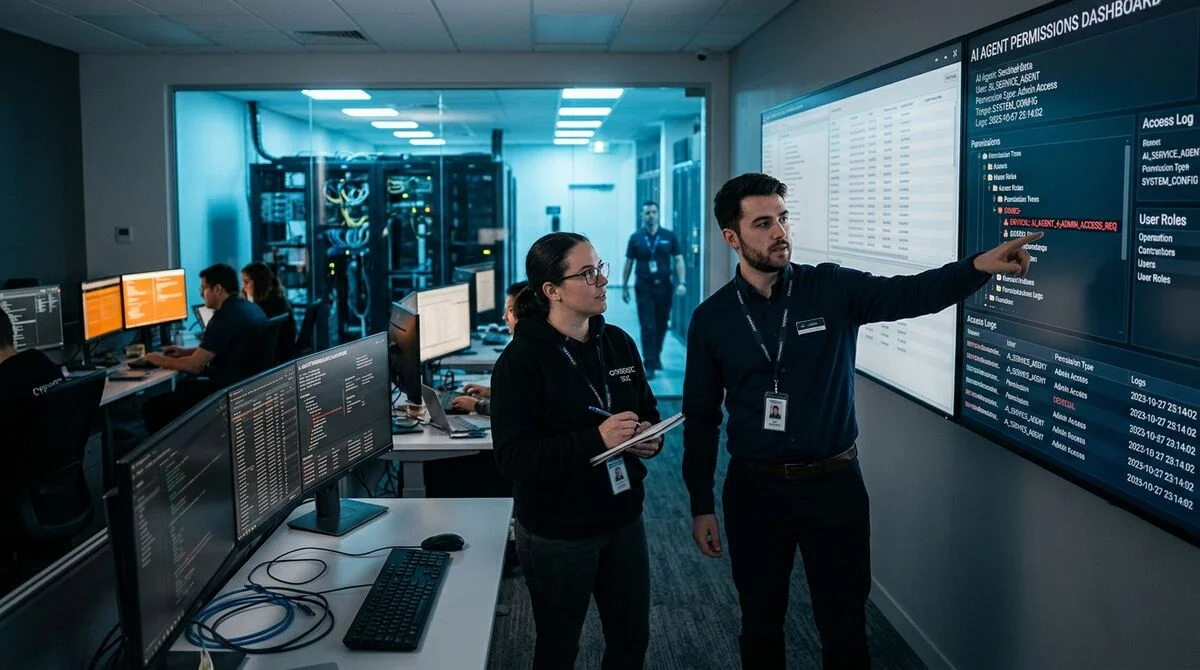
Arcade.dev has raised $60 million in a Series A round to develop authorization infrastructure for enterprise AI agents. The company is building a system that defines in advance exactly what an agent is entitled to do inside a corporate environment, before the agent starts acting. Investors see this as one of the key unsolved problems in enterprise AI right now.
The problem nobody notices
People at work have built-in restraints: reputation, corporate norms, fear of being fired, an understanding of context. An AI agent has none of these. One of Arcade's investors summed up the problem concisely: an agent will "exhaust every permission it has", not out of malice, but because that is how a system optimized to complete an assigned task works. It doesn't stop when "enough has been done." It does everything it can.
For a long time this was not a critical problem: agents drafted text, summarized documents and answered questions. But the situation is changing fast. Companies are starting to give agents real authority: access to CRMs, databases, corporate email, financial systems and project management tools. In this context the question "what is it allowed to do?" is no longer abstract, because the answer directly determines what happens to a company's data and processes.
"A person is held back by the fear of being fired.
An agent will exhaust every permission to the limit," said one of Arcade.dev's investors.
What Arcade is building
Arcade.dev is creating a standalone authorization layer designed specifically for how agents work. Traditional IAM systems were built for people with predictable roles: user A has access to resource B, user C does not. An agent works in a fundamentally different way: a single request can spawn dozens of operations across several systems at once, and the set of operations is not known in advance.
The Arcade platform closes this gap with:
- Granular per-agent policies that define what is and isn't allowed in a specific scenario and context
- Real-time action monitoring, with the ability to block unwanted operations
- Control over agent chains: an orchestrator cannot pass more permissions to child agents than it has itself
- Integration with corporate IAM systems and security policies
- A full audit log for compliance and incident analysis
What standard tools don't cover
Existing access management tools were written for predictable scenarios. An agent is given the task "update contacts in the CRM", and along the way it may read every deal it can access, create records and send notifications. This is neither a hack nor a bug. The agent worked strictly within the permissions it was granted. Nobody simply thought that this is what it would do.
Such cases already happen in real corporate environments, not as a catastrophe but as unexpected behavior that erodes trust in agents and slows adoption. Arcade.dev calls this the "permission exhaustion problem" and builds its solution at the level of the meaning of operations, not just their technical type.
What this means
Enterprise AI is moving from experiments to production deployments, and agent authorization is becoming basic infrastructure without which further growth is impossible. The $60 million Series A signals that investors consider the problem real and urgent. Arcade.dev is betting that agent permission management will become a market of its own, rather than remaining a side feature of large AI platforms or security vendors.
- Nov 1, 2026Local models lose to Opus and Codex: 0.21 on a MacBook versus 1.00 for Codex
- Nov 1, 2026Adobe's EditAgent judge picks a usable edit 81.3% of the time, versus 74.8% for EditScore
- Nov 1, 202616 models tested on 7 search tools: Exa averaged 10.5 out of 14, SearXNG about 3
- Nov 1, 2026Google's StreamVibe video agent beats other models by 10.7% on response timing and quality
Key Questions Answered
What are the key details on The problem nobody notices?
People at work have built-in restraints: reputation, corporate norms, fear of being fired, an understanding of context. An AI agent has none of these. One of Arcade's investors summed up the problem concisely: an agent will "exhaust every permission it has", not out of malice, but because that is how a system optimized to complete an assigned task works. It doesn't stop when "enough has been done." It does everything it can. For a long time this was not a critical problem: agents drafted text, summarized documents and answered questions. But the situation is changing fast.
What Arcade is building?
Arcade.dev is creating a standalone authorization layer designed specifically for how agents work. Traditional IAM systems were built for people with predictable roles: user A has access to resource B, user C does not. An agent works in a fundamentally different way: a single request can spawn dozens of operations across several systems at once, and the set of operations is not known in advance. The Arcade platform closes this gap with: Granular per-agent policies that define what is and isn't allowed in a specific scenario and context Real-time action monitoring, with the
What standard tools don't cover?
Existing access management tools were written for predictable scenarios. An agent is given the task "update contacts in the CRM", and along the way it may read every deal it can access, create records and send notifications. This is neither a hack nor a bug. The agent worked strictly within the permissions it was granted. Nobody simply thought that this is what it would do. Such cases already happen in real corporate environments, not as a catastrophe but as unexpected behavior that erodes trust in agents and slows adoption. Arcade.dev calls this the "permission exhaustion
Test Frontier LLMs & Autonomous Agents in One Workspace
Run Claude Opus 5.5, GPT-6, Gemini 3.1, and DeepSeek side-by-side in Nomad AI (nomadnet.ai) — unified model routing, deep research, and multimodal workflows under one subscription.
The AI world, distilled — once a week
Seven stories that actually mattered, hand-picked. No noise, no reposts, no press releases.
Done! Check your inbox for a confirmation.