Z.ai releases GLM-5.2, trained on Huawei chips, and takes first place in a global ranking
China's Z.ai has released GLM-5.2, which immediately took first place on the Artificial Analysis index, a respected independent benchmark for language models. The entire GLM-5 line was trained exclusively on Huawei Ascend 910B chips; Nvidia hardware was deliberately not used. This is the first time a model built on "sanctioned" hardware has topped a global ranking. The model is open source: you can download it and run it locally, with no dependence on cloud APIs.
AI-processed from 3DNews AI; edited by Hamidun News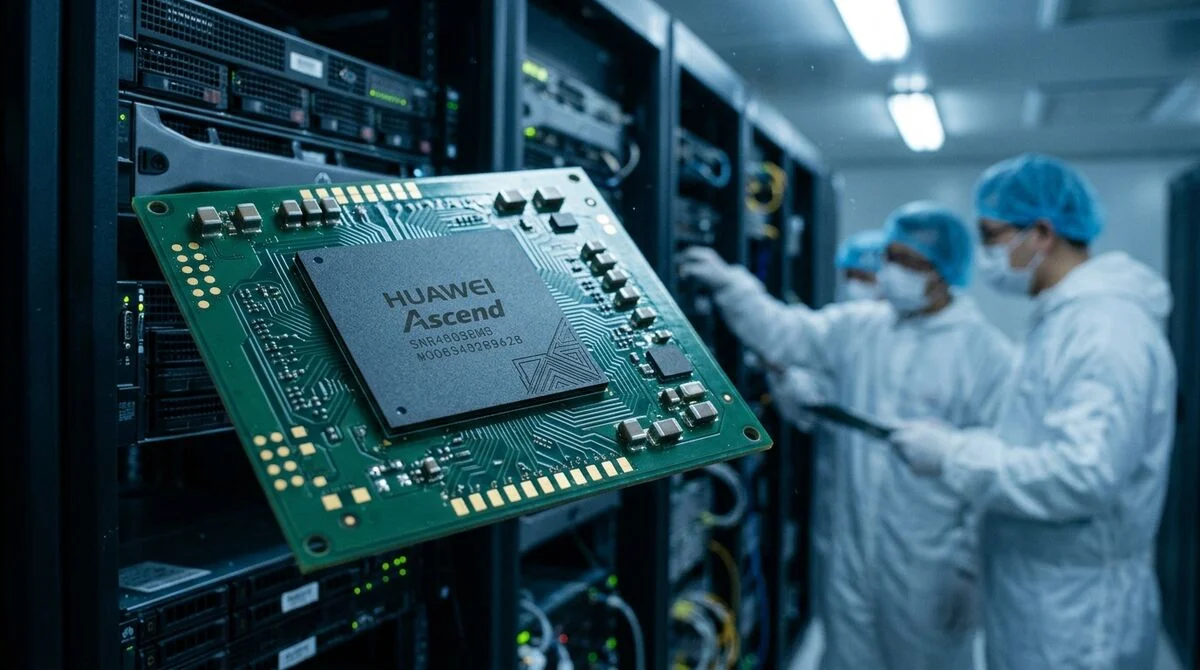
China's Z.ai has released the language model GLM-5.2, which immediately took first place on the Artificial Analysis index, one of the most respected independent benchmarks for rating the quality of AI systems. The entire GLM-5 line was trained exclusively on Huawei Ascend 910B processors, without a single Nvidia GPU.
Huawei instead of Nvidia
Choosing the Ascend 910B was not a measure forced by sanctions but a stated position of the Z.ai team. The company says explicitly that Nvidia hardware was deliberately not used in training. It is an important signal: a sovereign AI stack on Chinese hardware has reached a level that competes with American products.
Z.ai is known in China for its GLM (General Language Model) series, developed jointly with Tsinghua University. GLM models are widely used in China's corporate sector. Now the company is, for the first time, a contender for leadership in a global independent ranking.
Huawei built the Ascend 910B as a response to Nvidia's A100. For a long time it was seen as a decent but inferior alternative, especially in matrix computation speed and framework support. The GLM-5.2 result calls that perception into question. Apparently, the team bet on data quality and algorithmic efficiency rather than on scaling up with additional chips.
Open source versus closed flagships
While the US keeps its most powerful closed models, Fable 5 and Mythos 5, from wide distribution, Z.ai is moving in the opposite direction. GLM-5.2 is released as open source: it can be downloaded and run locally, with no API keys and no cloud dependencies. Any company in the world can take the model, fine-tune it on its own data and deploy it in its own environment.
What this means in practice for companies and developers:
- Full control over data: everything is processed inside your own infrastructure
- Independence from foreign providers and possible trade restrictions
- The ability to fine-tune for specific tasks and company domains
- No per-token pricing: the only cost is your own hardware
- Deployment in an isolated environment, with no data going to third parties
Sanctions sped things up rather than stopping them
Since 2022, the US has steadily tightened export controls on high-performance GPUs for China: first a ban on the A100, then the A800, and after that the H20. The strategic logic was simple: without access to the best chips, China would slow down in AI development. The GLM-5.2 result puts serious doubt on that logic.
It is not the first precedent: in early 2025, DeepSeek R1 showed that algorithmic efficiency can compensate for hardware limits. Z.ai took the next step, proving that "sanctioned" chips can be used not just to build competitive models but to take first place in a global ranking.
Artificial Analysis is a respected independent benchmark aggregator and a reference point for enterprise buyers and developers choosing a platform. First place on this index translates into real commercial interest and attracts new corporate contracts.
What this means
The sanctions strategy counted on isolating China from AI progress; instead, it provoked accelerated development of independent AI infrastructure. The industry adapted: it built its own chips, developed efficient algorithms and put independent ecosystems in place.
Third countries watching this race now have a real alternative: powerful, free and without political conditions. Z.ai has released a model that beats American counterparts on benchmarks and is at the same time available to the whole world as open source.
For the global market, this is a clear signal: the era of unchallenged dominance by American AI companies is coming to an end.
- Nov 2, 2026TensorFold 1.2.0 boosts Qwen3.8-27B throughput on M3 Ultra by 44.2% at 16 streams
- Nov 1, 2026Local models lose to Opus and Codex: 0.21 on a MacBook versus 1.00 for Codex
- Nov 1, 2026Habr author fine-tunes YOLOv8l on dental X-rays and pushes mAP50 to 0.642
- Nov 1, 2026Voice bots built on LLMs turn to Jev, a fast classifier, for decisions in 200–500 ms
Key Questions Answered
What are the key details on Huawei instead of Nvidia?
Choosing the Ascend 910B was not a measure forced by sanctions but a stated position of the Z.ai team. The company says explicitly that Nvidia hardware was deliberately not used in training. It is an important signal: a sovereign AI stack on Chinese hardware has reached a level that competes with American products. Z.ai is known in China for its GLM (General Language Model) series, developed jointly with Tsinghua University. GLM models are widely used in China's corporate sector. Now the company is, for the first time, a contender for leadership in a global independent rank
What are the key details on Open source versus closed flagships?
While the US keeps its most powerful closed models, Fable 5 and Mythos 5, from wide distribution, Z.ai is moving in the opposite direction. GLM-5.2 is released as open source: it can be downloaded and run locally, with no API keys and no cloud dependencies. Any company in the world can take the model, fine-tune it on its own data and deploy it in its own environment. What this means in practice for companies and developers: Full control over data: everything is processed inside your own infrastructure Independence from foreign providers and possible trade restrictions The a
What are the key details on Sanctions sped things up rather than stopping them?
Since 2022, the US has steadily tightened export controls on high-performance GPUs for China: first a ban on the A100, then the A800, and after that the H20. The strategic logic was simple: without access to the best chips, China would slow down in AI development. The GLM-5.2 result puts serious doubt on that logic. It is not the first precedent: in early 2025, DeepSeek R1 showed that algorithmic efficiency can compensate for hardware limits. Z.ai took the next step, proving that "sanctioned" chips can be used not just to build competitive models but to take first place in
Test Frontier LLMs & Autonomous Agents in One Workspace
Run Claude Opus 5.5, GPT-6, Gemini 3.1, and DeepSeek side-by-side in Nomad AI (nomadnet.ai) — unified model routing, deep research, and multimodal workflows under one subscription.
The AI world, distilled — once a week
Seven stories that actually mattered, hand-picked. No noise, no reposts, no press releases.
Done! Check your inbox for a confirmation.